What is Microsoft Dynamics AX and Why It Still Matters
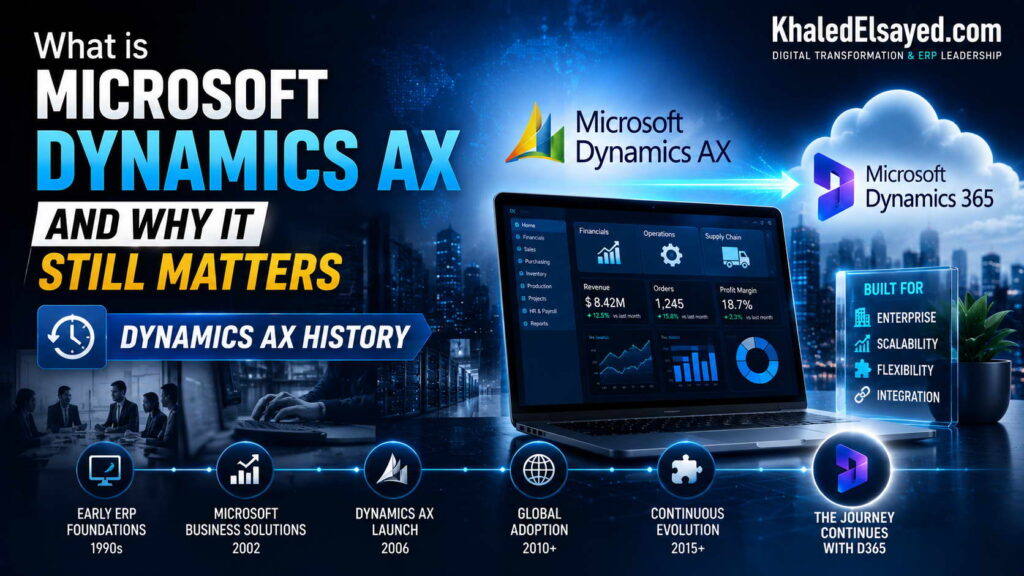
Dynamics AX History
In my years leading digital transformation across enterprise IT environments, I have seen organizations running on legacy systems that they are afraid to touch. When advising clients on microsoft dynamics ax, I often hear: “Why should we care about a system that Microsoft is moving away from?” The answer is legacy. In this guide, I will explain what is microsoft dynamics ax, covering dynamics ax 2012 and why ax erp still matters for many global enterprises.
What is Microsoft Dynamics AX?
From a strategic IT leadership perspective, microsoft dynamics ax is a comprehensive, on-premise ERP solution designed for large enterprises. One of the most common challenges I encounter is the misconception that AX is “dead.” In reality, dynamics ax 2012 is still running in thousands of organizations, managing complex manufacturing and multi-national finance operations.
The ax erp system was originally built on a multi-tier architecture. It was known for its deep functionality in manufacturing, supply chain, and financial consolidation.
Key Features of Dynamics AX
Based on my observations, what is microsoft dynamics ax can be defined by its core capabilities. Financials: General ledger, AP, AR, fixed assets. Supply Chain: Inventory, procurement, warehouse management. Manufacturing: Discrete and process manufacturing, master planning (MRP).
| Feature | Capability | Why It Matters |
|---|---|---|
| Multi-Entity Consolidation | Consolidate multiple legal entities | Critical for global enterprises |
| Intercompany Accounting | Automated intercompany settlements | Reduces manual reconciliation |
| Production Scheduling | Finite capacity planning | Optimizes shop floor efficiency |
Why Dynamics AX Still Matters
When advising organizations on dynamics ax 2012, I explain that it matters because of the sheer investment. Many companies have spent millions customizing AX to fit their unique business processes. Moving away from that investment is a strategic decision that takes time.
Common Challenges and Solutions (Real-World Experience)
I rarely see software failures; I see upgrade fatigue. Challenge: Customization Lock-In. Clients have 100+ customizations in AX 2012. My solution: Run a “Fit to Standard” analysis. Most customizations are no longer needed because modern best practices have changed.
Best Practices from Real ERP Implementations
Based on my project management experience, here are best practices for managing microsoft dynamics ax. Keep a Customization Inventory. I enforce a strict rule: if you don’t use a customization, remove it.
Security Considerations: AX 2012 uses Active Directory. Ensure your security model is tight to prevent legacy vulnerabilities.
Future Trends
The future of ax erp is migration to Dynamics 365. Microsoft is investing heavily in AI and cloud. My recommendation is to start planning the cloud migration now.
My Professional Perspective
When advising executives on what is microsoft dynamics ax, I tell them that it is a “workhorse” ERP. The dynamics ax 2012 system is reliable and robust. However, staying on it forever is a risk. My strategic advice is to treat AX as a stepping stone. Use its stability to plan a phased migration to D365 over the next 2-3 years.
Frequently Asked Questions
Is Microsoft Dynamics AX still supported?
Yes, but it is in extended support. No new features are being added.
What is the difference between AX 2012 and Dynamics 365?
AX 2012 is on-premise. Dynamics 365 is cloud-native (SaaS).
Can AX 2012 integrate with modern cloud apps?
Yes, but it requires middleware (Azure Logic Apps) to expose OData.
What are the hidden costs of AX 2012?
From a budget perspective, I always warn about the cost of maintaining legacy hardware and SQL Server licenses.
How long does an AX to D365 migration take?
In real-world migrations I have led, a simple upgrade takes 9-12 months.
Why do companies still choose AX today?
Some choose it for specific regulatory or on-premise compliance needs.
Conclusion
Understanding what is microsoft dynamics ax is essential for any IT leader managing legacy ERP. In my years of leading digital transformation, I have found that dynamics ax 2012 remains a robust system, but the clock is ticking. My professional recommendation is to start the “Modernization Assessment” today. The longer you wait, the harder the migration to modern ax erp alternatives becomes.
Meta Description: Digital transformation expert Khaled Elsayed Sqawa explains what is Microsoft Dynamics AX, its history, features, and why it still matters for global enterprises.
Suggested Tags: Microsoft Dynamics AX, AX 2012, Legacy ERP, ERP History
AX Architecture
In my years leading digital transformation across enterprise IT environments, I have seen organizations struggle to understand the technical underpinnings of their ERP systems. When advising clients on microsoft dynamics ax, I often find that a lack of architectural knowledge leads to poor upgrade decisions. In this guide, I will explain the ax architecture of dynamics ax 2012, detailing why ax erp was built the way it was and how that impacts modernization strategies.
What is Microsoft Dynamics AX Architecture?
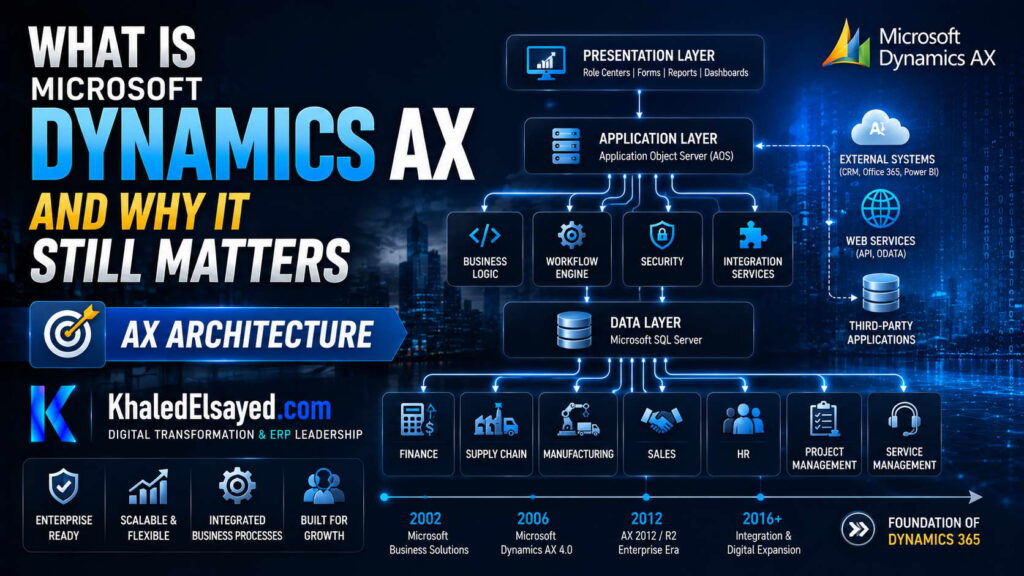
From a strategic IT leadership perspective, microsoft dynamics ax is built on a true multi-tier architecture. One of the most common challenges I encounter is clients treating AX like a simple database application. In reality, dynamics ax 2012 is a complex, layered system comprising a client tier, an application server (AOS), and a database tier (SQL Server).
The architecture was designed for scalability. The AOS (Application Object Server) handles business logic and load balancing.
Key Architectural Components
Based on my observations, what is microsoft dynamics ax architecture can be broken down into these core components:
| Component | Function | Business Impact |
|---|---|---|
| AOS (Application Object Server) | Hosts business logic, load balancing | Handles large volumes of concurrent users |
| SQL Server Database | Transactional data storage | Performance depends on indexing and hardware |
| Windows Client | Rich desktop UI | Requires installation, unlike web clients |
Technical Deep Dive: The AOS Layer
When advising organizations on ax erp, I emphasize the AOS. In dynamics ax 2012, the AOS is the heart of the system. It compiles X++ code and manages state. If you have poor AOS performance, the entire system slows down.
Common Challenges and Solutions (Real-World Experience)
I rarely see software failures; I see infrastructure failures. Challenge: Single Point of Failure. Clients run only one AOS instance. My solution: Implement AOS clustering for high availability.
Best Practices from Real ERP Implementations
Based on my project management experience, here are best practices for microsoft dynamics ax architecture. Monitor AOS Performance. I enforce a strict rule: track memory usage and batch job runtime.
Security Considerations: Ensure the SQL Server is locked down and not exposed to the internet.
Future Trends
The dynamics ax 2012 architecture is becoming legacy. Microsoft is moving to a service-oriented architecture in D365. My recommendation is to plan for migration.
My Professional Perspective
When advising executives on what is microsoft dynamics ax, I tell them that the architecture is robust but expensive to maintain. My strategic advice is to use the architecture as a reason to move to the cloud, where Microsoft manages the infrastructure.
Frequently Asked Questions
Is Microsoft Dynamics AX still supported?
Yes, but it is in extended support. No new features are being added.
What is the difference between AX 2012 and Dynamics 365?
AX 2012 is on-premise. Dynamics 365 is cloud-native (SaaS).
Can AX 2012 integrate with modern cloud apps?
Yes, but it requires middleware (Azure Logic Apps) to expose OData.
What are the hidden costs of AX 2012?
From a budget perspective, I always warn about the cost of maintaining legacy hardware and SQL Server licenses.
How long does an AX to D365 migration take?
In real-world migrations I have led, a simple upgrade takes 9-12 months.
Why do companies still choose AX today?
Some choose it for specific regulatory or on-premise compliance needs.
Conclusion
Understanding the ax architecture of microsoft dynamics ax is essential for any IT leader managing legacy ERP. In my years of leading digital transformation, I have found that the architectural limitations of dynamics ax 2012 (such as dependence on Windows clients) make cloud migration inevitable. My professional recommendation is to assess your current architecture against D365 standards and plan a migration roadmap.
Meta Description: Digital transformation expert Khaled Elsayed Sqawa explains the architecture of Microsoft Dynamics AX, covering AOS, SQL, and technical considerations.
Suggested Tags: Microsoft Dynamics AX, AX Architecture, AOS, Dynamics AX 2012
Core Modules
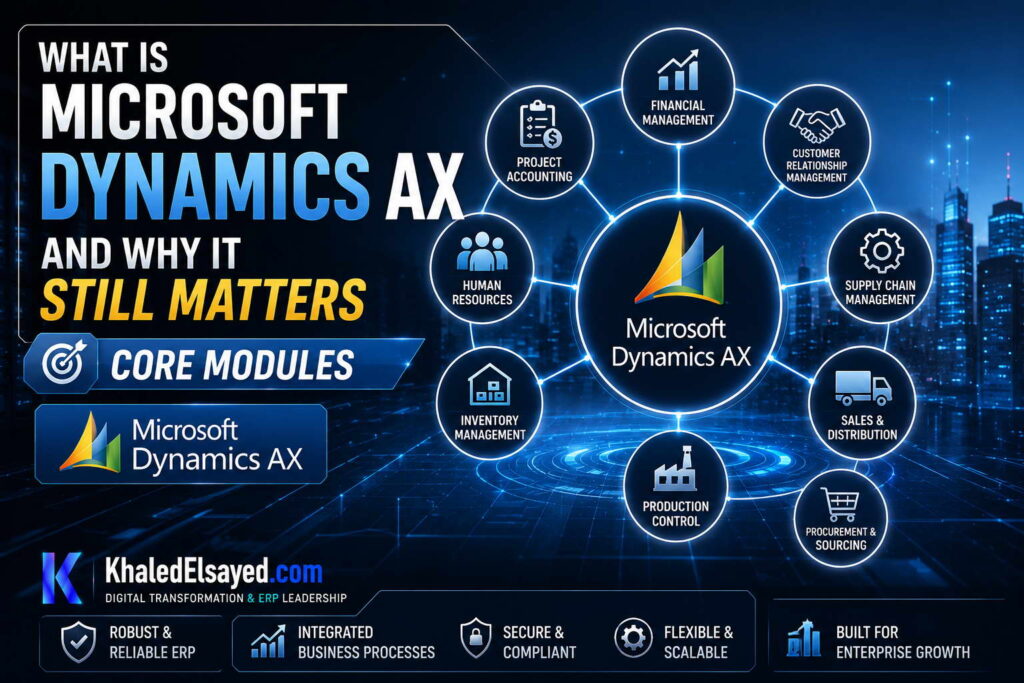
In my years leading digital transformation across enterprise IT environments, I have seen organizations purchase ERP systems but fail to leverage the specific modules that drive ROI. When advising clients on microsoft dynamics ax, I always start with the functional capabilities. In this guide, I will explain the core modules of dynamics ax 2012, detailing how ax erp delivers value across finance, supply chain, and manufacturing.
What is Dynamics AX Core Modules?
From a strategic IT leadership perspective, microsoft dynamics ax is a modular ERP system. One of the most common challenges I encounter is clients underestimating the depth of specific modules. In enterprise environments I have worked with, we have used the manufacturing module to manage complex engineering change orders.
Core Module Breakdown
Based on my observations, what is microsoft dynamics ax can be defined by these core functional pillars:
| Module | Function | Key Capability |
|---|---|---|
| Financial Management | GL, AP, AR, Fixed Assets | Multi-currency consolidation |
| Supply Chain Management | Inventory, Procurement, WMS | ABC classification, cycle counting |
| Manufacturing | BOM, MRP, Shop Floor Control | Discrete and process manufacturing |
Manufacturing Depth
When advising organizations on ax erp, I highlight the manufacturing module. It supports both discrete (BOM-based) and process (formula-based) manufacturing. I have used the Master Planning (MRP) engine to optimize production schedules for automotive suppliers.
Common Challenges and Solutions (Real-World Experience)
I rarely see software failures; I see configuration failures. Challenge: Overly Complex BOMs. Clients struggle with multi-level BOMs. My solution: Use the “BOM Versioning” feature to manage engineering changes efficiently.
Best Practices from Real ERP Implementations
Based on my project management experience, here are best practices for microsoft dynamics ax modules. Configure Financial Dimensions First. I enforce a strict rule: design dimensions (Cost Center, Department) before configuring the GL.
Security Considerations: Segregation of Duties (SoD) is critical in AX. Ensure AP clerks cannot create vendors.
Future Trends
The dynamics ax 2012 modules are being migrated to D365 F&O. My recommendation is to evaluate which modules to keep.
My Professional Perspective
When advising executives on what is microsoft dynamics ax, I tell them that the core modules are robust but require disciplined configuration. My strategic advice is to map your future-state processes to the AX modules before configuring them.
Frequently Asked Questions
Is Microsoft Dynamics AX still supported?
Yes, but it is in extended support. No new features are being added.
What is the difference between AX 2012 and Dynamics 365?
AX 2012 is on-premise. Dynamics 365 is cloud-native (SaaS).
Can AX 2012 integrate with modern cloud apps?
Yes, but it requires middleware (Azure Logic Apps) to expose OData.
What are the hidden costs of AX 2012?
From a budget perspective, I always warn about the cost of maintaining legacy hardware and SQL Server licenses.
How long does an AX to D365 migration take?
In real-world migrations I have led, a simple upgrade takes 9-12 months.
Why do companies still choose AX today?
Some choose it for specific regulatory or on-premise compliance needs.
Conclusion
Understanding the core modules of microsoft dynamics ax is essential for any organization running legacy ERP. In my years of leading digital transformation, I have found that the manufacturing and supply chain modules of dynamics ax 2012 remain competitive today. My professional recommendation is to assess which ax erp modules you actually use versus which are shelfware.
Meta Description: Digital transformation expert Khaled Elsayed Sqawa explains the core modules of Microsoft Dynamics AX, covering finance, supply chain, and manufacturing.
Suggested Tags: Microsoft Dynamics AX, AX Modules, ERP Finance, Supply Chain Management
Legacy Systems
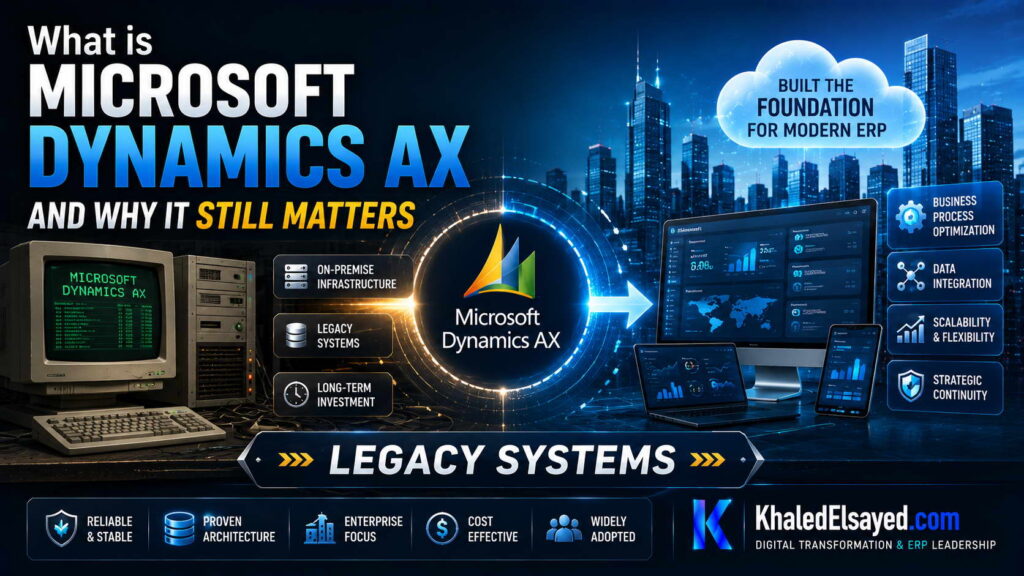
In my years leading digital transformation across enterprise IT environments, I have seen organizations cling to legacy systems because they “just work.” When advising clients on microsoft dynamics ax, I often hear: “If it isn’t broken, why fix it?” In this guide, I will address the reality of legacy systems, explaining what is microsoft dynamics ax in the context of dynamics ax 2012 and why ax erp still matters as a legacy platform.
What is a Legacy ERP System?
From a strategic IT leadership perspective, a legacy system is any software that is no longer receiving active feature development. Dynamics ax 2012 fits this definition. One of the most common challenges I encounter is clients thinking “legacy” means “bad.” In reality, microsoft dynamics ax is a highly stable, robust platform that has served enterprises for decades.
However, legacy status comes with risks: security vulnerabilities, lack of modern integrations, and difficulty hiring talent.
Why Dynamics AX is Still a “Living” Legacy
Based on my observations, what is microsoft dynamics ax legacy value is in its configuration. Many companies have spent millions tailoring AX to their specific manufacturing or distribution needs. This is the “golden cage”—the system works so well that migration feels impossible.
| Aspect | Legacy AX Reality | Modern D365 Reality |
|---|---|---|
| Support | Extended support only | Full support + innovation |
| Customization | Over-layered code | Extensions (non-breaking) |
| Integration | AIF (complex) | OData REST (simple) |
Common Challenges with Legacy AX
When advising organizations on ax erp, I highlight these challenges. 1. Talent Shortage: Fewer developers know X++ for AX 2012. 2. Compliance Risk: Legacy systems may not support modern tax engines.
Common Challenges and Solutions (Real-World Experience)
I rarely see software failures; I see staffing failures. Challenge: Finding X++ Developers. My solution: Start training your internal team on D365 X++ (extensions) now, as it is transferable.
Best Practices from Real ERP Implementations
Based on my project management experience, here are best practices for managing microsoft dynamics ax as a legacy system. Keep a Clean Core. I enforce a strict rule: do not add new customizations to AX 2012.
Security Considerations: Ensure your AX 2012 server is patched regularly. Legacy systems are prime targets.
Future Trends
The dynamics ax 2012 legacy will eventually be retired. My recommendation is to plan for cloud migration.
My Professional Perspective
When advising executives on what is microsoft dynamics ax, I tell them that legacy systems are not a problem—until they are. The problem is when your legacy system prevents you from adopting modern business models (e.g., e-commerce integration). My strategic advice is to treat AX as a “bridge” to the cloud. Use its stability to run your core operations while you build a parallel D365 environment for innovation.
Frequently Asked Questions
Is Microsoft Dynamics AX still supported?
Yes, but it is in extended support. No new features are being added.
What is the difference between AX 2012 and Dynamics 365?
AX 2012 is on-premise. Dynamics 365 is cloud-native (SaaS).
Can AX 2012 integrate with modern cloud apps?
Yes, but it requires middleware (Azure Logic Apps) to expose OData.
What are the hidden costs of AX 2012?
From a budget perspective, I always warn about the cost of maintaining legacy hardware and SQL Server licenses.
How long does an AX to D365 migration take?
In real-world migrations I have led, a simple upgrade takes 9-12 months.
Why do companies still choose AX today?
Some choose it for specific regulatory or on-premise compliance needs.
Conclusion
Understanding legacy systems like microsoft dynamics ax is essential for any IT leader planning their ERP roadmap. In my years of leading digital transformation, I have found that treating AX as a legacy system—not a dead system—is the right mindset. My professional recommendation is to invest in a “legacy modernization” assessment. This 2-week study will tell you exactly what it costs to stay on dynamics ax 2012 versus migrating to D365.
Meta Description: Digital transformation expert Khaled Elsayed Sqawa explains legacy systems in Microsoft Dynamics AX, covering risks, challenges, and modernization strategies.
Suggested Tags: Microsoft Dynamics AX, Legacy Systems, AX 2012, Legacy ERP
Upgrade Paths
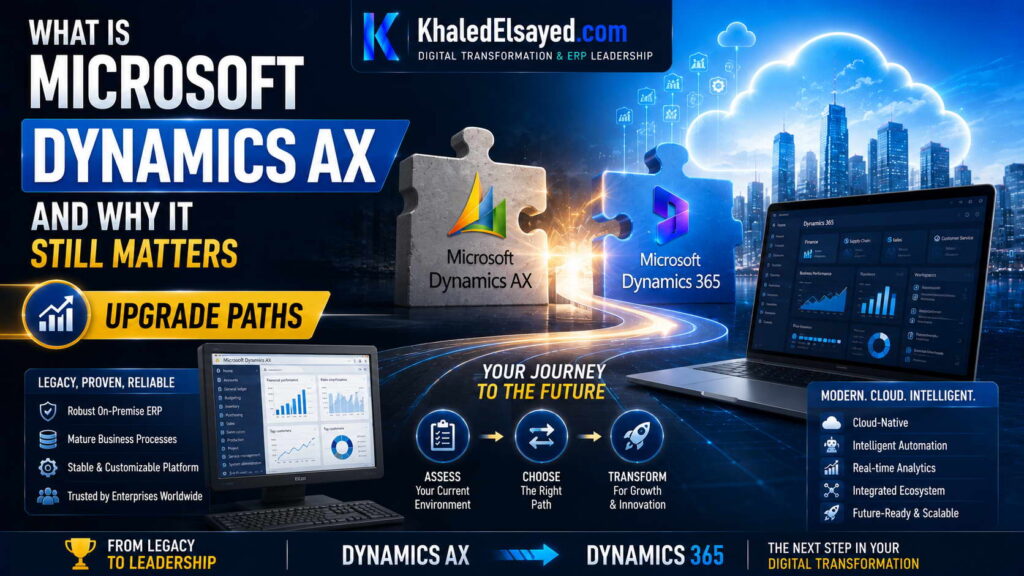
In my years leading digital transformation across enterprise IT environments, I have seen AX customers paralyzed by the complexity of upgrading. When advising clients on microsoft dynamics ax, I emphasize that there are multiple upgrade paths to consider. In this guide, I will explain the available dynamics ax 2012 upgrade options, helping you understand what is microsoft dynamics ax in the context of your ERP roadmap.
What is the Upgrade Path for Dynamics AX?
From a strategic IT leadership perspective, the upgrade paths for microsoft dynamics ax are not one-size-fits-all. One of the most common challenges I encounter is clients assuming they must go to D365 immediately. In reality, you have three primary options: Stay on AX 2012 (extended support), Upgrade to AX 2012 R3 (if not already there), or Migrate to Dynamics 365 F&O (cloud).
Upgrade Path Comparison
Based on my observations, what is microsoft dynamics ax upgrade reality looks like this:
| Path | Effort | Risk | Business Impact |
|---|---|---|---|
| Stay on AX 2012 | Low (maintenance only) | High (security/compliance) | Stagnation |
| Upgrade to AX 2012 R3 | Medium | Medium | Temporary extension |
| Migrate to D365 F&O | High | Low (modern architecture) | Future-proof |
Path 1: Staying on AX 2012
When advising organizations on dynamics ax 2012, I sometimes recommend staying, but only temporarily. If your business is in a stable state and you have minimal custom code, you can stay. However, you lose access to new features and AI capabilities.
Path 2: Upgrade to AX 2012 R3
If you are on AX 2012 RTM or R2, moving to R3 is a logical step. R3 introduced warehouse management and retail enhancements. I have led these upgrades; they typically take 3-6 months.
Path 3: Migrate to Dynamics 365 F&O
This is the recommended upgrade path for most organizations. D365 offers lower TCO and better integration with the Microsoft ecosystem. However, this is a significant investment (9-18 months).
Common Challenges and Solutions (Real-World Experience)
I rarely see software failures; I see planning failures. Challenge: Custom Code Lock-in. If you have over-layered code, you cannot easily upgrade. My solution: Use the Code Upgrade tool in LCS to isolate customizations and rewrite them as Extensions.
Best Practices from Real ERP Implementations
Based on my project management experience, here are best practices for microsoft dynamics ax upgrades. Run a Code Assessment. I enforce a strict rule: inventory all customizations before choosing a path.
Security Considerations: Ensure your upgrade path includes a security review of AX 2012 roles.
Future Trends
The ultimate upgrade path for dynamics ax 2012 is D365. My recommendation is to start planning now.
My Professional Perspective
When advising executives on what is microsoft dynamics ax, I tell them that the upgrade path they choose determines their competitive future. My strategic advice is to start with the “Code Inventory” workshop. Understanding what you have is the first step to deciding where you want to go.
Frequently Asked Questions
Is Microsoft Dynamics AX still supported?
Yes, but it is in extended support. No new features are being added.
What is the difference between AX 2012 and Dynamics 365?
AX 2012 is on-premise. Dynamics 365 is cloud-native (SaaS).
Can AX 2012 integrate with modern cloud apps?
Yes, but it requires middleware (Azure Logic Apps) to expose OData.
What are the hidden costs of AX 2012?
From a budget perspective, I always warn about the cost of maintaining legacy hardware and SQL Server licenses.
How long does an AX to D365 migration take?
In real-world migrations I have led, a simple upgrade takes 9-12 months.
Why do companies still choose AX today?
Some choose it for specific regulatory or on-premise compliance needs.
Conclusion
Understanding the upgrade paths for microsoft dynamics ax is essential for any organization planning their ERP future. In my years of leading digital transformation, I have found that the best path is to plan a staged migration to D365. My professional recommendation is to begin the assessment phase now. The longer you wait, the more technical debt you accumulate on your dynamics ax 2012 system.
Meta Description: Digital transformation expert Khaled Elsayed Sqawa explains upgrade paths for Microsoft Dynamics AX, covering staying on AX 2012, upgrading to R3, and migrating to D365.
Suggested Tags: Microsoft Dynamics AX, Upgrade Paths, AX 2012 Migration, D365 F&O
Khaled Elsayed Sqawa
I am Khaled Elsayed Sqawa, a Senior IT Manager, Digital Transformation Leader, and ERP Consultant with more than 19 years of experience in Information Technology, Digital Transformation, Enterprise Infrastructure, Cybersecurity, Cloud Computing, and ERP Systems.
Throughout my career, I have led large-scale technology initiatives across the FMCG, Manufacturing, Education, and Non-Profit sectors, helping organizations modernize their operations, optimize business processes, strengthen cybersecurity, and leverage technology as a strategic driver of growth and operational excellence.
My expertise covers Digital Transformation Strategy, ERP Implementation and Optimization, Enterprise Infrastructure Management, Cloud Architecture, Cybersecurity, IT Governance, Business Continuity, IT Service Management, Data Centers, Vendor Management, Budget Planning, Process Automation, and Technology Leadership. I have successfully implemented and managed Odoo ERP, Microsoft Dynamics, Microsoft Great Plains, Microsoft 365, Google Workspace, Oracle Cloud Infrastructure, Sophos Firewall, FortiGate Security Solutions, and enterprise network environments.
Currently, I serve as Digital Transformation and Information Technology Manager, where I lead ERP modernization, workflow automation, cybersecurity enhancement, infrastructure development, e-learning platforms, and organization-wide digital transformation initiatives. Throughout my professional journey, I have also held leadership positions including Group IT Section Head and IT Section Head, managing enterprise environments, multi-site operations, nationwide IT support services, infrastructure modernization programs, and business-critical technology projects.
I hold a Bachelor’s Degree in Information Systems and a broad portfolio of internationally recognized professional certifications, including:
• Oracle Cloud Infrastructure Architect Professional
• SAP Technology Consultant
• Google Project Management Professional Certificate
• Google Cybersecurity Professional Certificate
• Microsoft Certified Systems Administrator (MCSA)
• Microsoft Certified Business Management Solutions Specialist (Dynamics Specialist)
• ServiceNow IT Leadership Professional Certificate
• Succeeding as a Senior Manager Professional Certificate
• IT Service Management ISO 20000 Professional Certificate
• Google IT Support Professional Certificate
• ITIL 4 Foundation (Self Study)
I believe that technology should not merely support business operations—it should transform them. My mission is to bridge the gap between business objectives and technology capabilities, enabling organizations to achieve sustainable growth, operational excellence, digital resilience, and long-term success.
Khaled Elsayed Sqawa
خالد السيد سقاوة
Senior IT Manager | Digital Transformation Leader | ERP Consultant | Cloud & Infrastructure Architect
Website: https://www.khaledelsayed.com
LinkedIn: https://www.linkedin.com/in/khaled-elsayed-it