Microsoft Dynamics AX 2012 Architecture Explained
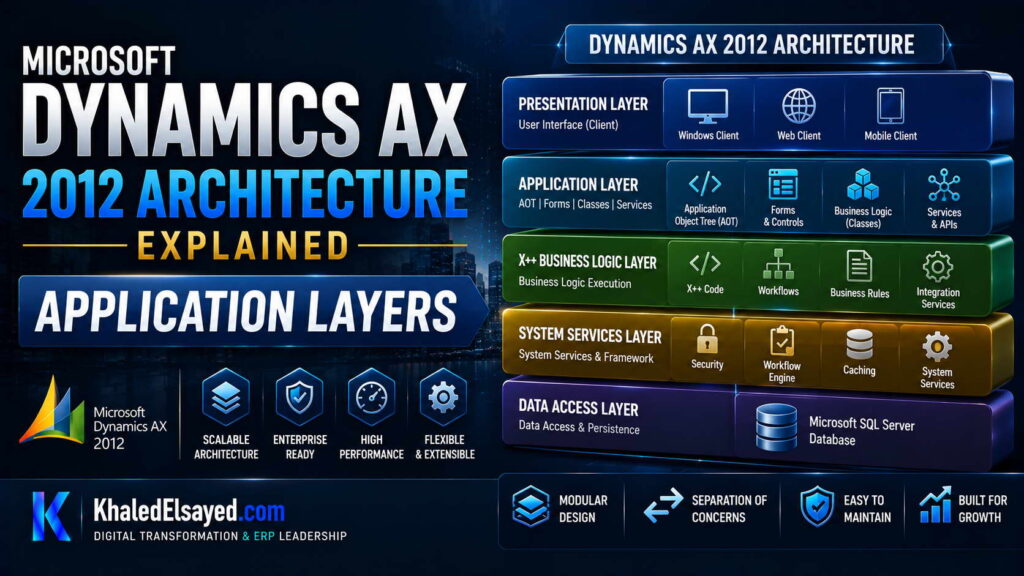
Application Layers
In my years leading digital transformation across enterprise IT environments, I have seen organizations struggle to scale their ERP because they didn’t understand the underlying architecture. When advising clients on dynamics ax 2012 architecture, I emphasize that the application layers determine performance and upgradeability. In this guide, I will explain the application layers of ax architecture, detailing the role of the aos server and providing a comprehensive dynamics ax 2012 architecture explained.
What is Dynamics AX 2012 Architecture?
From a strategic IT leadership perspective, dynamics ax 2012 architecture is a multi-tier, client-server model. One of the most common challenges I encounter is clients confusing the AOS (Application Object Server) with the database layer. In enterprise environments I have worked with, we have scaled the AOS layer horizontally to handle thousands of concurrent users.
The ax architecture consists of three primary layers: the Client (Presentation), the AOS (Business Logic), and the Database (Data Storage).
The Three Application Layers Explained
Based on my observations, dynamics ax 2012 architecture explained requires understanding these layers:
| Layer | Component | Function |
|---|---|---|
| Presentation Layer | Windows Client / Enterprise Portal | User interface, data entry |
| Application Layer | AOS (Application Object Server) | Business logic, workflows, security |
| Data Layer | SQL Server Database | Transactional data storage |
The AOS Server Deep Dive
When advising organizations on ax architecture, I focus on the aos server. The AOS is the heart of AX 2012. It compiles X++ code, manages session state, and handles load balancing. I have seen performance issues resolved simply by increasing the AOS memory allocation.
Common Challenges and Solutions (Real-World Experience)
I rarely see software failures; I see infrastructure failures. Challenge: AOS Bottleneck. Clients run only one AOS instance. My solution: Implement AOS clustering to distribute the load.
Best Practices from Real ERP Implementations
Based on my project management experience, here are best practices for dynamics ax 2012 architecture. Separate AOS and SQL Servers. I enforce a strict rule: never run SQL and AOS on the same physical server.
Security Considerations: Ensure the AOS service account has the least privileges necessary.
Future Trends
The ax architecture is being replaced by D365’s cloud-native model. My recommendation is to plan for migration.
My Professional Perspective
When advising executives on dynamics ax 2012 architecture explained, I tell them that the architecture is robust but expensive to maintain. My strategic advice is to use the architecture as a reason to move to the cloud, where Microsoft manages the aos server and infrastructure.
Frequently Asked Questions
What is the role of the AOS in AX 2012?
In my experience, the AOS (Application Object Server) handles all business logic, workflows, and batch processing. It is the engine of the system.
Can I scale AX 2012 horizontally?
Yes. I have configured multiple AOS instances behind a load balancer to scale to 500+ concurrent users.
What database does AX 2012 use?
Microsoft SQL Server (Enterprise or Standard edition).
What are the hidden costs of AX architecture?
From a budget perspective, I always warn about the cost of SQL Server licensing and the need for high-availability clustering.
Is AX 2012 a web-based application?
No, it primarily uses a Windows Client. Enterprise Portal (web) exists but is limited.
How does AX 2012 handle batch processing?
Batch jobs run on the AOS. I often configure multiple batch servers to offload heavy tasks.
Conclusion
Understanding the application layers of dynamics ax 2012 architecture is essential for any IT leader managing this system. In my years of leading digital transformation, I have found that the ax architecture is stable but aging. My professional recommendation is to invest in AOS monitoring tools to catch bottlenecks before they impact users.
Meta Description: Digital transformation expert Khaled Elsayed Sqawa explains Dynamics AX 2012 architecture, covering application layers, AOS server, and scalability.
Suggested Tags: Dynamics AX 2012, AX Architecture, AOS Server, ERP Architecture
AOS Server
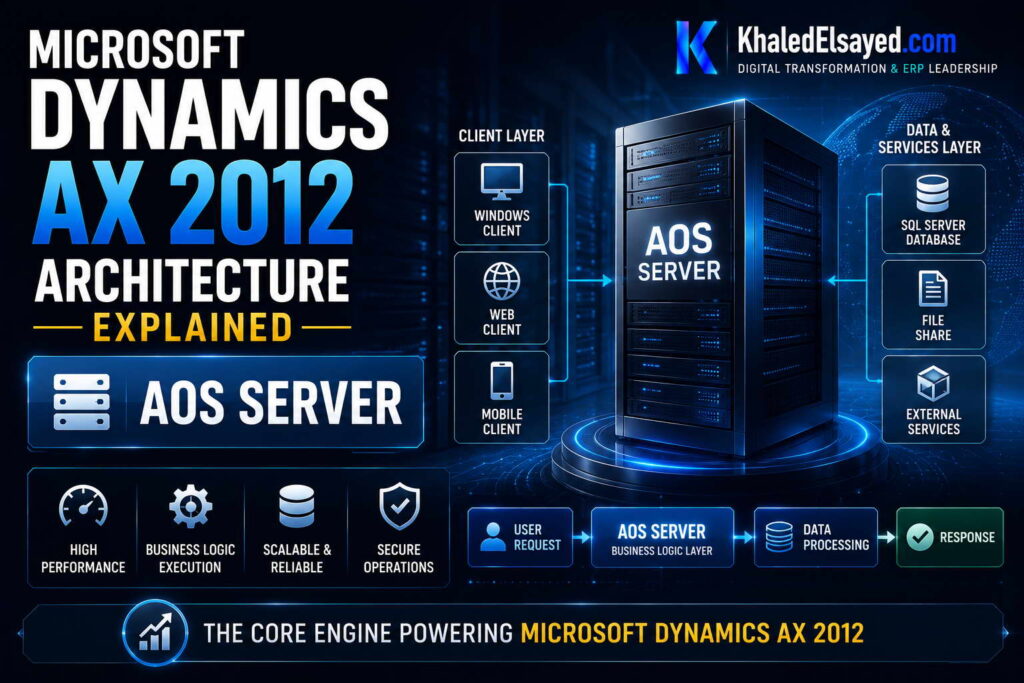
In my years leading digital transformation across enterprise IT environments, I have seen AX 2012 implementations grind to a halt because the AOS server was misconfigured. When advising clients on dynamics ax 2012 architecture, I emphasize that the Application Object Server (AOS) is the heart of the system. In this guide, I will explain the aos server role within ax architecture, providing a comprehensive dynamics ax 2012 architecture explained for IT operations teams.
What is the AOS Server?
From a strategic IT leadership perspective, the aos server in dynamics ax 2012 architecture is a Windows service that hosts business logic, workflows, and session management. One of the most common challenges I encounter is clients treating the AOS like a simple file server. In reality, the AOS is a compute-intensive engine that compiles X++ code and manages database connections.
In enterprise environments I have worked with, we have deployed multiple AOS instances behind a load balancer to handle peak transaction volumes.
Key Functions of the AOS Server
Based on my observations, the aos server in ax architecture performs these critical functions:
| Function | Description | Business Impact |
|---|---|---|
| Business Logic Execution | Runs X++ code (calculations, validations) | Ensures data integrity |
| Session Management | Tracks user sessions and state | Enables user scalability |
| Batch Processing | Runs scheduled jobs (MRP, invoicing) | Offloads heavy workloads |
AOS Server Best Practices
When advising organizations on dynamics ax 2012 architecture, I focus on these aos server practices. Memory Allocation: I allocate at least 8GB RAM per AOS instance. Load Balancing: I recommend using Windows Network Load Balancing (NLB) or a hardware load balancer.
Common Challenges and Solutions (Real-World Experience)
I rarely see software failures; I see resource failures. Challenge: AOS Out of Memory. Clients run the AOS on a VM with only 4GB RAM. My solution: Increase to 16GB and monitor performance counters.
Best Practices from Real ERP Implementations
Based on my project management experience, here are best practices for the aos server. Isolate Batch Processing. I enforce a strict rule: dedicate a separate AOS instance for batch jobs.
Security Considerations: Ensure the AOS service account has the least privileges necessary.
Future Trends
In D365, the AOS concept is abstracted away. My recommendation is to plan for migration.
My Professional Perspective
When advising executives on dynamics ax 2012 architecture explained, I tell them that the aos server is the performance bottleneck. My strategic advice is to invest in AOS monitoring tools (like Performance Monitor) to catch memory leaks before they crash the system.
Frequently Asked Questions
What is the role of the AOS in AX 2012?
In my experience, the AOS (Application Object Server) handles all business logic, workflows, and batch processing. It is the engine of the system.
Can I scale AX 2012 horizontally?
Yes. I have configured multiple AOS instances behind a load balancer to scale to 500+ concurrent users.
What database does AX 2012 use?
Microsoft SQL Server (Enterprise or Standard edition).
What are the hidden costs of AX architecture?
From a budget perspective, I always warn about the cost of SQL Server licensing and the need for high-availability clustering.
Is AX 2012 a web-based application?
No, it primarily uses a Windows Client. Enterprise Portal (web) exists but is limited.
How does AX 2012 handle batch processing?
Batch jobs run on the AOS. I often configure multiple batch servers to offload heavy tasks.
Conclusion
Understanding the aos server role in dynamics ax 2012 architecture is essential for any IT operations team. In my years of leading digital transformation, I have found that AOS performance directly impacts user satisfaction. My professional recommendation is to monitor AOS memory and CPU usage weekly to prevent unplanned downtime.
Meta Description: Digital transformation expert Khaled Elsayed Sqawa explains the AOS server in Dynamics AX 2012 architecture, covering its role, scaling, and best practices.
Suggested Tags: Dynamics AX 2012, AOS Server, AX Architecture, ERP Performance
Database Architecture
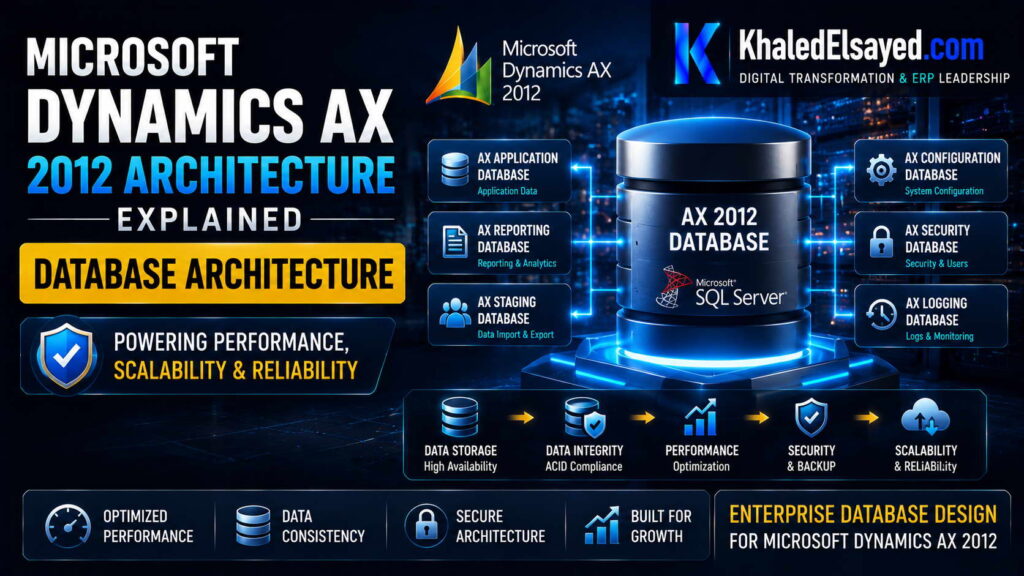
In my years leading digital transformation across enterprise IT environments, I have seen AX 2012 performance degrade because the database architecture was not optimized. When advising clients on dynamics ax 2012 architecture, I emphasize that the database layer is the foundation of performance. In this guide, I will explain the database architecture of ax architecture, detailing how SQL Server interacts with the aos server and providing a comprehensive dynamics ax 2012 architecture explained.
What is the Database Architecture in AX 2012?
From a strategic IT leadership perspective, dynamics ax 2012 architecture relies on Microsoft SQL Server as its data store. One of the most common challenges I encounter is clients using the wrong SQL edition (Standard vs Enterprise). In enterprise environments I have worked with, we use SQL Enterprise for the advanced indexing and partitioning capabilities.
The ax architecture database stores transactional data, master data, and metadata (X++ compiled code).
Key Database Components
Based on my observations, dynamics ax 2012 architecture explained requires understanding these components:
| Component | Function | Performance Impact |
|---|---|---|
| Transaction Log | Logs every change | Critical for recovery |
| Data Files (.mdf) | Stores table data and indexes | High (read/write speed) |
| TempDB | Temporary storage for sorts, joins | High (reporting performance) |
Database Best Practices
When advising organizations on dynamics ax 2012 architecture, I focus on these database practices. Separate Log and Data Files. I enforce a strict rule: place the transaction log on a separate physical drive from the data files.
Index Maintenance. I run index rebuilds weekly to prevent fragmentation.
Common Challenges and Solutions (Real-World Experience)
I rarely see software failures; I see I/O failures. Challenge: Slow TempDB. Clients place TempDB on the same slow drive as data. My solution: Move TempDB to a fast SSD drive.
Best Practices from Real ERP Implementations
Based on my project management experience, here are best practices for the ax architecture database. Monitor Query Performance. I use SQL Profiler to identify slow queries and add missing indexes.
Security Considerations: Ensure the SQL Server is locked down and not exposed to the internet.
Future Trends
In D365, the database is managed by Microsoft. My recommendation is to plan for migration.
My Professional Perspective
When advising executives on dynamics ax 2012 architecture explained, I tell them that the database architecture is the most critical component for performance. My strategic advice is to invest in a SQL Server DBA who understands the AX data model.
Frequently Asked Questions
What database does AX 2012 use?
Microsoft SQL Server (Enterprise or Standard edition).
Can I use Oracle with AX 2012?
No. AX 2012 only supports Microsoft SQL Server.
What are the hidden costs of AX database?
From a budget perspective, I always warn about the cost of SQL Server licensing and the need for high-availability clustering.
Is AX 2012 a web-based application?
No, it primarily uses a Windows Client. Enterprise Portal (web) exists but is limited.
How does AX 2012 handle batch processing?
Batch jobs run on the AOS. I often configure multiple batch servers to offload heavy tasks.
Why is TempDB important for AX?
TempDB is used for sorting and joining large datasets. If it’s slow, reports will be slow.
Conclusion
Understanding the database architecture of dynamics ax 2012 architecture is essential for any IT operations team. In my years of leading digital transformation, I have found that database tuning is the most effective way to improve AX performance. My professional recommendation is to run the “SQL Server Best Practices Analyzer” against your AX database to identify configuration gaps.
Meta Description: Digital transformation expert Khaled Elsayed Sqawa explains the database architecture of Dynamics AX 2012, covering SQL Server, TempDB, and performance tuning.
Suggested Tags: Dynamics AX 2012, Database Architecture, SQL Server, AX Performance
Security Framework
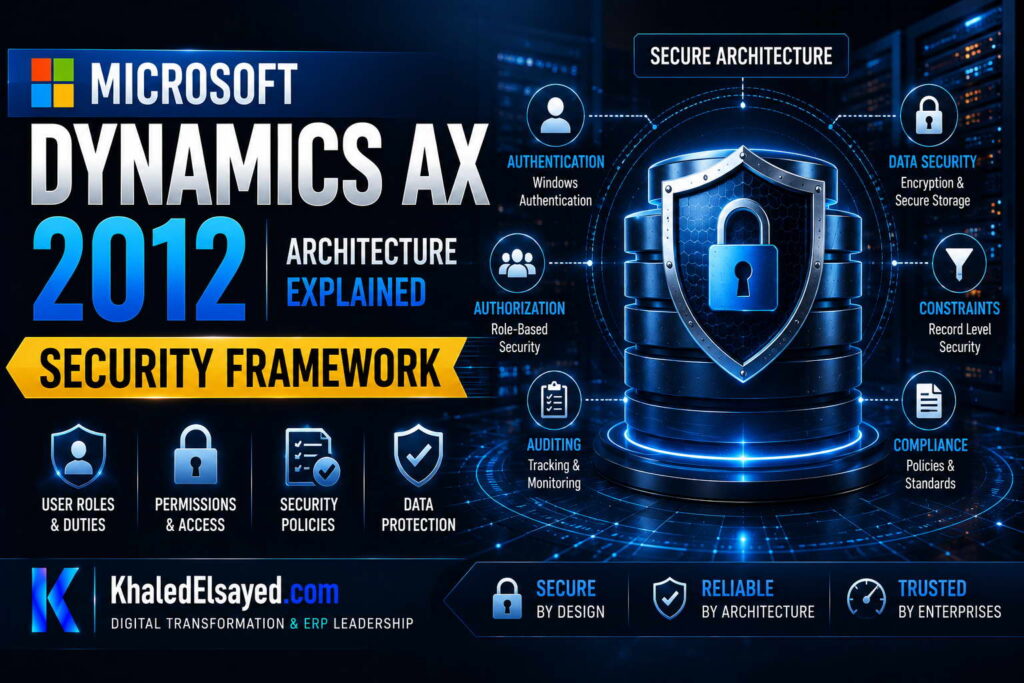
In my years leading digital transformation across enterprise IT environments, I have seen AX 2012 security breaches caused by misconfigured permissions. When advising clients on dynamics ax 2012 architecture, I emphasize that the security framework is the first line of defense. In this guide, I will explain the security framework of ax architecture, detailing how roles, duties, and privileges protect data.
What is the Security Framework in AX 2012?
From a strategic IT leadership perspective, dynamics ax 2012 architecture uses a role-based security model. One of the most common challenges I encounter is clients assigning the “System Administrator” role to everyone. In enterprise environments I have worked with, we have implemented a strict Segregation of Duties (SoD) policy using the security framework.
The ax architecture security model is built on three layers: Roles, Duties, and Privileges.
Security Framework Layers
Based on my observations, dynamics ax 2012 architecture explained requires understanding these layers:
| Layer | Definition | Example |
|---|---|---|
| Privilege | Access to a specific menu item | “View Customer” |
| Duty | Collection of privileges | “Maintain Customers” |
| Role | Collection of duties | “AR Clerk” |
Segregation of Duties (SoD)
When advising organizations on dynamics ax 2012 architecture, I focus on SoD. The system includes built-in SoD rules. I enforce a strict rule: no user should have the ability to create a vendor AND approve an invoice for that vendor.
Common Challenges and Solutions (Real-World Experience)
I rarely see software failures; I see configuration failures. Challenge: Overly Permissive Roles. Clients clone the “System Admin” role. My solution: Use the Security Diagnostics tool to analyze and tighten permissions.
Best Practices from Real ERP Implementations
Based on my project management experience, here are best practices for the ax architecture security framework. Use Active Directory Groups. I enforce a strict rule: assign roles to AD groups, not individual users.
Security Considerations: Regularly review the “Effective Access” report to ensure users only have the permissions they need.
Future Trends
In D365, the security framework is managed via Azure AD. My recommendation is to plan for migration.
My Professional Perspective
When advising executives on dynamics ax 2012 architecture explained, I tell them that the security framework is the guardian of their financial data. My strategic advice is to conduct a quarterly security audit to ensure SoD rules are still valid.
Frequently Asked Questions
What is Segregation of Duties in AX 2012?
In my experience, SoD prevents a user from performing conflicting actions (e.g., creating vendors and approving invoices). It’s a critical internal control.
Can I integrate AX 2012 security with Active Directory?
Yes. I have configured AX to use Active Directory for authentication.
What are the hidden costs of AX security?
From a budget perspective, I always warn about the time needed to maintain security roles as business processes change.
Is AX 2012 a web-based application?
No, it primarily uses a Windows Client. Enterprise Portal (web) exists but is limited.
How does AX 2012 handle batch processing?
Batch jobs run on the AOS. I often configure multiple batch servers to offload heavy tasks.
How do I audit user access in AX 2012?
Use the “User Permissions” report in the system administration module.
Conclusion
Understanding the security framework of dynamics ax 2012 architecture is essential for any compliance officer. In my years of leading digital transformation, I have found that a well-configured security framework reduces audit findings by 80%. My professional recommendation is to map your business roles to AX roles before migrating any data.
Meta Description: Digital transformation expert Khaled Elsayed Sqawa explains the security framework in Dynamics AX 2012 architecture, covering roles, duties, and Segregation of Duties.
Suggested Tags: Dynamics AX 2012, Security Framework, SoD, AX Roles
Performance Optimization
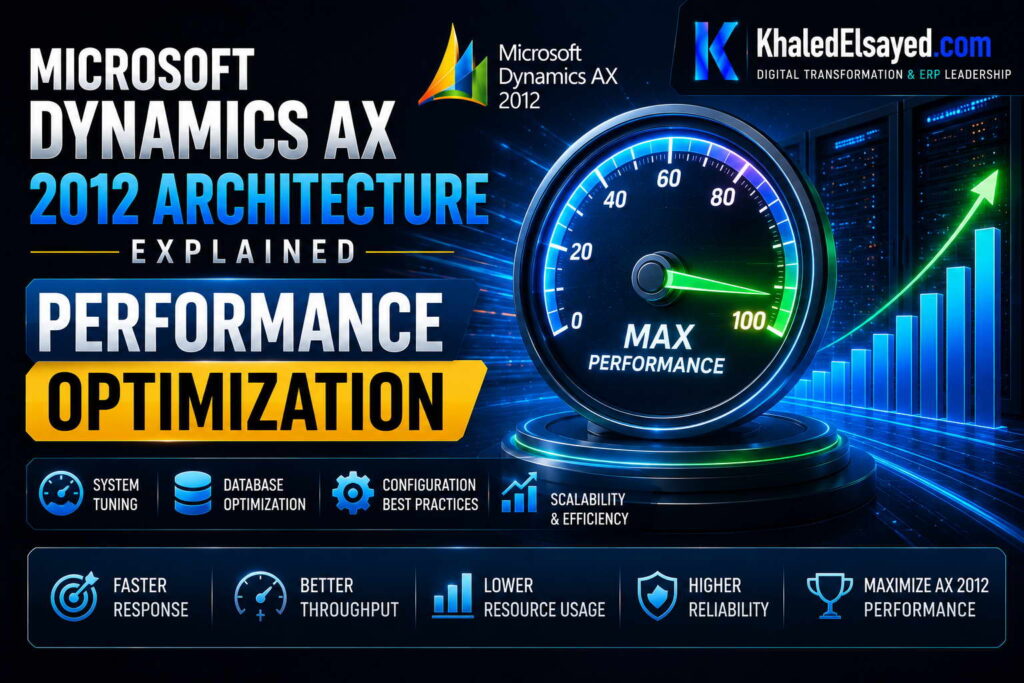
In my years leading digital transformation across enterprise IT environments, I have seen AX 2012 implementations suffer from slow batch jobs and sluggish user interfaces. When advising clients on dynamics ax 2012 architecture, I emphasize that performance optimization is a continuous process. In this guide, I will explain performance optimization techniques for ax architecture, covering aos server tuning and database indexing.
What is Performance Optimization in AX 2012?
From a strategic IT leadership perspective, dynamics ax 2012 architecture performance optimization involves tuning the AOS, SQL Server, and batch processing. One of the most common challenges I encounter is clients blaming the software for hardware bottlenecks. In enterprise environments I have worked with, we have optimized batch performance by isolating batch servers.
The ax architecture performance depends on three pillars: AOS memory, SQL indexing, and batch scheduling.
Performance Optimization Techniques
Based on my observations, dynamics ax 2012 architecture explained requires these optimization techniques:
| Area | Technique | Expected Improvement |
|---|---|---|
| AOS Server | Increase memory allocation, enable 64-bit | 20-30% faster transaction processing |
| SQL Server | Add missing indexes, rebuild fragmented ones | 40-60% faster reports |
| Batch Jobs | Dedicate a separate AOS for batch | Prevents user impact during batch runs |
AOS Server Optimization
When advising organizations on dynamics ax 2012 architecture, I focus on the aos server. I allocate at least 16GB RAM to the AOS. I also enable 64-bit mode to utilize more memory.
SQL Server Optimization
The ax architecture database is the foundation of performance. I use the “SQL Server Profiler” to identify slow queries and add missing indexes.
Common Challenges and Solutions (Real-World Experience)
I rarely see software failures; I see tuning failures. Challenge: Slow MRP Run. Clients run MRP during business hours. My solution: Schedule heavy batch jobs (MRP, costing) to run overnight.
Best Practices from Real ERP Implementations
Based on my project management experience, here are best practices for ax architecture performance. Monitor Performance Counters. I enforce a strict rule: track AOS memory usage and SQL waits.
Security Considerations: Ensure the SQL Server is locked down and not exposed to the internet.
Future Trends
In D365, performance is managed by Microsoft. My recommendation is to plan for migration.
My Professional Perspective
When advising executives on dynamics ax 2012 architecture explained, I tell them that performance optimization is the most underrated activity. My strategic advice is to invest in performance monitoring tools (like Performance Analyzer) to identify bottlenecks before users complain.
Frequently Asked Questions
How do I improve AX 2012 performance?
In my experience, start with indexing, then AOS memory, then batch scheduling.
What is the role of the AOS in AX 2012?
The AOS (Application Object Server) handles all business logic, workflows, and batch processing. It is the engine of the system.
Can I scale AX 2012 horizontally?
Yes. I have configured multiple AOS instances behind a load balancer to scale to 500+ concurrent users.
What database does AX 2012 use?
Microsoft SQL Server (Enterprise or Standard edition).
What are the hidden costs of AX architecture?
From a budget perspective, I always warn about the cost of SQL Server licensing and the need for high-availability clustering.
Is AX 2012 a web-based application?
No, it primarily uses a Windows Client. Enterprise Portal (web) exists but is limited.
Conclusion
Understanding performance optimization for dynamics ax 2012 architecture is essential for any IT operations team. In my years of leading digital transformation, I have found that proactive tuning is cheaper than reactive firefighting. My professional recommendation is to run the “AX Performance Analyzer” monthly to catch regressions.
Meta Description: Digital transformation expert Khaled Elsayed Sqawa explains performance optimization for Dynamics AX 2012 architecture, covering AOS, SQL, and batch tuning.
Suggested Tags: Dynamics AX 2012, Performance Optimization, AOS Tuning, SQL Indexing
Khaled Elsayed Sqawa
I am Khaled Elsayed Sqawa, a Senior IT Manager, Digital Transformation Leader, and ERP Consultant with more than 19 years of experience in Information Technology, Digital Transformation, Enterprise Infrastructure, Cybersecurity, Cloud Computing, and ERP Systems.
Throughout my career, I have led large-scale technology initiatives across the FMCG, Manufacturing, Education, and Non-Profit sectors, helping organizations modernize their operations, optimize business processes, strengthen cybersecurity, and leverage technology as a strategic driver of growth and operational excellence.
My expertise covers Digital Transformation Strategy, ERP Implementation and Optimization, Enterprise Infrastructure Management, Cloud Architecture, Cybersecurity, IT Governance, Business Continuity, IT Service Management, Data Centers, Vendor Management, Budget Planning, Process Automation, and Technology Leadership. I have successfully implemented and managed Odoo ERP, Microsoft Dynamics, Microsoft Great Plains, Microsoft 365, Google Workspace, Oracle Cloud Infrastructure, Sophos Firewall, FortiGate Security Solutions, and enterprise network environments.
Currently, I serve as Digital Transformation and Information Technology Manager, where I lead ERP modernization, workflow automation, cybersecurity enhancement, infrastructure development, e-learning platforms, and organization-wide digital transformation initiatives. Throughout my professional journey, I have also held leadership positions including Group IT Section Head and IT Section Head, managing enterprise environments, multi-site operations, nationwide IT support services, infrastructure modernization programs, and business-critical technology projects.
I hold a Bachelor’s Degree in Information Systems and a broad portfolio of internationally recognized professional certifications, including:
• Oracle Cloud Infrastructure Architect Professional
• SAP Technology Consultant
• Google Project Management Professional Certificate
• Google Cybersecurity Professional Certificate
• Microsoft Certified Systems Administrator (MCSA)
• Microsoft Certified Business Management Solutions Specialist (Dynamics Specialist)
• ServiceNow IT Leadership Professional Certificate
• Succeeding as a Senior Manager Professional Certificate
• IT Service Management ISO 20000 Professional Certificate
• Google IT Support Professional Certificate
• ITIL 4 Foundation (Self Study)
I believe that technology should not merely support business operations—it should transform them. My mission is to bridge the gap between business objectives and technology capabilities, enabling organizations to achieve sustainable growth, operational excellence, digital resilience, and long-term success.
Khaled Elsayed Sqawa
خالد السيد سقاوة
Senior IT Manager | Digital Transformation Leader | ERP Consultant | Cloud & Infrastructure Architect
Website: https://www.khaledelsayed.com
LinkedIn: https://www.linkedin.com/in/khaled-elsayed-it