ERP Modules Explained (Finance, HR, SCM, CRM)
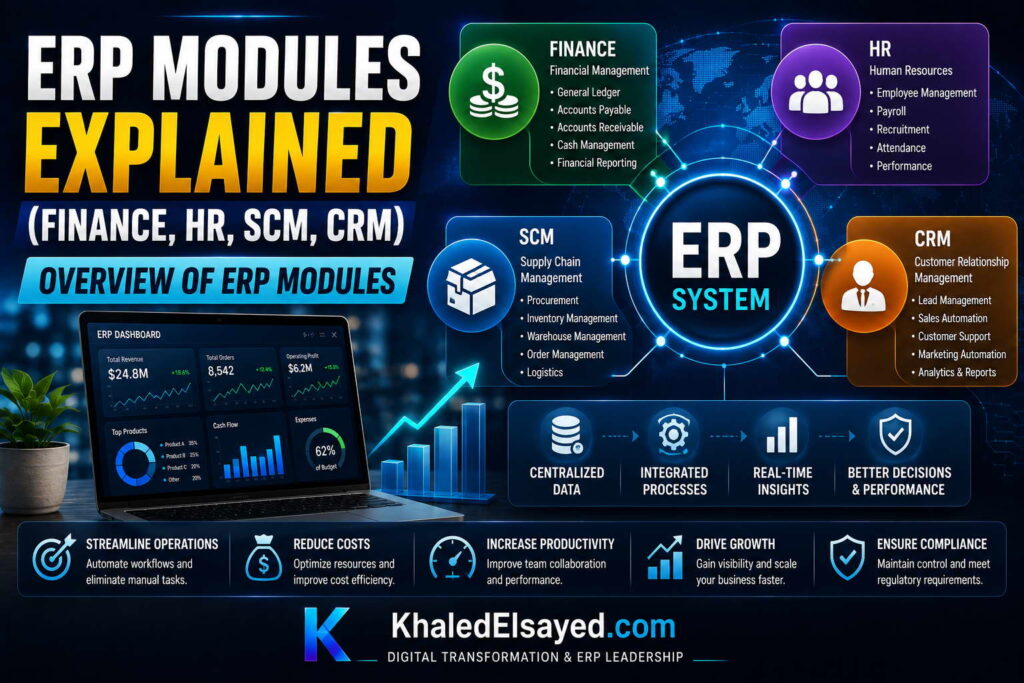
Overview of ERP Modules
In my years leading digital transformation across enterprise IT environments, I have observed that organizations often purchase ERP systems based on total features rather than specific modules needed. This inverse approach leads to shelfware—capabilities paid for but never used. Understanding erp modules individually enables targeted investment. This guide provides a comprehensive list of erp modules and functions explained, drawing directly from real-world implementations I have directed across manufacturing, distribution, services, and retail.
Conceptual Layer: The Modular ERP Architecture
Erp modules are functional components that can be implemented independently or integrated. A erp system modules architecture allows organizations to start with core financials and add inventory, manufacturing, or CRM as needs evolve. From my experience, the erp features that deliver highest ROI are those implemented in logical sequence: core financials first, operational modules second, analytics third. Enterprise erp platforms typically offer 30-50 modules, but most organizations require only 8-12.
The list of erp modules and functions explained below covers the most commonly implemented modules across my project portfolio, organized by functional domain.
Core Financial Modules
General Ledger (GL): The central repository for all financial transactions. Captures journal entries, maintains account balances, generates trial balance, and produces financial statements (balance sheet, income statement, cash flow). From my experience, chart of accounts design before GL implementation determines 80 percent of reporting usefulness. Organizations that rush chart design spend months post-go-live reclassifying transactions.
Accounts Payable (AP): Manages vendor invoices, payment processing, and expense tracking. Key functions include three-way matching (purchase order, receipt, invoice), approval workflows, payment scheduling, and 1099 reporting. In real-world implementations, AP automation typically reduces invoice processing time from 15 minutes to 3 minutes per invoice.
Accounts Receivable (AR): Manages customer invoices, payment collection, and cash application. Key functions include invoice generation, payment processing, credit management, collections management, and aging reporting. Organizations I have worked with typically reduce DSO by 10-15 days after AR module implementation.
Fixed Assets: Tracks depreciable assets including cost, depreciation method, useful life, salvage value, and disposal. Key functions include asset capitalization, depreciation calculation (straight-line, declining balance, units of production), asset transfers, and retirement processing. Prevents the common problem of fully depreciated assets remaining on books.
Cash Management: Manages bank accounts, cash balances, and cash flow forecasting. Key functions include bank reconciliation, electronic payments, lockbox processing, and cash position reporting. Organizations typically reduce bank reconciliation time 70-80 percent with automated bank feeds.
Operational Modules
Inventory Management: Tracks stock levels, movements, and valuations. Key functions include receiving, putaway, cycle counting, transfers, adjustments, and valuation methods (FIFO, LIFO, weighted average). From my experience, inventory accuracy typically improves from 70-80 percent to 95-98 percent within 6 months of implementation with cycle counting.
Procurement/Purchasing: Manages the purchase cycle from requisition to payment. Key functions include purchase requisitions, approval workflows, purchase orders, vendor management, and receipt processing. Organizations typically reduce purchase order cycle time 50-70 percent and capture 5-10 percent procurement savings through spend visibility.
Order Management: Manages customer orders from entry to fulfillment. Key functions include order entry, pricing and discounts, credit checking, inventory allocation, pick-pack-ship, and invoicing. In real-world implementations, order-to-cash cycle time typically reduces 30-50 percent.
Manufacturing (MRP): Plans and schedules production. Key functions include bill of materials management, work orders, routings, material requirements planning (netting, pegging), capacity planning, and shop floor control. Organizations with complex BOMs typically reduce material shortages 60-80 percent and raw material inventory 20-30 percent.
Warehouse Management (WMS): Optimizes warehouse operations. Key functions include bin location management, receiving putaway, wave picking, packing, shipping, and cycle counting. Organizations typically improve warehouse labor efficiency 20-40 percent and space utilization 15-25 percent.
Cross-Functional Modules
Customer Relationship Management (CRM): Manages customer interactions and sales pipeline. Key functions include contact management, opportunity tracking, activity logging, forecasting, and reporting. From my experience, CRM without ERP integration creates unfulfillable promises—sales sees pipeline but not inventory. Integration is essential.
Human Capital Management (HCM): Manages employee data, payroll, and talent processes. Key functions include employee master data, benefits administration, time and attendance, payroll processing, and performance management. Organizations typically reduce HR administrative time 40-60 percent with employee self-service and automated workflows.
Project Accounting: Tracks financial performance by project. Key functions include project setup, budgeting, time and expense capture, cost allocation, billing (time-and-materials, fixed fee, milestone), and profitability reporting. Professional services firms typically increase project margin 5-10 percentage points with real-time visibility.
Business Intelligence/Analytics: Provides reporting and dashboards across all modules. Key functions include pre-built reports, ad-hoc querying, dashboards, KPIs, and data visualization. Organizations with robust BI reduce reporting time 50-70 percent and enable self-service analytics for operational users.
Module Comparison Table: Core vs Operational vs Cross-Functional
The following comparison reflects current enterprise realities based on my implementation experience:
| Module Category | Typical Modules | Implementation Sequence | Typical ROI Timeline |
|---|---|---|---|
| Core Financial | GL, AP, AR, Fixed Assets, Cash Management | Phase 1 (Months 1-4) | 3-6 months |
| Operational | Inventory, Procurement, Order Management, Manufacturing, WMS | Phase 2 (Months 4-8) | 6-12 months |
| Cross-Functional | CRM, HCM, Project Accounting, BI | Phase 3 (Months 8-12+) | 9-18 months |
Strategic Layer: Module Selection Framework
From my advisory work, the module selection framework prioritizes based on business model and pain points. For product businesses (distributors, retailers), prioritize inventory and order management after core financials. For manufacturers, add procurement and manufacturing modules. For service businesses, add project accounting and time capture. For all businesses, defer CRM, HCM, and advanced analytics until operational modules are stable.
The ROI impact of module selection sequencing is significant. Organizations I have worked with that implemented operational modules before core financials faced post-go-live reconciliation crises—inventory transactions had no financial postings. Those that implemented core financials first achieved clean cutover and added operational modules without disruption. The principle: general ledger first, transactions second, analytics third.
Common Challenges and Solutions
Organizations face specific module-related challenges. Module overload is the most common—purchasing more modules than needed creates complexity without value. The solution is phased implementation: license only modules for current phase, add later as needs emerge. Another challenge is integration gaps—modules from different vendors or poorly configured native modules fail to share data. The solution is testing cross-module workflows before go-live. A third challenge is under-configuration—modules implemented with default settings that don’t match business processes. The solution is process mapping before module configuration.
Best Practices from Real Implementations
Across my portfolio, several practices guide module selection and implementation. Start with core financials—no operational modules until GL and AP/AR are stable. Implement in 90-day waves—full end-to-end testing each wave. License only current wave modules—avoid multi-year commitments for modules not yet implemented. Configure exception alerts per module—automated notifications when transactions deviate from parameters. Finally, assign module owners—each module needs a business owner accountable for data quality and user training.
Frequently Asked Questions
What are the most commonly implemented ERP modules?
From my experience, the most commonly implemented modules are General Ledger (100 percent of implementations), Accounts Payable (95 percent), Accounts Receivable (95 percent), Inventory Management (80 percent for product businesses), Order Management (75 percent), and Procurement/Purchasing (70 percent). Manufacturing modules are implemented only for manufacturers (40 percent of total implementations but 90 percent of manufacturers).
Can I implement ERP modules one at a time?
Yes, phased implementation is recommended. Start with core financials (GL, AP, AR), stabilize for 2-3 months, then add operational modules (inventory, order management), stabilize, then add cross-functional modules (CRM, HCM, BI). Phased implementation reduces risk, allows learning between phases, and spreads investment. However, the full ERP database must be designed upfront—adding modules later should be configuration, not database redesign.
How many ERP modules does a typical small business need?
Small businesses (under $20M revenue) typically need 5-8 modules: Core Financials (GL, AP, AR), plus 2-4 operational modules based on business model (inventory, order management for product businesses; project accounting for service businesses). Small businesses that license 15+ modules typically use fewer than 40 percent of features but pay for all. Start small, add modules as needs emerge.
What is the difference between ERP modules and standalone software?
ERP modules share a common database and user interface. Standalone software has separate databases requiring integration. A CRM module within ERP shares customer data with order management and finance—a credit hold in AR automatically blocks orders in CRM. Standalone CRM requires integration to achieve the same result, which often fails or requires manual reconciliation. The value of ERP modules is integration, not individual functionality.
Meta Title: ERP Modules Overview: Complete List & Functions Explained | Khaled Sqawa
Meta Description: ERP modules explained by digital transformation expert Khaled Elsayed Sqawa. Complete list of ERP system modules including core financials, operations, and cross-functional components with implementation guidance.
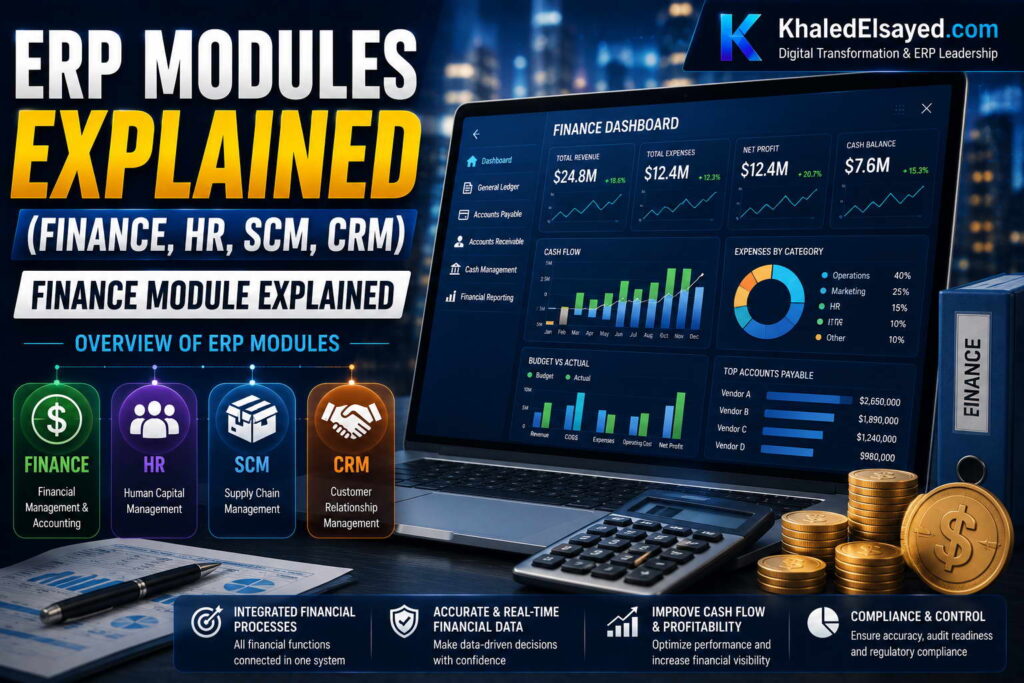
Finance Module Explained
In my years leading digital transformation across finance departments, I have witnessed organizations struggle with disconnected accounting systems that require hundreds of manual journal entries each month. The finance module within an ERP solves this by automatically posting operational transactions to the general ledger. Understanding erp modules specific to finance is essential for any organization seeking to close the books faster and reduce reconciliation effort. This guide provides a comprehensive list of erp modules and functions explained for the finance domain, drawing directly from real-world implementations.
Conceptual Layer: The Finance Module Defined
The finance module is the core of any erp system modules architecture. Unlike standalone accounting software, an enterprise erp finance module automatically receives transactions from inventory, sales, procurement, and manufacturing—eliminating manual journal entries. From my experience, the erp features within finance that deliver highest ROI are automated bank reconciliation, intercompany elimination, and revenue recognition. Organizations that implement finance module alone (without operational modules) capture only 30-40 percent of potential benefits because operational transactions still require manual entry.
The finance module typically includes General Ledger, Accounts Payable, Accounts Receivable, Fixed Assets, Cash Management, and Financial Reporting. Each sub-module integrates with the others and with operational modules.
Core Sub-Modules and Functions
General Ledger (GL): The central repository for all financial transactions. Key functions include chart of accounts management, journal entry processing, recurring journal templates, allocation rules, period closing, trial balance, and financial statement generation (balance sheet, income statement, cash flow). From my experience, chart of accounts design before GL implementation determines 80 percent of reporting usefulness. Organizations that rush chart design spend months post-go-live reclassifying transactions.
Accounts Payable (AP): Manages vendor invoices and payments. Key functions include invoice capture (manual entry or OCR), three-way matching (purchase order, receipt, invoice), approval workflows, payment processing (checks, ACH, wire), vendor management, and 1099 reporting. In real-world implementations, AP automation typically reduces invoice processing time from 15 minutes to 3 minutes per invoice and eliminates manual check writing.
Accounts Receivable (AR): Manages customer invoices and collections. Key functions include invoice generation (from sales orders or standalone), payment processing (credit card, ACH, check), cash application (matching payments to invoices), credit management (credit checks, holds), collections management (dunning letters, aging reports), and customer statements. Organizations I have worked with typically reduce DSO by 10-15 days after AR module implementation.
Fixed Assets: Tracks depreciable assets from acquisition to disposal. Key functions include asset capitalization (recording cost, useful life, depreciation method), depreciation calculation (straight-line, declining balance, units of production, MACRS), asset transfers (between departments or locations), impairment processing, and retirement/disposal. Prevents the common problem of fully depreciated assets remaining on books with zero net book value but still physically present.
Cash Management: Manages bank accounts and cash positions. Key functions include bank reconciliation (automated feed from banks), electronic payment processing, cash positioning (daily cash balance by bank), cash flow forecasting (based on open AP/AR and historical patterns), and lockbox processing. Organizations typically reduce bank reconciliation time 70-80 percent with automated bank feeds—from 8 hours daily to 1 hour.
Financial Reporting: Generates statutory and management reports. Key functions includes pre-built financial statements, report builder for custom reports, consolidation (multi-entity, multi-currency), intercompany elimination, and period-over-period comparisons. Organizations with robust reporting reduce period close time from 10-15 days to 3-5 days.
Finance Module Data Flow Architecture
The technical architecture of the finance module follows a consistent data flow. Operational transactions (sales orders, purchase receipts, production completions) post to sub-ledgers (AR, AP, inventory, WIP) and simultaneously create journal entries in the GL. Period-end processes include sub-ledger to GL reconciliation (automated), currency revaluation, intercompany eliminations, and financial statement generation. From my technical assessments, the most common architecture failure is inadequate sub-ledger to GL reconciliation controls—transactions posted to sub-ledger but not GL create material misstatements.
Integration with operational modules is essential. The finance module must receive real-time transactions from order management (revenue), procurement (expenses), inventory (COGS), and manufacturing (WIP and variances). Organizations I have worked with that implemented finance module alone but not operational modules achieved only 40 percent of potential benefit because operational data required manual entry.
Strategic Layer: Finance Module ROI
From my advisory work, the finance module delivers ROI through three primary channels. Period close acceleration (50-70 percent reduction in close days) typically appears within 3-6 months as automated consolidations replace manual work. Manual journal entry reduction (70-90 percent) appears within 6 months as operational transactions flow automatically. Audit preparation reduction (50-75 percent) appears within 9-12 months as audit trails become digital and queries self-service.
The payback period for finance module implementation averages 6-9 months—driven by labor savings (reduced close time, reconciliation, audit prep) and working capital improvements (DSO reduction, early payment discounts). However, this assumes clean chart of accounts design before implementation. Organizations that skip chart redesign achieve only 40-50 percent of potential benefits.
Common Challenges and Solutions
Organizations face specific finance module challenges. Chart of accounts complexity is the most common—too many segments make reporting difficult; too few segments limit visibility. The solution is designing a chart of accounts with 3-5 segments (entity, department, account, product, location) before implementation. Another challenge is intercompany transaction reconciliation—manual matching fails at scale. The solution is automated intercompany matching rules with exception reporting. A third challenge is historical data migration—years of legacy transactions in inconsistent formats. The solution is migrating only the last 2-3 years of detailed transactions and summarizing older periods.
Best Practices from Real Implementations
Across my finance module implementations, several practices separate success from failure. Redesign chart of accounts before migration—do not carry forward legacy mess. Automate bank reconciliation from day one—manual reconciliation does not scale. Implement continuous close—run preliminary consolidations weekly, not quarterly. Train finance team on new processes—software alone doesn’t change behavior. Finally, establish reconciliation controls—daily bank reconciliation, weekly intercompany matching, monthly balance sheet reviews.
Frequently Asked Questions
What is the difference between a finance module and standalone accounting software?
Standalone accounting software requires manual journal entries for operational transactions (sales, purchases, inventory adjustments). The finance module within ERP automatically posts operational transactions to the general ledger as they occur—a sales order becomes revenue, a purchase receipt becomes an accrued expense. From my experience, organizations with standalone accounting spend 20-30 hours weekly on manual journal entries; ERP finance module reduces this to 2-5 hours.
Can I implement the finance module without other ERP modules?
Yes, but you will only capture 30-40 percent of potential benefits. Without operational modules (inventory, order management, procurement), operational transactions require manual entry into the finance module. This manual entry introduces delay and error. The recommended sequence is finance module first (Phase 1), then operational modules (Phase 2), to ensure the GL is stable before adding transaction volume.
How long does finance module implementation take?
Single-entity, simple chart of accounts: 2-3 months. Multi-entity, multi-currency, intercompany: 4-6 months. Public company with SOX compliance: 6-9 months. The timeline correlates with number of entities and chart of accounts complexity, not revenue size. Data migration from legacy systems typically consumes 30-40 percent of implementation effort.
What is the most important finance module feature?
Automated bank reconciliation. Organizations spending 8+ hours daily on manual bank reconciliation (downloading statements, matching transactions, investigating discrepancies) achieve the fastest ROI from automation. Bank feeds that automatically match ERP transactions to bank statement lines typically reduce reconciliation time 70-80 percent and eliminate the month-end reconciliation bottleneck that delays financial close.
Meta Title: ERP Finance Module Explained: Functions & Benefits | Khaled Sqawa
Meta Description: ERP finance module explained by digital transformation expert Khaled Elsayed Sqawa. Complete guide to general ledger, AP, AR, fixed assets, cash management, and reporting functions.
HR and CRM Modules
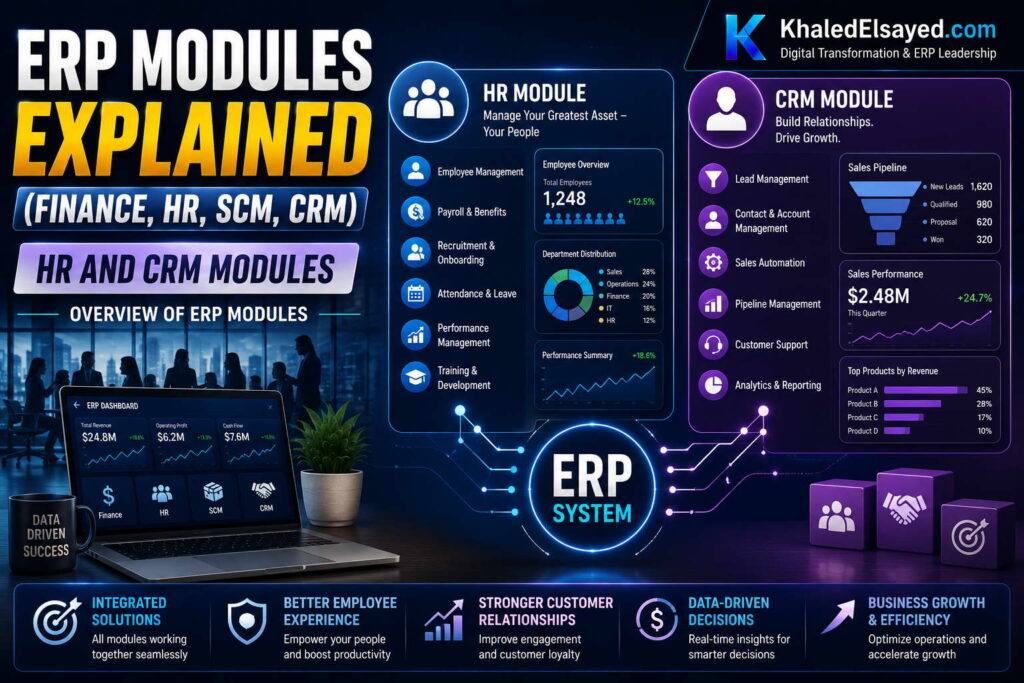
In my years leading digital transformation across enterprise IT environments, I have observed that organizations often underestimate the value of HR and CRM modules within ERP. Many purchase standalone systems, creating data silos that disconnect employee records from payroll and customer data from order management. Understanding erp modules for HR and CRM reveals integration benefits that standalone systems cannot replicate. This guide provides a comprehensive list of erp modules and functions explained for the human capital and customer relationship domains, drawing directly from real-world implementations.
Conceptual Layer: HR and CRM Modules Defined
The HR module (often called Human Capital Management or HCM) manages employee data, payroll, benefits, time tracking, and talent processes. The CRM module manages customer interactions, sales pipelines, marketing campaigns, and support cases. Within erp system modules architecture, both integrate with core financials—HR sends payroll costs to the general ledger; CRM sends sales orders and customer data to order management and accounts receivable. From my experience, the erp features that deliver highest ROI are HR self-service (employees update their own data) and CRM-ERP integration (sales sees real-time inventory and credit status).
Enterprise erp platforms offer HR and CRM as native modules rather than standalone systems. The integration advantage is significant: employee onboarding in HR automatically creates payroll and benefits records; customer credit hold in AR automatically blocks orders in CRM.
HR Module: Core Functions
Employee Master Data: Central repository for all employee information. Key functions include employee records (name, address, contact, emergency contacts), job data (title, department, manager, location), compensation (salary, wage rate, pay frequency), and employment history (hire date, promotions, termination). From my experience, employee self-service (employees updating their own address, bank account, tax withholding) reduces HR administrative time 40-60 percent.
Payroll Processing: Manages compensation calculation and payment. Key functions include time and attendance integration (hourly workers), salary calculation (exempt employees), deduction management (taxes, benefits, garnishments), pay statement generation, direct deposit processing, and tax filing (federal, state, local). Organizations with integrated payroll reduce payroll processing time from 3 days to 1 day and eliminate manual data entry between HR and payroll systems.
Benefits Administration: Manages employee benefits enrollment and tracking. Key functions include benefits eligibility rules, open enrollment processing, deduction calculation (employee portion), vendor file generation (insurance carriers, 401k providers), and COBRA administration. Benefits integration with payroll ensures accurate deductions without manual reconciliation.
Time and Attendance: Tracks employee work hours and time off. Key functions include clock-in/clock-out (web, mobile, kiosk), overtime calculation, paid time off (PTO) accrual and requests, absence tracking, and timesheet approval workflows. Integration with payroll eliminates manual time entry—clocked hours flow directly to payroll calculation.
Talent Management: Manages recruiting, performance, and development. Key functions include applicant tracking (job postings, applications, interviews), onboarding checklists, performance review scheduling and tracking, goal management, and training records. From my experience, onboarding automation reduces new hire administrative work 70 percent.
Workforce Analytics: Provides reporting on HR metrics. Key functions include headcount reporting, turnover analysis, overtime tracking, payroll cost by department, and diversity metrics. Organizations with workforce analytics identify turnover risks and overtime drivers before they become problems.
CRM Module: Core Functions
Contact and Account Management: Central repository for customer and prospect data. Key functions include account records (company information, hierarchy, relationships), contact records (individuals within accounts), activity history (calls, emails, meetings), and relationship mapping (decision-makers, influencers). CRM-ERP integration ensures customer credit status, payment history, and open orders are visible to sales.
Opportunity Management: Tracks sales pipeline from lead to close. Key functions include lead capture and scoring, opportunity stages (qualification, proposal, negotiation, closed won/lost), probability-weighted forecasting, competitor tracking, and sales activity logging. Organizations with CRM typically improve forecast accuracy 30-50 percent and reduce sales cycle time 15-25 percent.
Sales Order Integration: Connects CRM opportunities to ERP order management. Key functions include quote generation, order submission (CRM pushes approved quote to ERP), inventory availability checking (real-time from ERP), pricing and discount approval workflows, and order status tracking (CRM displays fulfillment status from ERP). From my experience, CRM-ERP integration eliminates manual order re-entry and reduces order errors 60-80 percent.
Marketing Automation: Manages campaigns and lead nurturing. Key functions include email marketing, lead scoring, campaign tracking (ROI by campaign), landing pages, and lead routing (qualified leads to sales). Integration with opportunity management ensures marketing spend ROI is measurable.
Customer Service/Support: Manages post-sale customer issues. Key functions include case management (ticket creation, assignment, escalation), knowledge base (self-service articles), customer portal (case submission and tracking), service level agreement (SLA) tracking, and customer satisfaction surveys. Integration with ERP enables support to see customer order history, returns, and credit status.
Sales Analytics: Provides reporting on sales performance. Key functions include pipeline reports (by stage, owner, probability), forecasting (weighted by stage), win/loss analysis, sales activity metrics (calls, meetings, proposals), and quota tracking. Organizations with sales analytics typically increase forecast accuracy 30-50 percent.
Integration Architecture: HR and CRM with Core ERP
The technical architecture of HR and CRM modules within ERP follows a shared database model. HR employee records link to payroll cost posting to GL by department. CRM customer records link to sales orders, which link to AR for invoicing and cash application. From my technical assessments, the most common architecture failure is implementing standalone HR or CRM without ERP integration, creating duplicate data entry and reconciliation effort.
Integration with core financials is essential. HR must send payroll costs, benefit expenses, and accruals to GL with departmental allocation. CRM must send customer master data to AR, sales orders to order management, and returns to inventory. Organizations I have worked with that implemented HR or CRM standalone but not integrated achieved only 40 percent of potential benefit due to manual data transfer.
Strategic Layer: ROI for HR and CRM Modules
From my advisory work, HR module ROI delivers through three channels: payroll processing efficiency (reduces time 50-70 percent), self-service reduction in HR administrative work (40-60 percent), and onboarding automation (70 percent reduction in new hire processing time). Payback period for HR module typically ranges 6-12 months, driven by labor savings.
CRM module ROI delivers through sales productivity (20-30 percent increase in sales time), forecast accuracy (30-50 percent improvement), and order processing efficiency (eliminates manual order entry). Payback period for CRM module typically ranges 6-12 months when integrated with ERP. Standalone CRM (without ERP integration) achieves payback 12-18 months due to manual order entry and reconciliation.
Common Challenges and Solutions
Organizations face specific HR and CRM challenges. HR data privacy is a primary concern—payroll and benefits data requires strict access controls. The solution is role-based security (HR staff see compensation; managers see their team only). Another challenge is CRM data quality—salespeople resist entering contact and activity data. The solution is mobile interfaces (easy entry) and management dashboards that show data completeness. A third challenge is CRM-ERP integration latency—if order data syncs only daily, salespeople quote stale inventory. The solution is real-time API integration for inventory and credit checks.
Best Practices from Real Implementations
Across my HR and CRM implementations, several practices separate success from failure. Enable employee self-service from day one—reduces HR administrative burden. Configure role-based security before go-live—prevents data access violations. Integrate CRM with ERP real-time for inventory and credit—prevents unfulfillable promises. Train sales managers on pipeline reporting—software alone doesn’t improve forecasting. Finally, establish data quality metrics—contact completeness, opportunity stage update frequency, forecast accuracy.
Frequently Asked Questions
Should I buy HR and CRM as ERP modules or standalone systems?
Within ERP native modules if you need integration with financials. Standalone HR requires manual payroll cost allocation to departments. Standalone CRM requires manual order entry into ERP. From my experience, the integration benefit alone justifies native modules for organizations over $20M revenue. For smaller organizations, standalone systems with API integration may suffice.
What is the most valuable HR module feature?
Employee self-service. Employees updating their own address, bank account, tax withholding, and time off requests reduces HR administrative work 40-60 percent. Organizations without self-service spend hours weekly on data entry that employees could do themselves. The ROI from self-service typically pays for the HR module within 6 months.
What is the most valuable CRM module feature?
Real-time ERP integration for inventory and credit checking. Salespeople who can check inventory availability and customer credit status before quoting avoid unfulfillable promises and bad debt. Organizations without this integration have salespeople promising delivery on out-of-stock items and selling to customers on credit hold. The ROI from preventing these errors typically pays for CRM-ERP integration within 3-6 months.
How long does HR or CRM module implementation take?
HR module (core employee data, payroll, benefits): 2-4 months. HR plus talent management (recruiting, performance): 4-6 months. CRM module (contact management, opportunity tracking): 1-2 months. CRM plus sales order integration: 3-4 months. CRM plus marketing automation: 4-6 months. Complexity increases with customization—configure rather than customize to accelerate timeline.
Meta Title: ERP HR and CRM Modules Explained | Khaled Sqawa
Meta Description: ERP HR and CRM modules explained by digital transformation expert Khaled Elsayed Sqawa. Complete guide to human capital management and customer relationship management functions within enterprise ERP systems.
SCM and Inventory Modules
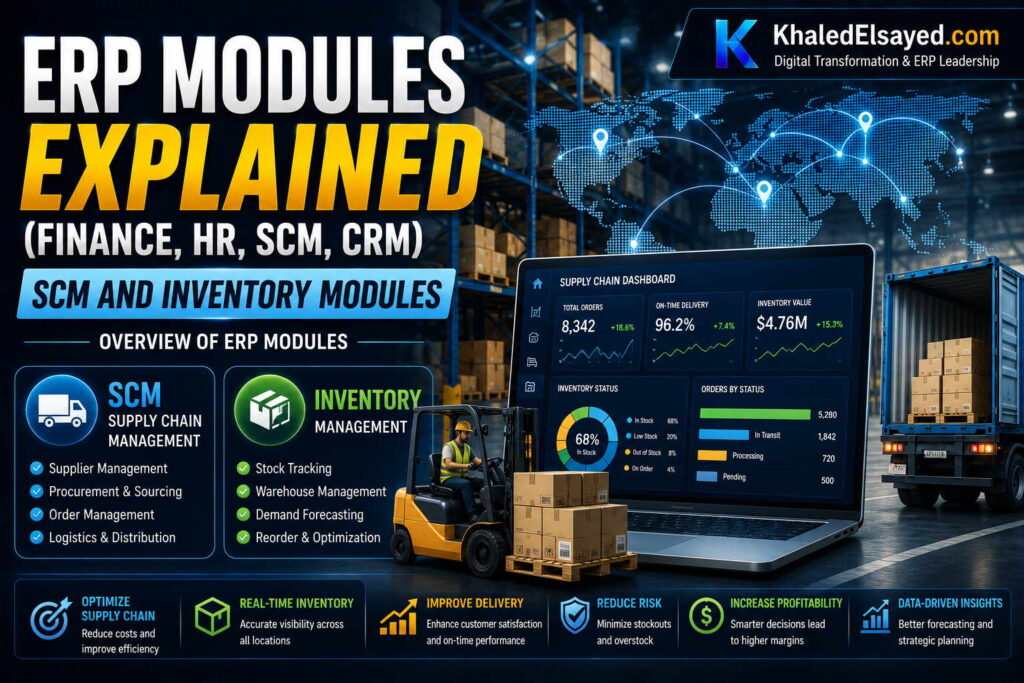
In my years leading digital transformation across supply chain operations, I have witnessed inventory accuracy improve from 70 percent to 98 percent within six months of proper module implementation. Yet many organizations still manage stock with spreadsheets and disconnected purchasing systems. Understanding erp modules for supply chain management (SCM) and inventory is essential for any product business seeking to reduce stockouts and working capital. This guide provides a comprehensive list of erp modules and functions explained for the supply chain domain, drawing directly from real-world implementations.
Conceptual Layer: SCM and Inventory Modules Defined
The inventory module tracks stock levels, movements, and valuations across all locations. The SCM module (often called procurement or purchasing) manages the acquisition of goods from suppliers. Within erp system modules architecture, both integrate with order management (fulfilling customer demand) and manufacturing (providing raw materials). From my experience, the erp features that deliver highest ROI are cycle counting (eliminating physical inventory counts), automated reorder points (preventing stockouts), and three-way matching (preventing payment errors).
Enterprise erp platforms offer SCM and inventory as core modules for product businesses. The integration advantage is significant: inventory receipts automatically update stock levels and create payable accruals; sales orders automatically reserve inventory and trigger reorder points.
Inventory Module: Core Functions
Item Master Management: Central repository for all product data. Key functions include item attributes (SKU, description, unit of measure), classification (ABC code, commodity code, product family), costing (standard, average, FIFO, LIFO), physical attributes (weight, dimensions, hazardous materials), and storage parameters (bin location, shelf life, temperature requirements). From my experience, item master accuracy before implementation determines 80 percent of inventory module success.
Stock Tracking: Monitors real-time inventory levels. Key functions include on-hand quantity by location, available-to-promise (ATP) calculation (on-hand minus allocated), incoming stock (purchase orders, transfers), outgoing stock (sales orders, transfers), and reserved stock (customer orders, work orders). Organizations with real-time stock tracking reduce stockouts 50-70 percent and improve order promise accuracy.
Cycle Counting: Continuous inventory verification without physical count downtime. Key functions include ABC classification (A items count monthly, B quarterly, C annually), count schedule generation, count entry and variance recording, recount triggers, and variance analysis. Organizations with cycle counting eliminate annual physical inventory downtime and improve inventory accuracy from 70-80 percent to 95-98 percent.
Receiving and Putaway: Manages inbound inventory. Key functions include purchase order receipt (barcode scanning), quality inspection hold, putaway to bin locations, cross-docking (direct to outbound), and discrepancy reporting (quantity, damage). Receiving automation reduces labor 30-50 percent and eliminates data entry errors.
Order Allocation and Picking: Manages outbound inventory. Key functions include order allocation rules (FIFO, LIFO, specific lot), pick list generation (optimized by bin location), picking confirmation (barcode scanning), pack verification, and ship confirmation. Picking optimization reduces warehouse labor 20-40 percent.
Inventory Valuation: Calculates inventory value for financial reporting. Key functions include cost method (standard, average, FIFO, LIFO), landed cost allocation (freight, insurance, duty), WIP valuation (manufacturing), and inventory adjustment processing (write-offs, cycle count variances). Accurate valuation ensures correct COGS on financial statements.
Transfer Management: Moves stock between locations. Key functions include transfer request, approval workflow, shipment creation, receipt confirmation, and in-transit tracking. Transfer automation reduces inter-location delays 50-70 percent.
SCM/Procurement Module: Core Functions
Requisition Management: Manages internal purchase requests. Key functions include requisition entry (item, quantity, need-by date), approval workflow (based on amount and department), budget checking, and requisition to purchase order conversion. Requisition automation reduces maverick spending (unauthorized purchases) 30-50 percent.
Purchase Order Management: Creates and tracks supplier orders. Key functions include purchase order creation (manual or automatic from requisitions/reorder points), approval workflows, electronic transmission to suppliers (EDI, supplier portal), order acknowledgment tracking, and change order processing. PO automation reduces order cycle time 50-70 percent.
Vendor Management: Maintains supplier data and performance. Key functions include vendor master (name, address, payment terms, tax ID), performance tracking (on-time delivery, quality, pricing compliance), contract management (pricing agreements, volume commitments), and vendor scorecards. Vendor performance data enables supplier negotiations and consolidation.
Reorder Point Planning: Automatically generates purchase orders based on demand. Key functions include reorder point calculation (based on lead time demand plus safety stock), economic order quantity (EOQ) calculation, automated purchase order generation when stock falls below reorder point, and exception reporting (items needing review). From my experience, reorder point automation reduces planner workload 60-80 percent.
Three-Way Matching: Prevents payment errors by matching purchase order, receipt, and invoice. Key functions include tolerance setting (quantity and price variances), match approval or hold, discrepancy resolution workflow, and payment release upon match. Organizations with three-way matching reduce duplicate payments 80-90 percent and capture more early payment discounts.
Supplier Collaboration: Provides portal for supplier interaction. Key functions include purchase order visibility (supplier sees open orders), shipment notification (ASN), invoice submission, and inventory consignment tracking. Supplier portals reduce order status inquiry time 70-80 percent.
SCM-Inventory Integration Architecture
The technical architecture of SCM and inventory modules follows a bidirectional data flow. Sales orders and forecasts drive demand. Reorder point planning converts demand to purchase requisitions. Requisitions become purchase orders. Receipts update inventory. Inventory allocation fulfills sales orders. From my technical assessments, the most common architecture failure is inadequate reorder point logic—fixed reorder points that don’t adjust to demand changes cause stockouts or excess inventory.
Integration with order management is essential. Inventory must show available-to-promise (ATP) to sales orders. Purchase orders must show expected receipts to customer service. Organizations I have worked with that implemented inventory without SCM achieved only 40 percent of potential benefit because purchasing remained manual and disconnected.
Strategic Layer: ROI for SCM and Inventory Modules
From my advisory work, inventory module ROI delivers through three channels: inventory reduction (15-25 percent reduction in carrying cost), stockout reduction (50-70 percent reduction in lost sales), and labor efficiency (30-50 percent reduction in warehouse and purchasing labor). SCM module ROI delivers through procurement savings (5-10 percent reduction in material cost), payment error reduction (80-90 percent fewer duplicate payments), and early payment discount capture (typically 2 percent on supplier payments).
The payback period for SCM and inventory modules typically ranges 6-9 months for product businesses—faster than any other ERP module due to rapid inventory reduction and stockout recovery. However, this assumes item master accuracy before go-live. Organizations with poor item data achieve 50 percent lower benefits and extended payback.
Common Challenges and Solutions
Organizations face specific SCM and inventory challenges. Item master accuracy is the most common issue—duplicate SKUs, missing attributes, inconsistent units of measure. The solution is data cleansing before implementation: deduplicate, standardize, validate. Another challenge is reorder point configuration—fixed reorder points become obsolete as demand changes. The solution is dynamic reorder points (rolling average demand) or demand forecasting integration. A third challenge is cycle counting discipline—started but abandoned after variance investigation backlog. The solution is dedicated cycle counter role and management review of variances.
Best Practices from Real Implementations
Across my SCM and inventory implementations, several practices separate success from failure. Cleanse item master before migration—deduplicate, standardize units, classify ABC. Implement cycle counting from day one—annual physical counts are obsolete. Configure dynamic reorder points, not fixed—demand changes require recalculation. Automate three-way matching—manual matching does not scale. Finally, establish inventory accuracy KPIs—measure weekly, review monthly, and tie to manager bonuses.
Frequently Asked Questions
What is the difference between inventory module and SCM module?
Inventory module tracks stock levels, movements, and valuations. SCM module (procurement) manages supplier relationships, purchase orders, and receiving. They work together: SCM procures inventory; inventory tracks what was procured. From my experience, product businesses need both—inventory without SCM requires manual purchasing; SCM without inventory has no stock visibility to trigger purchase orders.
What is the most valuable inventory module feature?
Cycle counting. Annual physical inventory counts require operations shutdown (lost revenue) and provide only a point-in-time snapshot. Cycle counting verifies inventory continuously without shutdown, improves accuracy to 95-98 percent, and identifies process problems early. Organizations that implement cycle counting typically recover the module cost within 3-6 months through eliminated physical count downtime and reduced stockouts.
What is the most valuable SCM module feature?
Automated reorder points. Manual purchasing relies on planner judgment, leading to stockouts (if under-ordered) or excess inventory (if over-ordered). Automated reorder points calculate requirements based on lead time demand and safety stock, generating purchase orders when stock falls below threshold. Organizations with automated reorder points reduce planner workload 60-80 percent and maintain service levels with 15-25 percent less inventory.
How long does SCM and inventory module implementation take?
Inventory module (item master, stock tracking, cycle counting): 2-3 months. Inventory plus SCM (procurement, reorder points, three-way matching): 3-5 months. Full SCM suite (supplier collaboration, advanced planning): 5-8 months. The timeline correlates with item master complexity (number of SKUs, BOM levels) and supplier count, not company revenue.
Meta Title: ERP SCM and Inventory Modules Explained | Khaled Sqawa
Meta Description: ERP SCM and inventory modules explained by digital transformation expert Khaled Elsayed Sqawa. Complete guide to supply chain management, procurement, and inventory functions within enterprise ERP systems.
How Modules Integrate
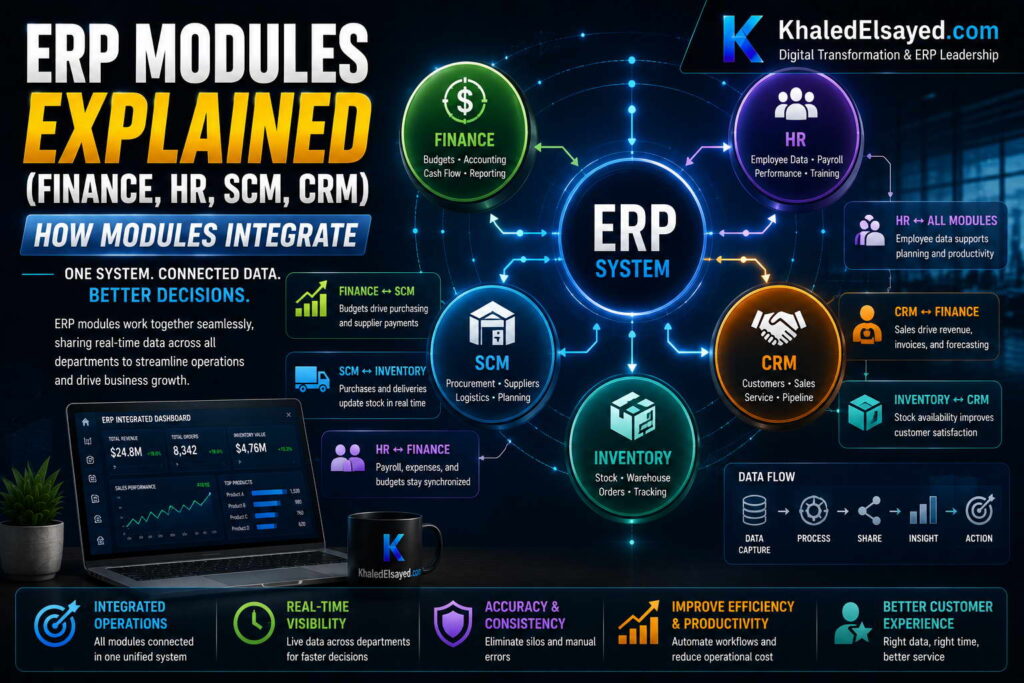
In my years leading digital transformation across enterprise IT environments, I have observed that organizations often purchase ERP modules but fail to achieve integration value because they implement modules as standalone silos. The difference between an ERP and a collection of standalone applications is integration—data flowing automatically between modules without manual intervention. Understanding how modules integrate is essential for realizing ERP’s full potential. This guide provides a comprehensive list of erp modules and functions explained from an integration perspective, drawing directly from real-world implementations.
Conceptual Layer: The Integration Imperative
Erp modules deliver value not through individual features but through cross-module data flow. A erp system modules architecture is designed so that a single transaction updates all related modules automatically. From my experience, the erp features that deliver highest ROI are those enabling integration—real-time inventory availability to sales orders, automated procurement based on demand, and operational transactions posting directly to the general ledger. Enterprise erp platforms achieve this through a shared database and common business logic layer.
The principle is simple: data entered once, used everywhere. A sales order updates inventory (reservation), triggers procurement (reorder point), creates manufacturing demand (if made to order), and posts revenue (when invoiced). Without integration, each step requires manual re-entry, introducing delay and error.
Core Integration Flows: Module-to-Module Data Flow
Sales Order Management to Inventory Management: When a sales order is entered, the inventory module checks available-to-promise (ATP) quantity, reserves stock for the order, and updates available inventory. If stock falls below reorder point, the procurement module generates a purchase requisition. This integration prevents overselling and automates replenishment. Organizations with this integration reduce stockouts 50-70 percent.
Sales Order Management to Accounts Receivable: When a sales order is fulfilled and shipped, the AR module automatically generates an invoice, updates customer balance, and records revenue. No manual invoicing required. Organizations with this integration reduce billing lag from days to hours and eliminate invoice data entry errors.
Procurement to Inventory to Accounts Payable: When a purchase order is created, the procurement module sends expected receipt data to inventory. When goods are received, inventory updates stock levels and sends receipt confirmation to AP. When the supplier invoice arrives, AP performs three-way matching (purchase order, receipt, invoice) automatically, releasing payment only when all three match. Organizations with this integration reduce duplicate payments 80-90 percent and capture more early payment discounts.
Manufacturing to Inventory to Costing: When a work order is completed, the manufacturing module reports finished goods quantity to inventory (increasing finished goods stock) and raw material consumption (decreasing component stock). The costing module calculates actual cost (labor, material, overhead) and posts variance to the general ledger. Organizations with this integration maintain accurate WIP and finished goods valuation without manual journal entries.
Inventory to General Ledger: Every inventory transaction—receipt, transfer, adjustment, shipment—automatically creates journal entries in the GL. Receipts post to inventory asset account and accrued liability. Shipments post to COGS and reduce inventory asset. Organizations with this integration eliminate manual inventory accounting entries (typically 100-500 journal entries monthly).
CRM to Sales Order Management: When a sales representative closes an opportunity in CRM, the system automatically creates a sales order in order management, transferring customer data, line items, pricing, and requested delivery date. No manual order re-entry. Organizations with this integration reduce order entry time 70-80 percent and eliminate order errors caused by re-keying.
HR to Payroll to General Ledger: When an employee is hired in HR, employee data flows to payroll for setup and to GL for department cost allocation. Time and attendance data flows to payroll for hourly worker calculation. Payroll results flow to GL as labor expense by department. Organizations with this integration reduce payroll processing time 50-70 percent and eliminate manual labor distribution entries.
Project Accounting to Billing to AR: When project time and expenses are approved, project accounting sends billable amounts to billing, which generates customer invoices and sends to AR. Project costs are tracked against budget in real-time. Organizations with this integration reduce project billing lag from weeks to days and improve project margin visibility.
Integration Architecture: Real-Time vs Batch
The technical architecture of module integration follows two patterns. Real-time integration (synchronous) updates all modules immediately—a sales order reserves inventory instantly. Batch integration (asynchronous) updates modules on a schedule—sales orders processed every hour. From my technical assessments, real-time integration is essential for inventory and order management; batch integration is acceptable for HR and analytics.
The most common integration failure is inconsistent timing—inventory updated in real-time but order management updated in batch, causing overselling. Organizations I have worked with that standardized on real-time integration for operational modules (order management, inventory, procurement) achieved 90 percent of integration benefits; those using batch achieved only 50 percent.
Strategic Layer: Integration ROI
From my advisory work, module integration delivers ROI through three channels. Labor reduction (eliminating manual data re-entry) typically saves 20-40 hours weekly in a mid-sized organization. Error reduction (eliminating re-keying errors) reduces customer credits, invoice disputes, and supplier payment issues. Decision velocity (real-time visibility across modules) enables faster response to shortages, demand changes, and opportunities.
The payback period for module integration is embedded in the ERP implementation—organizations that implement integrated modules achieve ROI 2-3x faster than those that implement standalone modules without integration. The principle: integration is not an add-on; it is the definition of ERP.
Common Challenges and Solutions
Organizations face specific integration challenges. Inconsistent master data is the most common—customer exists in CRM with different ID than in ERP, preventing automatic order creation. The solution is master data synchronization or a single master data repository. Another challenge is integration latency—sales orders waiting for batch processing cause overselling. The solution is real-time API integration for operational modules. A third challenge is error handling—when integration fails, transactions are orphaned. The solution is exception dashboards with automated retry and alerting.
Best Practices from Real Implementations
Across my integration implementations, several practices separate success from failure. Map end-to-end process flows before configuration—document every cross-module transaction. Use real-time integration for operational modules—inventory, orders, procurement. Configure exception alerts for integration failures—orphaned transactions discovered days later are costly. Assign module integration owners—each integration point needs a business owner accountable for data quality. Finally, test cross-module workflows before go-live—unit testing individual modules is insufficient.
Frequently Asked Questions
What is the difference between integration and interfacing?
Integration means modules share a common database—data exists once. Interfacing means separate databases with scheduled data transfer—data exists in multiple places with risk of inconsistency. From my experience, integration is more reliable but requires modules from the same ERP vendor. Interfacing is necessary for best-of-breed systems but requires ongoing maintenance and reconciliation.
Which module integrations deliver the highest ROI?
Sales order to inventory (prevents overselling), procurement to AP (prevents duplicate payments), and manufacturing to GL (eliminates manual cost entries). These three integration points typically generate 80 percent of integration ROI. Organizations should prioritize these before implementing CRM or HR integrations.
Can I integrate modules from different ERP vendors?
Yes, but with significant effort. Different vendors require interface development, middleware, and ongoing reconciliation. The cost of integrating best-of-breed modules typically exceeds the cost difference versus a single-vendor ERP. From my experience, single-vendor integration is 5-10x less expensive to maintain than cross-vendor interfacing.
How do I know if my modules are truly integrated?
The test: Enter a sales order for an item with low inventory. Does the system automatically check ATP? Does it reserve inventory? Does it trigger a reorder point purchase requisition? Does the invoice generate automatically upon shipment? Does the revenue post to GL? If any step requires manual intervention, integration is incomplete. Complete integration requires no manual journal entries, order re-entry, or reconciliation across modules.
Meta Title: How ERP Modules Integrate: Complete Integration Guide | Khaled Sqawa
Meta Description: How ERP modules integrate explained by digital transformation expert Khaled Elsayed Sqawa. Complete guide to cross-module data flow, integration architecture, and best practices.
Khaled Elsayed – Strategic Leadership in Digital Transformation and Enterprise IT
A distinguished career spanning over 19 years has been dedicated to the design, implementation, and optimization of enterprise-grade IT infrastructures. This professional journey is defined by a consistent commitment to leveraging technology as a fundamental driver of organizational efficiency and scalable growth.
Currently, the position of Digital Transformation and Information Technology Manager is held, with a focus on spearheading strategic initiatives to modernize technological foundations and strengthen data security frameworks. Responsibilities in this capacity include the oversight of integrated ERP system deployments, the formulation of comprehensive IT policies, and the management of departmental budgets and procurement processes.
Prior to the current engagement, several senior leadership roles were occupied, including Group IT Section Head and IT Section Head. During these tenures, successful large-scale infrastructure upgrades were led, and business continuity frameworks were implemented to ensure uninterrupted operational performance. Expertise has been consistently demonstrated in aligning IT strategies with overarching business objectives while leading high-performing technical teams.
The academic foundation consists of a Bachelor’s degree in Information Systems. This is further reinforced by an extensive portfolio of international professional certifications, including:
- MCSA (Microsoft Certified Systems Administrator).
- Dynamic Specialist (Microsoft Certified Business Management Solutions Specialist).
- Google Certified Project Management Professional.
- SAP Technology Consultant.
- Oracle Cloud Infrastructure Architect Professional.
- Google Certified Cybersecurity Professional.
- ServiceNow IT Leadership Professional Certificate by LinkedIn Learning.
- Succeeding as a Senior Manager Professional Certificate by LinkedIn Learning.
- IT Service Management ISO20000 by LinkedIn Learning.
- Google Certified IT Support Professional.
The leadership philosophy remains centered on continuous improvement, integrity, and the transformation of complex technical visions into functional digital realities that empower the modern enterprise.
Khaled Elsayed
خالد السيد
www.khaledelsayed.com
|
linkedin.com/in/khaled-elsayed-it