ERP System Architecture Explained Simply
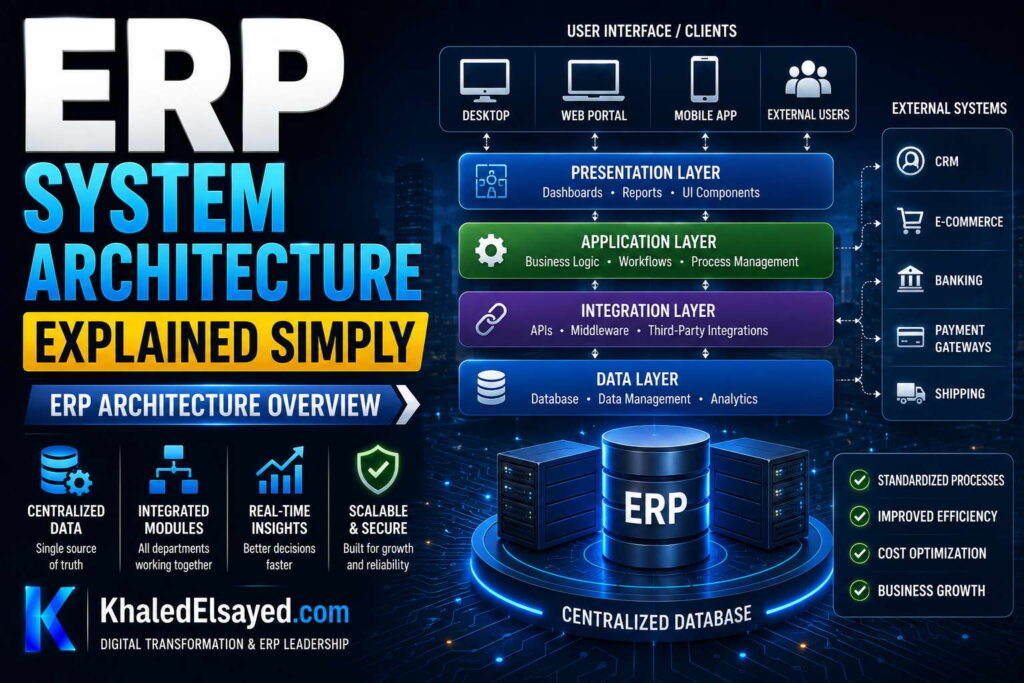
ERP Architecture Overview
In my years leading digital transformation across enterprise IT environments, I have seen ERP architecture determine everything from implementation speed to upgrade cost. Organizations that understand erp architecture make better vendor selections and avoid costly architectural mistakes. This guide provides a complete erp system architecture diagram explained, covering erp system design, enterprise systems patterns, and erp structure—drawing directly from real-world implementations.
Conceptual Layer: Defining ERP Architecture
Erp architecture refers to the structural design that governs how modules interact, data flows between functions, and the system scales with organizational growth. From my experience, erp system design encompasses three layers: presentation (user interfaces), application (business logic and workflows), and data (centralized database). Enterprise systems architecture determines upgrade complexity, integration capability, and total cost of ownership.
The erp structure can be monolithic (single codebase) or microservices (independent services). Each has trade-offs that impact long-term maintainability.
Technical Layer: Three-Tier Architecture Explained
Modern ERP follows a three-tier architecture pattern. Presentation Tier (Client Layer): Web browsers, mobile apps, and desktop interfaces. Users interact with this layer, which contains no business logic—only UI components. Cloud ERP uses responsive web design accessible from any device.
Application Tier (Business Logic Layer): The core of the ERP. Contains business rules, workflows, calculations, and security. When a sales order is entered, this layer validates pricing, checks credit limits, reserves inventory, and calculates commissions. This layer is where configuration vs customization decisions matter—configurable rules reside here; custom code creates upgrade burden.
Data Tier (Database Layer): Stores all transactional and master data. Modern ERP uses relational databases (PostgreSQL, MySQL, SQL Server, Oracle). The database schema must support referential integrity—deleting a customer should not orphan sales orders. Data tier is where performance tuning occurs—indexes, query optimization, partitioning.
From my technical assessments, the most common architecture failure is inadequate separation between tiers. Organizations that allow business logic in presentation layer or database create unmaintainable systems where changes require touching all three tiers.
Architecture Patterns: Monolithic vs Microservices
Monolithic Architecture: All modules (finance, inventory, manufacturing, HR) share a single codebase and database. Advantages: simpler deployment, transactional integrity (ACID across modules), easier debugging. Disadvantages: scaling requires scaling everything, upgrades affect all modules, technology stack is uniform. Best for: organizations under $500M revenue with moderate transaction volume and limited development resources.
Microservices Architecture: Each business capability runs as independent service with its own database. Advantages: independent scaling (scale inventory service without scaling finance), independent upgrades (update one service without touching others), polyglot persistence (different databases for different services). Disadvantages: distributed transaction complexity (eventual consistency), operational overhead (service discovery, API gateways, monitoring). Best for: global enterprises (500+ concurrent users, 100M+ transactions annually) with mature DevOps capabilities.
Modular Monolithic (Compromise): Separate codebases for each module but shared database. Advantages: independent upgrades (finance can upgrade without manufacturing), simpler than microservices, maintains transactional integrity. Disadvantages: still scales together, database becomes bottleneck. Best for: most mid-market organizations ($50M-$500M revenue).
From my experience, 80 percent of organizations should start with modular monolithic architecture. Microservices are over-engineering for the typical mid-market company.
ERP Architecture Layers and Components Table
The following architecture comparison reflects current enterprise realities based on my implementation experience:
| Architecture Layer | Components | Technology Examples | Key Considerations |
|---|---|---|---|
| Presentation Tier | Web UI, mobile apps, APIs | React, Angular, Vue.js, REST/GraphQL | Responsive design, offline capability, role-based views |
| Application Tier | Business logic, workflows, security | Python (Odoo, ERPNext), Java (OFBiz), C# (Dynamics) | Configurable vs customizable, stateless for scaling |
| Data Tier | Database, file storage, cache | PostgreSQL, MySQL, SQL Server, Redis | Referential integrity, indexing, backup strategy |
Data Flow and Integration Architecture
Understanding erp system architecture diagram explained requires examining data flow. A sales order triggers: presentation tier captures order data, application tier validates pricing/credit/availability, application tier creates inventory reservation (calls inventory service), application tier creates invoice (calls accounting service), data tier commits all changes atomically (ACID transaction).
Integration architecture connects ERP to external systems: e-commerce (order import, inventory sync), banking (payment reconciliation), CRM (customer sync), WMS (fulfillment), EDI (B2B transactions). Integration patterns: API (synchronous, real-time), message queue (asynchronous, decoupled), batch file (periodic, legacy).
From my technical assessments, the most common integration failure is using batch when real-time is required. Inventory sync that runs hourly will cause overselling in high-volume environments. Design integration based on business tolerance for latency—not technical convenience.
Strategic Layer: Architecture Impact on TCO
Architecture directly determines total cost of ownership. Monolithic architecture: lower initial development cost ($100k-$500k), higher upgrade cost (15-20 percent of original cost annually), scales to 500-1,000 concurrent users. Microservices architecture: higher initial development cost ($500k-$2M+), lower upgrade cost (5-10 percent annually), scales to 10,000+ concurrent users.
From my advisory work, organizations that select microservices without the transaction volume to justify them pay 2-3x higher TCO than needed. The architecture decision should be driven by actual scale requirements—not aspirational “what if we grow 10x?”
Common Challenges and Solutions
Organizations face specific architecture challenges. Over-architecting is the most common—building microservices when monolithic would suffice. The solution is starting monolithic and refactoring to microservices when scale justifies—premature optimization is expensive. Another challenge is vendor lock-in—proprietary architecture makes switching vendors expensive. The solution is API-first design—standard interfaces reduce switching cost. A third challenge is integration latency—synchronous calls cascade failures. The solution is asynchronous patterns (message queues, event-driven architecture) where real-time not required.
Best Practices from Real Implementations
Across my portfolio, several architecture practices drive success. Start modular monolithic—add complexity only when scale demands. Design API-first—every internal capability should have API. Separate configuration from code—environment-specific settings externalized. Implement stateless application tier—enables horizontal scaling. Finally, monitor database performance—index usage, query optimization, connection pooling.
Frequently Asked Questions
What is the difference between monolithic and microservices ERP architecture?
Monolithic architecture houses all modules in a single codebase and database, requiring full system upgrades and scaling everything together. Microservices architecture deploys each business capability as an independent service with its own database, enabling independent upgrades and scaling. From my experience, monolithic suits organizations under $500M revenue; microservices benefits global enterprises with 500+ concurrent users. Most organizations should start monolithic and refactor to microservices only when scale justifies the complexity.
What does a typical ERP system architecture diagram include?
A typical erp system architecture diagram explained includes: presentation tier (web/mobile clients), application tier (API gateway, modules, workflows, security), data tier (database, file storage, cache), and external integrations (e-commerce, banking, CRM, WMS). Data flow arrows show direction and frequency (real-time API, batch file, message queue). From my technical assessments, the most valuable diagrams show integration points with external systems—where most architecture failures occur.
How does ERP architecture impact upgrade cost?
Architecture determines upgrade cost. Monolithic architecture with zero customization: upgrades take 1-2 days (test + deploy). Monolithic with 20 percent customization: upgrades take 2-4 months (regression testing customizations). Microservices with zero customization: upgrades take 1-2 days per service (can upgrade services independently). Microservices with customization: upgrades still complex but isolated to one service. The principle: customization is expensive regardless of architecture; avoid it unless absolutely necessary.
Meta Title: ERP Architecture Overview: Complete Guide | Khaled Sqawa
Meta Description: ERP architecture explained by digital transformation expert Khaled Elsayed Sqawa. Learn three-tier architecture, monolithic vs microservices, data flow, and integration patterns.
Core Components
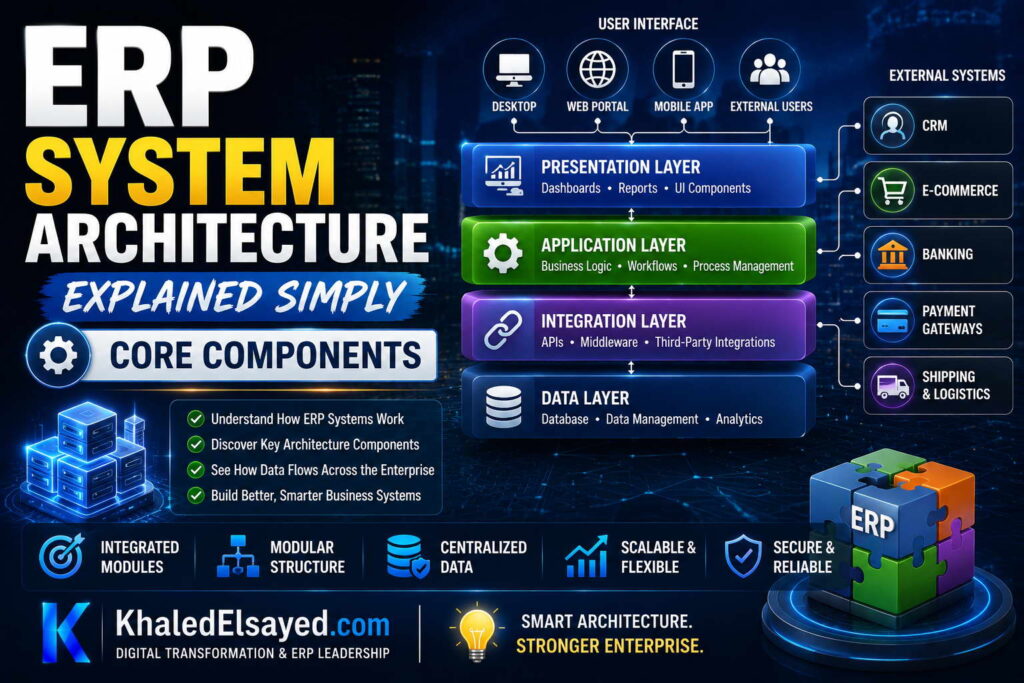
In my years leading digital transformation across enterprise IT environments, I have found that understanding erp architecture begins with its core components. Each component serves a specific function, and the way they integrate determines system performance and maintainability. This guide breaks down the essential erp system design components, providing an erp system architecture diagram explained through component relationships, covering enterprise systems fundamentals and erp structure building blocks.
Component 1: Database Layer (Data Tier)
The database layer is the foundation of any erp architecture. It stores all transactional and master data—customers, vendors, items, inventory, orders, invoices, GL accounts. From my experience, the database layer determines system performance more than any other component. A poorly designed database (missing indexes, unnormalized tables) will make even the fastest application tier unusable.
Key elements: Relational database management system (PostgreSQL, MySQL, SQL Server, Oracle). Tables with referential integrity (foreign keys prevent orphaned records). Indexes on frequently queried columns (customer ID, order date, item code). Stored procedures for complex calculations (cost rollups, period closing). Partitioning for large tables (archiving old data).
Implementation consideration: Database layer must support the transaction volume. A distributor with 10,000 orders daily needs different database configuration than a service business with 100 invoices weekly. From my technical assessments, inadequate database indexing is the most common performance issue—queries that should take milliseconds take minutes.
Component 2: Application Server (Business Logic Tier)
The application server contains the business logic—workflows, calculations, validations, security rules. When a sales order is entered, the application server validates pricing, checks credit limits, reserves inventory, calculates commissions, and creates GL entries. From my experience, the application server is where configuration vs customization decisions have the greatest impact.
Key elements: Business objects (sales order, purchase order, inventory transaction). Workflow engine (approval routing, notifications). Validation rules (credit limit, pricing, availability). Calculation engine (tax, commissions, landed cost). Security layer (authentication, authorization, audit logging).
Implementation consideration: Application server must be stateless for horizontal scaling. If session state stored locally, you cannot scale beyond one server. Most modern ERP uses stateless design with session state externalized (database, Redis).
Component 3: Web Server (Presentation Tier)
The web server delivers user interfaces to browsers and mobile apps. It contains no business logic—only UI components, form definitions, report templates. The web server calls the application server via API for all data operations. From my experience, separating presentation from business logic is essential for maintainability. Organizations that embed business logic in UI components cannot support multiple interfaces (web, mobile, API).
Key elements: Responsive HTML/CSS (adapts to desktop, tablet, mobile). JavaScript frameworks (React, Angular, Vue.js). Report rendering (PDF, Excel, CSV). Dashboard widgets (KPIs, charts). API client (calls application server).
Implementation consideration: Web server must support role-based UI—finance users see different screens than warehouse users. Role-based UI reduces training time and improves user adoption.
Component 4: Integration Middleware
Integration middleware connects ERP to external systems—e-commerce (order import, inventory sync), banking (payment reconciliation), CRM (customer sync), WMS (fulfillment), EDI (B2B transactions). From my technical assessments, middleware is the most underestimated component. Organizations assume ERP will connect directly to everything, then discover each connection requires custom development.
Key elements: API gateway (authenticates, rate-limits, routes). Message queue (handles asynchronous processing). ETL tools (batch data migration). Pre-built connectors (Shopify, Stripe, Salesforce). Webhooks (real-time event notifications).
Implementation consideration: Design integration patterns based on business tolerance for latency. Real-time (API) for inventory sync—customers need accurate availability now. Batch (nightly) for sales reporting—yesterday’s data sufficient.
Component 5: File Storage
File storage holds documents attached to ERP records—invoices (PDF), purchase orders (PDF), receipts (scanned images), contracts (Word). Modern ERP separates file storage from database to keep database size manageable. From my experience, organizations that store files in the database see database size grow 10x faster than those using external storage.
Key elements: Object storage (AWS S3, Azure Blob, Google Cloud Storage). Document management (versioning, retention policies). Optical character recognition (OCR) for scanned documents. Security (encryption at rest, access controls).
Implementation consideration: Define retention policies before go-live. How long to keep invoices? 7 years for tax compliance. How long to keep packing slips? 1 year for disputes. Automated cleanup prevents storage cost growth.
Component 6: Cache Layer
The cache layer stores frequently accessed data to reduce database load. Session data (user login state), reference data (item catalog, price lists), and report results (dashboard widgets) are cached. From my technical assessments, the cache layer is often omitted entirely, resulting in database overload during peak usage.
Key elements: In-memory cache (Redis, Memcached). Cache invalidation strategy (time-based, event-based). Session storage (user login state). Query cache (repeated identical queries).
Implementation consideration: Cache invalidation is the hardest problem. If cache not updated when data changes, users see stale data. Design cache invalidation carefully—time-based (expire after 5 minutes) is simple but may show stale data. Event-based (update cache when data changes) is accurate but complex.
ERP Core Components Summary Table
The following component breakdown reflects current enterprise realities based on my implementation experience:
| Component | Purpose | Technology Examples | Common Mistake |
|---|---|---|---|
| Database layer | Data persistence | PostgreSQL, MySQL, SQL Server | Missing indexes, no partitioning |
| Application server | Business logic | Python, Java, C# | Stateful design, no horizontal scaling |
| Web server | User interface | React, Angular, Vue.js | Business logic in UI |
| Integration middleware | External connectivity | MuleSoft, Dell Boomi, custom APIs | Underestimated complexity |
| File storage | Document attachments | AWS S3, Azure Blob | Files in database, no retention policy |
| Cache layer | Performance acceleration | Redis, Memcached | Omitted entirely, database overload |
Common Challenges and Solutions
Organizations face specific component challenges. Database performance degradation is the most common—as transaction volume grows, query times increase. The solution is database indexing, query optimization, and partitioning. Another challenge is stateful application server—session data stored locally prevents scaling beyond one server. The solution is external session storage (database, Redis). A third challenge is cache invalidation errors—users see stale data. The solution is event-based cache invalidation (update cache when data changes).
Best Practices from Real Implementations
Across my portfolio, several component practices drive success. Index database based on query patterns—not every column, just frequently queried ones. Keep application server stateless—enables horizontal scaling. Separate file storage from database—keeps database size manageable. Use cache for session data and reference data—reduces database load 50-70 percent. Finally, monitor component performance weekly—database query time, API response time, cache hit rate.
Frequently Asked Questions
What are the core components of ERP architecture?
The core components of erp architecture are: database layer (data persistence), application server (business logic), web server (user interface), integration middleware (external connectivity), file storage (document attachments), and cache layer (performance). Each component serves a distinct function. The erp structure defines how these components communicate—typically three-tier architecture (presentation, application, data) with integration middleware as an additional layer.
Why is the cache layer often omitted in ERP implementations?
The cache layer is omitted because it adds complexity—cache invalidation, additional infrastructure, debugging challenges. Organizations assume database can handle all load. From my experience, this assumption holds for the first 6-12 months, then fails as transaction volume grows. A distributor with 500 daily orders may not need cache. At 5,000 daily orders, database queries become slow; cache reduces database load 50-70 percent. The solution is implementing cache when performance degrades—not preemptively.
How do the core components communicate in a typical ERP system?
A typical erp system architecture diagram explained shows: web browser sends request to web server (HTTPS). Web server calls application server API (REST/GraphQL). Application server executes business logic, queries database (SQL). Results flow back through layers. For external integrations, middleware connects to application server via API. For file attachments, web server links to file storage. For performance, cache sits between application server and database. This layered design enables each component to scale independently.
Meta Title: ERP Architecture: Core Components Explained | Khaled Sqawa
Meta Description: ERP architecture core components explained by digital transformation expert Khaled Elsayed Sqawa. Learn database layer, application server, web server, middleware, file storage, and cache.
Data Flow in ERP
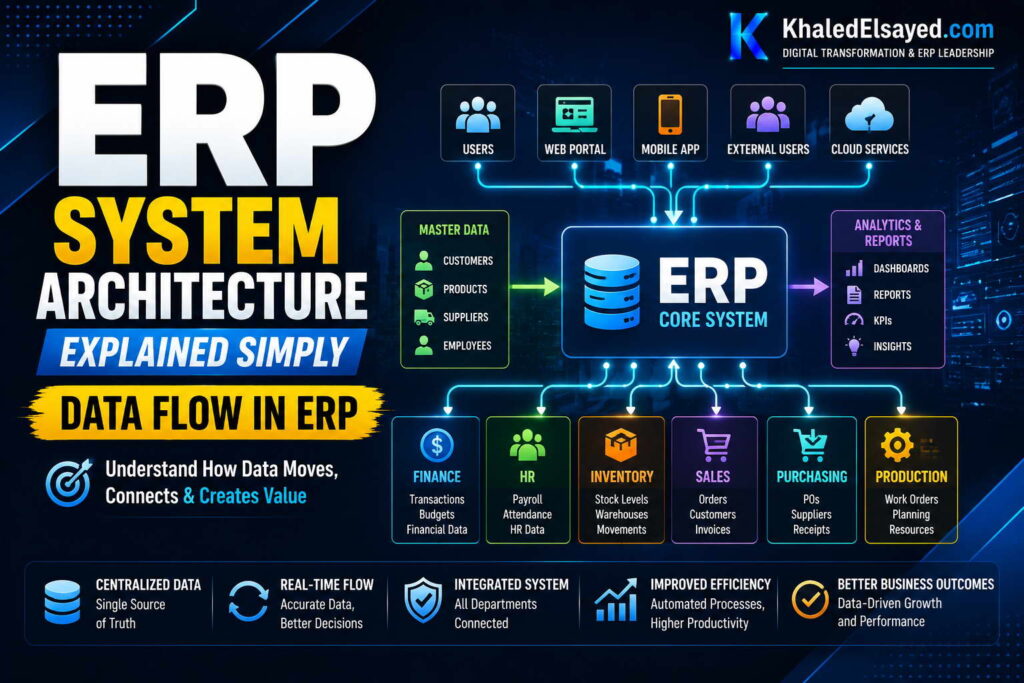
In my years leading digital transformation across enterprise IT environments, I have found that understanding erp architecture requires tracing how data moves through the system. Data flow determines system performance, data consistency, and integration capability. This guide explains erp system design from a data flow perspective, providing an erp system architecture diagram explained through transaction paths, covering enterprise systems integration and erp structure dynamics.
Conceptual Layer: The Data Flow Principle
The fundamental principle of erp architecture is single entry, multiple use. Data is entered once and flows to all modules that need it. From my experience, the value of ERP comes not from any single module but from the data flow between modules. A sales order should automatically create inventory reservation, pick list, invoice, and revenue posting—without re-entry.
Understanding erp system design data flow means answering: Where does data originate? Which modules consume it? How does it transform? What latency is acceptable? The answers determine integration architecture and performance requirements.
Data Flow 1: Order-to-Cash (Sales Cycle)
Origin: Customer order entry (sales module or e-commerce integration). Flow: Order data → inventory module (reserve stock) → warehouse module (create pick list) → shipping module (confirm shipment) → invoicing module (generate invoice) → accounts receivable (record receivable) → general ledger (post revenue and COGS).
Real-world example: A customer orders 100 units of SKU A-123 via e-commerce. The ERP flow: e-commerce order imported via API (real-time). Inventory module checks availability (100 in stock). Order status “confirmed” sent to customer. Inventory reserves 100 units (available drops from 150 to 50). Warehouse receives pick list (bin location A-12, pick 100). Shipping confirms shipment (tracking number generated). Invoicing generates invoice (due net 30). AR records receivable (customer balance increased). GL posts revenue (sales account credited) and COGS (inventory account debited).
Architectural consideration: This flow requires real-time integration. Batch processing would allow overselling—if inventory sync runs hourly, orders placed between syncs could exceed available stock.
Data Flow 2: Procure-to-Pay (Purchasing Cycle)
Origin: Purchase requisition (inventory reorder point or manual request). Flow: Requisition → approval workflow → purchase order → vendor confirmation → goods receipt → invoice receipt → three-way matching → payment → general ledger.
Real-world example: Inventory falls below reorder point for SKU A-123. ERP flow: inventory module detects stock below minimum (45 remaining, reorder point 100). Purchase requisition automatically created for 500 units. Approval workflow (if over $5,000, finance manager approves). Purchase order transmitted to vendor via EDI. Vendor sends advance ship notice (ASN). Goods receipt scanned via barcode (500 units received, quality inspection passed). Invoice received (vendor invoice for $5,000). Three-way matching compares PO ($5,000), receipt (500 units), invoice ($5,000)—match passes. Payment scheduled (net 30 terms). GL posts inventory asset increase, accounts payable liability.
Architectural consideration: Three-way matching is a critical control. Without it, organizations pay for goods not received or at wrong prices. ERP automates matching; manual matching fails at scale.
Data Flow 3: Record-to-Report (Financial Close)
Origin: Operational transactions across all modules. Flow: Sales orders, purchase receipts, production completions, expense reports → sub-ledgers (AR, AP, inventory, fixed assets) → general ledger → financial statements.
Real-world example: Month-end close. ERP flow: all sub-ledgers automatically post to GL throughout month (no manual journal entries). AP sub-ledger totals (accounts payable balance). AR sub-ledger totals (accounts receivable balance). Inventory sub-ledger totals (raw material, WIP, finished goods). Fixed assets sub-ledger (depreciation expense). GL consolidates all sub-ledgers. Trial balance run (debits = credits automatically—no out-of-balance). Financial statements generated (balance sheet, P&L, cash flow). Intercompany eliminations automated (subsidiary A receivable vs subsidiary B payable). Currency revaluation (foreign currency balances adjusted at period-end rate).
Architectural consideration: Without ERP, financial close requires manually consolidating sub-ledgers—reconciling AR to GL takes days. With ERP, sub-ledgers and GL are always in balance because transactions post to both simultaneously.
Data Flow 4: Plan-to-Produce (Manufacturing Cycle)
Origin: Sales forecast or sales order. Flow: Demand → material requirements planning (MRP) → purchase requisitions (raw materials) → work orders (production) → shop floor control → quality inspection → finished goods receipt → cost posting.
Real-world example: Sales order for 100 finished goods. ERP flow: demand from sales order triggers MRP. MRP nets finished goods (0 on hand, 100 to produce). MRP explodes BOM (each finished good requires 2 subassemblies, 5 raw materials). MRP nets components against inventory. Purchase requisitions generated for components not in stock. Work orders created for final assembly and subassemblies. Shop floor control tracks labor and machine hours. Quality inspection records results. Finished goods receipt (100 completed). Cost posting (labor, material, overhead calculated). GL updated (WIP reduced, finished goods increased).
Architectural consideration: Manufacturing data flow requires integration between planning (MRP) and execution (MES). Without integration, planned production dates diverge from actual shop floor status.
ERP Data Flow Summary Table
The following data flow patterns reflect current enterprise realities based on my implementation experience:
| Process | Data Origin | Data Destination | Latency Requirement | Integration Pattern |
|---|---|---|---|---|
| Order-to-cash | Sales order | Inventory, warehouse, AR, GL | Real-time | API (synchronous) |
| Procure-to-pay | Purchase requisition | PO, receipt, AP, GL | Real-time | API + EDI |
| Record-to-report | Operational transactions | Sub-ledgers, GL, financial statements | Real-time | Database (shared) |
| Plan-to-produce | Sales forecast/order | MRP, work orders, shop floor, GL | Batch (daily) | Message queue |
Common Challenges and Solutions
Organizations face specific data flow challenges. Data inconsistency is the most common—same data stored in multiple places with different values. The solution is single source of truth—each data element stored once. Another challenge is integration latency—batch processes cause data staleness. The solution is real-time APIs where latency matters (inventory availability). A third challenge is error handling—failed data flows create orphaned transactions. The solution is idempotent processing—operations safe to retry.
Best Practices from Real Implementations
Across my portfolio, several data flow practices drive success. Map data flows before configuration—document every transaction path. Use real-time API for customer-facing processes (order entry, inventory check). Use message queue for background processes (report generation, batch updates). Implement idempotent operations—same transaction processed twice produces same result. Finally, monitor data flow health—track failed integrations, stalled queues, data inconsistency alerts.
Frequently Asked Questions
What is the difference between data flow and process flow in ERP?
Data flow describes how information moves between modules—where data originates, which modules consume it, how it transforms. Process flow describes the sequence of activities users perform—order entry, approval, fulfillment. The erp architecture must support both. From my experience, process flow determines user experience; data flow determines system consistency. Organizations that design only process flow end up with data inconsistency—same customer address stored differently in sales, shipping, and accounting.
How does data flow differ in monolithic vs microservices architecture?
In monolithic architecture, data flow occurs through direct database access or function calls—fast but tightly coupled. Modules share the same database, so data consistency is automatic (ACID transactions). In microservices architecture, data flow occurs through APIs—slower but loosely coupled. Each service has its own database, so data consistency requires distributed transaction patterns (saga, eventual consistency). From my experience, monolithic data flow is simpler but less scalable; microservices data flow is complex but scales independently.
What is the most common data flow failure point?
From my experience, the most common data flow failure point is the boundary between ERP and external systems (e-commerce, banking, WMS). Organizations design internal data flow thoroughly but treat external integration as an afterthought. The result: orders fail to sync, payments not reconciled, inventory counts diverge. The solution is treating external integration as a first-class data flow—design error handling, monitoring, and retry logic before go-live. Test external integrations under load—failure at 2am on Saturday will happen; design for it.
Meta Title: ERP Data Flow: Architecture Guide | Khaled Sqawa
Meta Description: ERP data flow explained by digital transformation expert Khaled Elsayed Sqawa. Learn order-to-cash, procure-to-pay, record-to-report, and plan-to-produce data flow patterns.
Cost Overruns
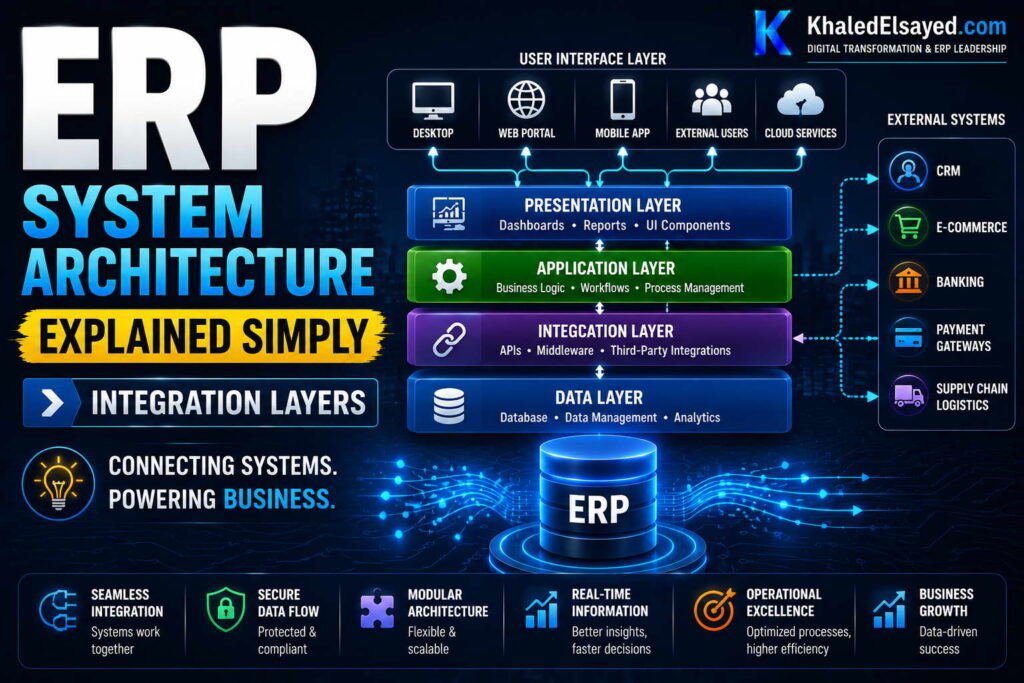
In my years leading digital transformation across enterprise IT environments, I have seen ERP implementations succeed or fail based on integration architecture. The most technically perfect ERP delivers limited value if it cannot exchange data with e-commerce, banking, CRM, and WMS systems. Understanding erp architecture integration layers is essential for designing systems that connect. This guide explains erp system design integration patterns, providing an erp system architecture diagram explained through connectivity layers, covering enterprise systems interoperability and erp structure boundaries.
Conceptual Layer: The Integration Imperative
No ERP operates in isolation. Erp architecture must include integration layers that connect to external systems. From my experience, integration consumes 20-30 percent of implementation budget and 30-40 percent of post-go-live support. Organizations that treat integration as an afterthought pay 2-3x more than those that design integration from day one.
The integration layers in erp system design follow a pattern: external system → API gateway → integration middleware → ERP. Each layer has specific responsibilities. Understanding this erp structure prevents the common mistake of connecting external systems directly to ERP databases.
Layer 1: External Systems (Source/Target)
External systems are the sources and targets of integration data. E-commerce platforms (Shopify, Magento, WooCommerce) send orders, receive inventory updates. Banking systems send payment files, receive invoice data. CRM systems (Salesforce, HubSpot) send customer data, receive order history. Warehouse systems (WMS) receive orders, send fulfillment status. EDI partners (retailers, distributors) send purchase orders, receive invoices and ASNs.
Architectural consideration: Each external system has its own data format, API style, and authentication method. The integration layer must normalize these differences before passing data to ERP.
Layer 2: API Gateway (Security and Traffic Management)
The API gateway sits between external systems and integration middleware. Responsibilities: authenticate requests (verify API keys, OAuth tokens), rate limit (prevent abuse), route requests (direct to appropriate integration), log requests (audit trail), transform protocols (REST to SOAP, HTTP to message queue). From my technical assessments, organizations that skip API gateway connect external systems directly to ERP—creating security vulnerabilities (no authentication) and performance issues (no rate limiting).
Implementation consideration: API gateway can be cloud-managed (AWS API Gateway, Azure API Management) or self-hosted (Kong, Tyk). Cloud-managed reduces operational burden; self-hosted offers more control. For most mid-market organizations, cloud-managed is the right choice.
Layer 3: Integration Middleware (Transformation and Routing)
Integration middleware is the brain of integration architecture. Responsibilities: data transformation (XML to JSON, CSV to database format), data enrichment (add default values, look up missing fields), orchestration (call multiple systems in sequence), error handling (retry logic, dead-letter queues), monitoring (track integration health).
Integration patterns within middleware: Point-to-point (simple, but doesn’t scale—each new integration adds connections). Hub-and-spoke (centralized, scales better—ERP connects once to hub, hub connects to all external systems). Enterprise service bus (ESB) (enterprise-grade, complex—full mediation, routing, transformation). Integration platform as a service (iPaaS) (cloud-native, recommended for most organizations—low-code, pre-built connectors).
From my experience, iPaaS is the right choice for 80 percent of organizations. Pre-built connectors for common systems (Shopify, Salesforce, Stripe) reduce development time from months to weeks. ESB is overkill for mid-market; point-to-point creates integration spaghetti.
Layer 4: ERP Integration Endpoints
ERP must expose integration endpoints for external systems to call. Modern ERP provides REST APIs (create order, update inventory, query customer). Legacy ERP may require SOAP APIs, database connections (not recommended—bypasses business logic), or flat file imports/exports (batch, not real-time).
API design considerations: Idempotency—same order submitted twice should not create duplicate orders. Bulk operations—create 100 orders in one API call, not 100 separate calls. Webhooks—ERP can push notifications (order shipped, invoice paid) instead of external systems polling. Rate limiting—protect ERP from being overwhelmed. Versioning—API changes without breaking existing integrations.
Implementation consideration: Never allow external systems to write directly to ERP database. Direct database access bypasses business logic (validation, workflows, audit trails). A distributor that allowed e-commerce to write directly to inventory table discovered stock adjustments without purchase orders—inventory count wrong for months.
Integration Patterns: Synchronous vs Asynchronous
Synchronous (Request-Response): External system calls ERP API and waits for response. Example: customer checks inventory availability. Latency: milliseconds to seconds. Use when: real-time response required, transaction volume moderate, network reliable.
Asynchronous (Event-Driven): External system sends message to queue; ERP processes when available. Example: order placed → warehouse picks order 5 minutes later. Latency: seconds to hours. Use when: real-time not required, high volume, unreliable network, decoupling needed.
Batch (File-Based): External system exports file (CSV, XML, EDI); ERP imports on schedule. Example: nightly transfer of sales orders. Latency: hours to days. Use when: real-time not required, high volume, legacy systems, regulatory requirement (EDI).
From my technical assessments, the most common integration mistake is using batch when real-time is required. Inventory sync that runs hourly will cause overselling. Choose pattern based on business tolerance for latency—not technical convenience.
Integration Layers Summary Table
The following integration layer breakdown reflects current enterprise realities based on my implementation experience:
| Integration Layer | Purpose | Technology Examples | Common Mistake |
|---|---|---|---|
| External systems | Source/target of data | Shopify, Salesforce, Stripe | No integration planning |
| API gateway | Security, rate limiting, routing | AWS API Gateway, Kong, Tyk | Direct ERP database access |
| Integration middleware | Transformation, orchestration, error handling | MuleSoft, Dell Boomi, Workato | Point-to-point spaghetti |
| ERP endpoints | APIs for external systems | REST, GraphQL, SOAP | Non-idempotent operations |
Common Challenges and Solutions
Organizations face specific integration challenges. The point-to-point trap is the most common—direct connections between each external system and ERP. With 5 external systems, point-to-point requires 20 connections (n*(n-1)). The solution is hub-and-spoke via integration middleware—5 external systems connect to middleware, middleware connects to ERP (6 connections total). Another challenge is error handling failure—integration fails silently, no one notices for days. The solution is dead-letter queues and monitoring alerts. A third challenge is idempotency violation—same order submitted twice creates duplicate orders. The solution is idempotent API design (client provides unique request ID; ERP rejects duplicate requests).
Best Practices from Real Implementations
Across my portfolio, several integration practices drive success. Use iPaaS for most organizations—pre-built connectors reduce development time 50-70 percent. Design idempotent APIs—same request submitted twice produces same result. Implement dead-letter queues—failed integrations go to queue for manual resolution, not disappear. Monitor integration health—track success rates, latency, error counts. Finally, test under load—integration failures often surface at 2am during peak batch processing.
Frequently Asked Questions
What is the difference between API gateway and integration middleware?
API gateway handles security and traffic management—authentication, rate limiting, request routing, protocol translation. Integration middleware handles data transformation and orchestration—mapping fields, enriching data, calling multiple systems in sequence, error handling. In erp architecture, they work together: external system → API gateway (security) → integration middleware (transformation) → ERP. Organizations that skip API gateway have security vulnerabilities; those that skip middleware have fragile integrations that break when data formats change.
What is the best integration pattern for ERP?
There is no single best pattern—it depends on requirements. Real-time inventory check: synchronous API (milliseconds). Order processing: asynchronous message queue (seconds to minutes). Nightly EDI batch: batch file (hours). The erp system design should support all three patterns. From my experience, the most common mistake is forcing all integrations into one pattern. An e-commerce platform that sends orders synchronously will slow checkout for customers; asynchronous messaging decouples order submission from order processing.
How do I design ERP integration for scalability?
Design for horizontal scaling at each layer. API gateway should be stateless—can add more instances. Integration middleware should use message queues—decouples producer from consumer, allows consumer to scale independently. ERP should have idempotent APIs—processing same request multiple times safe. Monitor queue depths—if queue growing, add more consumers. From my experience, most organizations don’t need microservices-level scaling. A well-designed monolithic ERP with API gateway and message queue can handle 10,000+ orders daily.
Meta Title: ERP Integration Layers: Architecture Guide | Khaled Sqawa
Meta Description: ERP integration layers explained by digital transformation expert Khaled Elsayed Sqawa. Learn API gateway, integration middleware, synchronous vs asynchronous patterns, and best practices.
Modern ERP Architecture
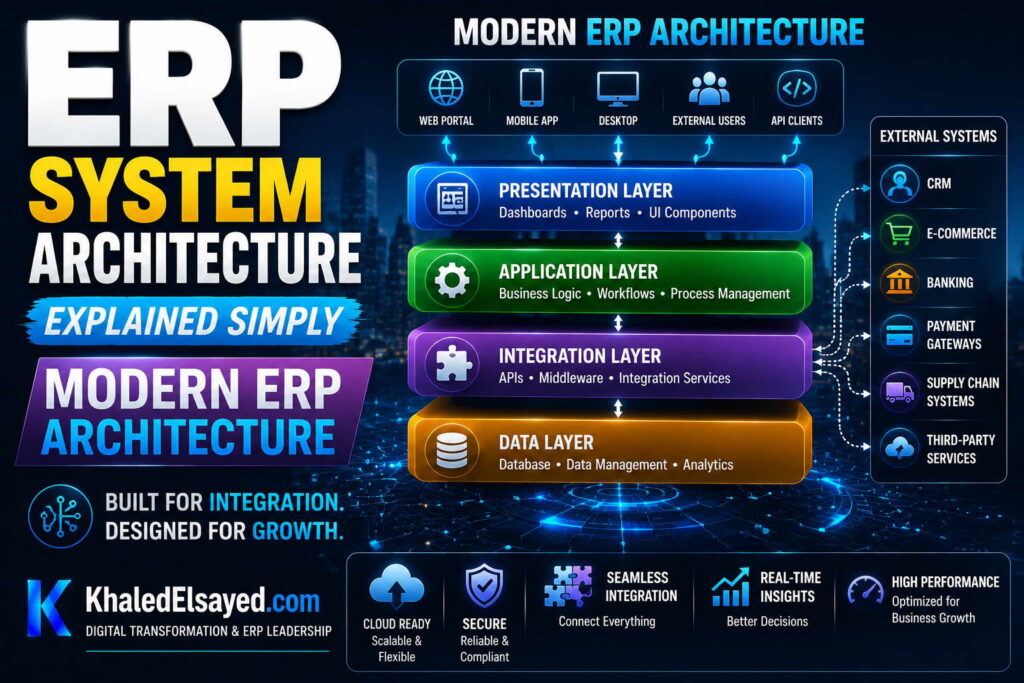
In my years leading digital transformation across enterprise IT environments, ERP architecture has evolved dramatically from monolithic on-premise systems to cloud-native, headless, and event-driven designs. Understanding erp architecture trends is essential for making decisions that won’t be obsolete in 3-5 years. This guide explores modern erp system design patterns, providing an erp system architecture diagram explained for contemporary enterprise systems, covering erp structure innovations.
The Shift from Monolithic to Composable ERP
Traditional erp architecture was monolithic—all modules (finance, inventory, manufacturing, HR) in a single codebase, deployed together, upgraded together. Modern ERP is moving toward composable architecture: independent services that can be selected, deployed, and upgraded independently. From my experience, composable ERP reduces upgrade risk (upgrade one service without touching others), enables best-of-breed (choose best inventory service, best finance service), and accelerates innovation (update one service without full regression testing).
Composable ERP structure: Core services (finance, inventory, order management) that are always required. Extension services (CRM, WMS, project accounting) that can be added as needed. Integration services (API gateway, message queue) that connect everything. The erp system design principle: small, independent services over large, tightly coupled monolith.
Implementation consideration: Composable ERP requires mature integration capabilities. Organizations without API management, message queues, and distributed transaction patterns should not attempt composable. For most mid-market organizations, modular monolithic (single vendor, integrated modules) is the right balance.
Headless ERP Architecture
Headless ERP separates the backend (business logic, data) from the frontend (user interface). The backend exposes APIs; any frontend can consume them—web browser, mobile app, voice assistant, chatbot, customer portal, partner portal. From my technical assessments, headless architecture enables organizations to maintain a stable ERP core while continuously innovating user experiences.
Headless ERP structure: Backend: ERP core (finance, inventory, order management) with REST/GraphQL APIs. Frontend(s): Admin dashboard (React), mobile app (React Native), customer portal (Vue.js), partner portal (Angular), chatbot (custom UI). API gateway authenticates, rate-limits, routes requests from all frontends.
Real-world example: A retailer needs custom customer portal for B2B clients. Headless ERP: backend unchanged, frontend team builds portal using ERP APIs in 6 weeks. Without headless, custom portal requires ERP modification—12 weeks and future upgrade burden.
Implementation consideration: Headless adds complexity—multiple frontends to maintain, API versioning, additional testing. For organizations with single user interface (web browser only), headless is over-engineering. For organizations with multiple interfaces (admin, mobile, customer portal, partner portal), headless reduces long-term maintenance.
Event-Driven ERP Architecture
Event-driven ERP reacts to business events in real-time instead of requiring user action or batch processing. Events: order placed, inventory low, invoice overdue, shipment delayed. When event occurs, ERP triggers automated responses. From my experience, event-driven architecture enables real-time business processes that were previously impossible with batch processing.
Event-driven ERP structure: Event sources (sales order entry, inventory system, payment gateway). Event bus (message queue—Kafka, RabbitMQ, AWS SQS). Event consumers (ERP modules, external systems, notification services). Event storage (event log for audit).
Real-world example: Inventory falls below reorder point. Event-driven flow: inventory system publishes “InventoryLow” event (SKU A-123, current stock 45, reorder point 100). Event bus delivers event to procurement service. Procurement service automatically creates purchase requisition (500 units, standard vendor). Requisition approved automatically (under $5,000). Purchase order sent to vendor via EDI. Inventory manager receives notification: “PO-12345 created for SKU A-123.” Total time: seconds.
Implementation consideration: Event-driven architecture requires designing for eventual consistency. When inventory event published, inventory count may be temporarily inaccurate. For most business processes, seconds of inconsistency acceptable. For financial transactions requiring immediate consistency, synchronous API patterns still needed.
Multi-Tenant vs Single-Tenant Cloud Architecture
Multi-tenant architecture: All customers share same software instance, database schema logically separated by tenant ID. Advantages: lower cost (vendor amortizes development across all customers), automatic upgrades (all customers on same version), faster innovation (vendor releases once for all). Disadvantages: limited customization (cannot modify core schema), potential performance interference (“noisy neighbor”). Best for: most mid-market organizations.
Single-tenant architecture: Each customer gets dedicated software instance, possibly dedicated database. Advantages: complete customization (any schema modification), no performance interference, data isolation. Disadvantages: higher cost (vendor must maintain multiple code lines), slower upgrades (each customer upgraded separately), slower innovation (vendor must backport fixes). Best for: enterprises with compliance requirements or extreme customization needs.
From my experience, multi-tenant cloud ERP is the right choice for 80 percent of organizations. The lower cost and faster innovation outweigh customization limitations for most businesses. Single-tenant only justified for regulated industries or organizations with true competitive advantage embedded in custom ERP logic.
Modern ERP Architecture Patterns Table
The following architecture patterns reflect current enterprise realities based on my implementation experience:
| Architecture Pattern | Key Characteristic | Best For | Complexity Level |
|---|---|---|---|
| Modular monolithic | Single vendor, integrated modules | Mid-market (80% of organizations) | Low |
| Composable | Independent services, best-of-breed | Enterprises with complex requirements | High |
| Headless | Backend APIs, multiple frontends | Organizations with multiple user interfaces | Medium-High |
| Event-driven | Real-time reactions to business events | High-volume, time-sensitive operations | High |
| Multi-tenant cloud | Shared instance, logical data isolation | Most mid-market organizations | Low (vendor managed) |
| Single-tenant cloud | Dedicated instance, complete isolation | Regulated industries, extreme customization | Medium |
Common Challenges and Solutions
Organizations face specific modern architecture challenges. Architecture over-engineering is the most common—implementing microservices, event-driven patterns, and headless when monolithic would suffice. The solution is starting simple; add complexity only when scale or requirements demand. Another challenge is skill gaps—modern patterns require API design, message queue management, distributed tracing. The solution is cloud-managed services (AWS, Azure) that abstract infrastructure complexity. A third challenge is debugging distributed systems—finding failure cause across multiple services is harder than monolithic debugging. The solution is distributed tracing (Jaeger, Zipkin) and centralized logging (ELK stack).
Best Practices from Real Implementations
Across my portfolio, several practices guide modern architecture adoption. Start modular monolithic—add composability when integration complexity demands. Use cloud-managed services for event bus, API gateway—reduces operational burden. Implement distributed tracing before first microservice—debugging without it is impossible. Design APIs for idempotency—same request processed twice produces same result. Finally, monitor event bus depth—growing queue indicates downstream bottleneck.
Frequently Asked Questions
What is the difference between monolithic and modern ERP architecture?
Monolithic erp architecture houses all modules in a single codebase—deployed together, upgraded together, scaled together. Modern ERP architecture uses composable, headless, and event-driven patterns—independent services, separate frontends/backends, real-time event reactions. From my experience, monolithic remains appropriate for organizations under $500M revenue; modern patterns benefit enterprises with complex requirements, multiple interfaces, or real-time processing needs. The erp structure decision should be driven by actual requirements—not chasing trends.
Is composable ERP the future?
Composable ERP—selecting best-of-breed services for each function—is the future for enterprises with complex, unique requirements. However, for most mid-market organizations, modular monolithic (single vendor, integrated modules) remains the right choice. Composable introduces integration complexity, distributed transaction challenges, and multiple vendor management. From my experience, organizations that attempt composable without mature integration capabilities end up with integration spaghetti. Start modular monolithic; evolve to composable when integration demands justify the complexity.
How does event-driven ERP handle data consistency?
Event-driven ERP uses eventual consistency, not ACID transactions. When an order is placed, the “OrderPlaced” event is published. Inventory service consumes event and reserves stock—this happens milliseconds later. For most business processes, this delay is acceptable. For financial transactions requiring immediate consistency (e.g., payment and order creation must both succeed or both fail), synchronous API patterns are still needed. The erp system design should use event-driven for non-critical latency (notifications, analytics, inventory updates) and synchronous for critical transactions (payments, order creation).
Meta Title: Modern ERP Architecture: Composable, Headless, Event-Driven | Khaled Sqawa
Meta Description: Modern ERP architecture explained by digital transformation expert Khaled Elsayed Sqawa. Learn composable, headless, event-driven, and multi-tenant vs single-tenant cloud patterns.
Khaled Elsayed – Strategic Leadership in Digital Transformation and Enterprise IT
A distinguished career spanning over 19 years has been dedicated to the design, implementation, and optimization of enterprise-grade IT infrastructures. This professional journey is defined by a consistent commitment to leveraging technology as a fundamental driver of organizational efficiency and scalable growth.
Currently, the position of Digital Transformation and Information Technology Manager is held, with a focus on spearheading strategic initiatives to modernize technological foundations and strengthen data security frameworks. Responsibilities in this capacity include the oversight of integrated ERP system deployments, the formulation of comprehensive IT policies, and the management of departmental budgets and procurement processes.
Prior to the current engagement, several senior leadership roles were occupied, including Group IT Section Head and IT Section Head. During these tenures, successful large-scale infrastructure upgrades were led, and business continuity frameworks were implemented to ensure uninterrupted operational performance. Expertise has been consistently demonstrated in aligning IT strategies with overarching business objectives while leading high-performing technical teams.
The academic foundation consists of a Bachelor’s degree in Information Systems. This is further reinforced by an extensive portfolio of international professional certifications, including:
- MCSA (Microsoft Certified Systems Administrator).
- Dynamic Specialist (Microsoft Certified Business Management Solutions Specialist).
- Google Certified Project Management Professional.
- SAP Technology Consultant.
- Oracle Cloud Infrastructure Architect Professional.
- Google Certified Cybersecurity Professional.
- ServiceNow IT Leadership Professional Certificate by LinkedIn Learning.
- Succeeding as a Senior Manager Professional Certificate by LinkedIn Learning.
- IT Service Management ISO20000 by LinkedIn Learning.
- Google Certified IT Support Professional.
The leadership philosophy remains centered on continuous improvement, integrity, and the transformation of complex technical visions into functional digital realities that empower the modern enterprise.
Khaled Elsayed
خالد السيد
www.khaledelsayed.com
|
linkedin.com/in/khaled-elsayed-it

is deltek an erp system, is deltek costpoint an erp system, erp deltek, erp system deltek, erp software deltek, is cin7 an erp, is cin7 core an erp, erp cin7, erp system cin7, erp brightpearl, brightpearl erp, what is focus erp, m focus erp, got focus erp, focus erp, focus erp software, focus erp system, focus erp login, focus erp 9, focus erp 9 login, focus erp price, focus erp careers, focus erp api, focus erp jobs uae, erp apache ofbiz, apache ofbiz vs erpnext, apache ofbiz erp, que es tryton erp, tryton erp, erp tryton, erpnext vs tryton, dolibarr erp y crm, telecharger dolibarr erp crm, dolibarr erp system & crm, download dolibarr erp crm, dolibarr erp crm, ai for dolibarr erp crm, dolibarr erp crm free download, dolibarr erp crm open source, dolibarr erp crm github, dolibarr erp crm demo, dolibarr erp crm download, dolibarr erp crm free, dolibarr erp crm files, 3 dolibarr erp crm, what is syspro erp, syspro erp system, is syspro an erp system, is syspro a good erp, syspro erp, erp syspro, erp system syspro, enterprise asset management syspro, erp software syspro, what is qad erp, what does qad erp stand for, who owns qad erp, what is qad erp software, qad erp system wiki, what is qad adaptive erp, what is erp in radio, qad full form in erp, que es qad erp, is qad erp, full form of qad erp, companies using qad erp, qad erp, qad erp system, qad erp software, qad erp vs sap, qad erp meaning, qad erp jobs, qad erp logo, qad erp training, qad erp modules, qad erp api, z erp, what is plex erp, plex erp vs sap, plex erp vs netsuite, verpex reseller, vlex erp, plex erp training videos, erpnext translation, sistema plex erp, rockwell plex erp, rockwell automation plex erp, que es plex erp, erp opening hours, erp 2.0 charges, hva er erp system, erpcloud.systems, plex online erp, plex erp odbc, who owns plex erp, what is oracle fusion erp, is plex erp, plex erp integration, what is plex erp system, erp software erp system examples, erp system examples, erp list of software, erp software examples, ix erp, how much does plex erp cost, erp egec, erp plus, plex erp cost, plex cloud erp, plex erp consultant, plex erp community, plex erp careers, plex erp competitors, plex manufacturing cloud erp, plex erp certification, plex erp customers, erp account manager jobs, plex erp, plex erp system, plex erp software, plex erp login, plex erp jobs, plex erp training, plex erp logo, plex erp tutorial, apex erp, apex erp system, apex erp login, apex erp software, is plex an erp system, plex erp api, plex erp api documentation, plex erp mobile app, plex erp ai, plex erp app, what is sap business one erp, use perpetual inventory in sap business one, sap erp vs sap business one, que es erp sap business one, is sap business one an erp, erp sap business one, erpnext vs sap business one, erp system sap business one, what is sage x3 erp, sage x3 erp, is sage x3 an erp system, erp sage x3, erp system sage x3, what is acumatica erp, is acumatica an erp, is acumatica a good erp, erp acumatica, erp system acumatica, zoho erp vs zoho one, zoho erp zoho one, erp zoho one, erpnext vs zoho one, zoho vs erpnext, zerodha erpnext, zatca erpnext, zkteco erpnext, zapier erpnext, zkteco integration with erpnext, youtube erpnext, your complete resource for erpnext, xero vs erpnext, what is erpnext software, what is erpnext developer, what is frappe erpnext, workflow erpnext, webshop erpnext, woocommerce erpnext, what is doctype in erpnext, whatsapp integration with erpnext, what is the latest version of erpnext, woocommerce erpnext integration, valuation rate in erpnext, version 16 erpnext, union erpnext, update erpnext, udemy erpnext, upgrade erpnext 15 to 16, upgrade erpnext 14 to 15, tally to erpnext, tally to erpnext migration, tally integration with erpnext, tutorial erpnext, tally vs erpnext, tryton vs erpnext, theme erpnext, stock reconciliation erpnext, sap vs erpnext, self host erpnext, subcontracting in erpnext, setup erpnext, sales order erpnext, shopify erpnext integration, sales invoice erpnext, raven erpnext, reddit erpnext, rest api erpnext, role permission manager erpnext, reset erpnext to default, report builder erpnext, reports in erpnext, restore erpnext backup, review erpnext, restaurant erpnext, quality inspection erpnext, quickbooks vs erpnext, quotation erpnext, quality inspection template erpnext, pos awesome erpnext 15, pos erpnext, erpnext pos awesome, pricing rule in erpnext, period closing voucher erpnext, print designer erpnext, payroll erpnext, purchase order erpnext, odoo vs erpnext, odoo erpnext, odoo vs erpnext reddit, odoo vs erpnext comparison, open source erpnext, opening balance in erpnext, odoo community vs erpnext, odoo erp vs erpnext, n8n erpnext, naming series in erpnext, n8n erpnext integration, notification in erpnext, netsuite vs erpnext, nextcloud erpnext, nestorbird erpnext, non profit erpnext, number card erpnext, no module named erpnext, manufacturing erpnext, material request erpnext, manufacturing module in erpnext, mint erpnext, mcp erpnext, modules in erpnext, material issue erpnext, learn erpnext, landed cost voucher erpnext, latest erpnext version, lms erpnext, logo erpnext, lead in erpnext, lending erpnext, karani erpnext, karani erpnext 15, erpnext egypt, journal entry erpnext, job card in erpnext, erpnext github, jan trade 25 erpnext com, erpnext download, erpnext pricing, install erpnext, india compliance erpnext, install erpnext 15 on ubuntu 24.04, is erpnext free, install erpnext 15 on ubuntu 22.04, install erpnext on ubuntu 24.04, install erpnext on ubuntu, install erpnext on windows, how to install erpnext, hrms erpnext, how to install erpnext on windows, how to install erpnext on ubuntu 24.04, how to use erpnext, how to install erpnext on ubuntu 22.04, healthcare erpnext, hr erpnext, github erpnext, github frappe erpnext, git erpnext, github erpnext docker, gst india compliance erpnext, getting started with erpnext, erpnext login, erpnext demo, frappe erpnext, frappe erpnext github, frappe erpnext documentation, frappe erpnext docker, frappe erpnext login, frappe erpnext developer jobs, frappe school erpnext, frappe erpnext installation, education module in erpnext, enable developer mode in erpnext, education erpnext, expense claim in erpnext, exchange rate revaluation erpnext, ecommerce erpnext, erp erpnext, ecommerce integration erpnext, e invoice erpnext, easy install erpnext, download erpnext, docs erpnext, demo erpnext, dolibarr vs erpnext, docker erpnext, download erpnext for windows, developer mode erpnext, docker frappe erpnext, code with karani erpnext 15, crm erpnext, cost center in erpnext, common party accounting erpnext, customize erpnext, coolify erpnext, chart of accounts erpnext, change erpnext logo, bitnami erpnext, bank reconciliation in erpnext, bom erpnext, blanket order erpnext, bench install erpnext, buying module in erpnext, backup erpnext, bench get app erpnext, erpnext, erpnext documentation, asset erpnext, api erpnext, accounting in erpnext, ai in erpnext, asset management erpnext, accounting module in erpnext, accounting dimension erpnext, asset module in erpnext, syspro erp photo, what is odoo erp, is odoo an erp, is odoo a erp system, github odoo enterprise, koperprijs, erp odoo, erpnext vs odoo, erp system odoo, erp software odoo, community vs enterprise odoo, what is epicor erp, what is epicor erp system, who owns epicor erp, what is epicor erp used for, what companies use epicor erp, sistema epicor erp, que es epicor erp, learn epicor erp, logo epicor erp, kinetic epicor erp, is epicor erp, is epicor erp cloud based, is epicor erp or mrp, how much is epicor erp, how to use epicor erp, harga epicor erp, eclipse epicor erp, download epicor erp, companies using epicor erp, cms epicor erp, epicor erp logo, epicor erp, apa itu epicor erp, epicor erp system, epicor erp software, epicor erp training, epicor erp jobs, epicor erp reviews, epicor erp pricing, epicor erp modules, epicor erp vs sap, what is ifs cloud erp, ifs cloud erp, erp ifs cloud, what is infor erp, who owns infor erp, what companies use infor erp, what does infor erp do, what is infor erp ln, what is infor erp engine, wat is infor erp, visual infor erp, tải phần mềm infor erp, sun infor erp, syteline infor erp, system infor erp, que es infor erp, phần mềm infor erp, phần mềm kế toán infoerp, ln infor erp, lawson infor erp, learn infor erp, logo infor erp, list of infor erp, is infor erp system, how much does infor erp cost, how to use infor erp, ferrari e infor erp, infor erp pricing, infor erp engine, companies that use infor erp, cloud infor erp, csi infor erp, baan infor erp ln jobs, baan infor erp, infor erp, infor erp system, infor erp software, infor erp vs sap, infor erp ln, infor erp reviews, infor erp products, infor erp jobs, ai for erp, ai for erp systems, ai for erpnext, is infor an erp system, is infor an erp, is infor a good erp system, infor erp api, is infor m3 an erp system, infor nexus erp, infor adage erp, what is oracle netsuite erp, que es oracle netsuite erp, oracle erp vs oracle netsuite, is oracle netsuite an erp, erp oracle netsuite, erp system oracle netsuite, erp systems sap oracle netsuite, difference between oracle netsuite and oracle erp, oracle netsuite erp, what is microsoft dynamics 365 erp, ultimate microsoft dynamics 365 crm for enterprises, oracle erp vs microsoft dynamics 365, is microsoft dynamics 365 an erp, microsoft dynamics 365 erp, erp microsoft dynamics 365, erp system microsoft dynamics 365, erp microsoft dynamics 365 business central, erp microsoft dynamics 365 login, erp software microsoft dynamics 365, microsoft dynamics 365 finance and operations erp, erp microsoft dynamics 365 price, you are configuring an oracle erp cloud adapter, what is oracle erp cloud, what is oracle erp cloud financials, securing oracle erp cloud, sap oracle erp cloud, rest api oracle erp cloud, que es oracle erp cloud, package consultant oracle erp cloud financials, oracle netsuite vs oracle erp cloud, oracle netsuite oracle erp cloud, oracle fusion vs oracle erp cloud, mulesoft oracle erp cloud connector, microsoft dynamics vs oracle erp cloud, modules in oracle erp cloud, logo oracle erp cloud, learn oracle erp cloud, latest oracle erp cloud version, is oracle erp cloud based, how to learn oracle erp cloud, free oracle erp cloud training, future of oracle erp cloud, oracle erp cloud adapter in oic, difference between oracle erp cloud and fusion, difference between oracle erp cloud and netsuite, consultant oracle erp cloud, business events in oracle erp cloud, oracle erp cloud jobs, avalara oracle erp cloud, oracle erp cloud, ai in oracle erp cloud, oracle erp cloud adapter, oracle erp cloud certification, oracle erp cloud logo, oracle erp cloud adapter capabilities, oracle erp cloud financials, oracle erp cloud training, oracle erp cloud modules, sap erp sap s 4hana, is sap s 4hana an erp system, erp sap s 4hana, erp system sap s 4hana, erpnext system, erpnext software, erpnext self hosted, erpnext setup, erpnext school, erpnext software download, erpnext software price, erpnext service providers, erpnext source code, erpnext support, erpnext git, erpnext github repo, erpnext guide, erpnext gst, erpnext germany, erpnext github docker, erpnext gst setup, erpnext getting started, erpnext crm, erpnext course, erpnext certification, erpnext cloud, erpnext customization, erpnext consultant, erpnext cloud pricing, erpnext careers, erpnext cost, erpnext company, erpnext v16, erpnext apps, erpnext api, erpnext accounting, erpnext api documentation, erpnext ai, erpnext alternative, erpnext ai integration, erpnext ai agent, erpnext accounting software, erpnext accounting module, odoo erp, infor erp logo, infor erp ln jobs, infor erp login, infor erp ln training pdf, erp infor, microsoft dynamics 365 erp youtube, deltekenterprise, costpoint deltekenterprise com, microsoft dynamics 365 vs oracle erp, https www deltekenterprise com, microsoft dynamics 365 is erp, microsoft dynamics 365 erp modules, microsoft dynamics 365 erp certification, microsoft dynamics 365 erp pricing, microsoft dynamics 365 erp training, microsoft dynamics 365 erp system, microsoft dynamics 365 erp course, oracle erp cloud vs netsuite, oracle erp cloud vs sap s 4hana, oracle erp cloud vs ebs, oracle erp cloud version, oracle erp cloud version history, oracle erp cloud vs peoplesoft, oracle erp cloud vs jd edwards, oracle erp cloud vs on premise, oracle erp cloud vs sap, oracle erp cloud fusion, oracle erp cloud vs fusion, is viewpoint vista an erp, viewpoint vista erp,