Odoo ERP Implementation Guide
In my years leading digital transformation across enterprise IT environments, I have witnessed ERP projects succeed and fail based not on software capability but on implementation discipline. The question of how to implement odoo erp step by step is one I encounter frequently from executives who have selected Odoo for its flexibility and cost-effectiveness. In this comprehensive odoo implementation guide, I will share the methodology I have refined across dozens of successful odoo system deployments, covering every aspect of odoo setup and erp deployment.
What is Odoo ERP Implementation?
Odoo implementation is the structured process of deploying the Odoo ERP system to support business operations. Unlike traditional erp deployment approaches that often require massive “big bang” migrations, Odoo’s modular architecture enables phased implementation. From my experience, the most successful odoo implementation projects follow a disciplined, step-by-step approach that balances speed with risk management.
The odoo setup process encompasses everything from initial requirements gathering to post-go-live support. Understanding how to implement odoo erp step by step is essential for executives, project managers, and IT leaders planning their ERP journey.
The Odoo Implementation Roadmap: A Step-by-Step Guide
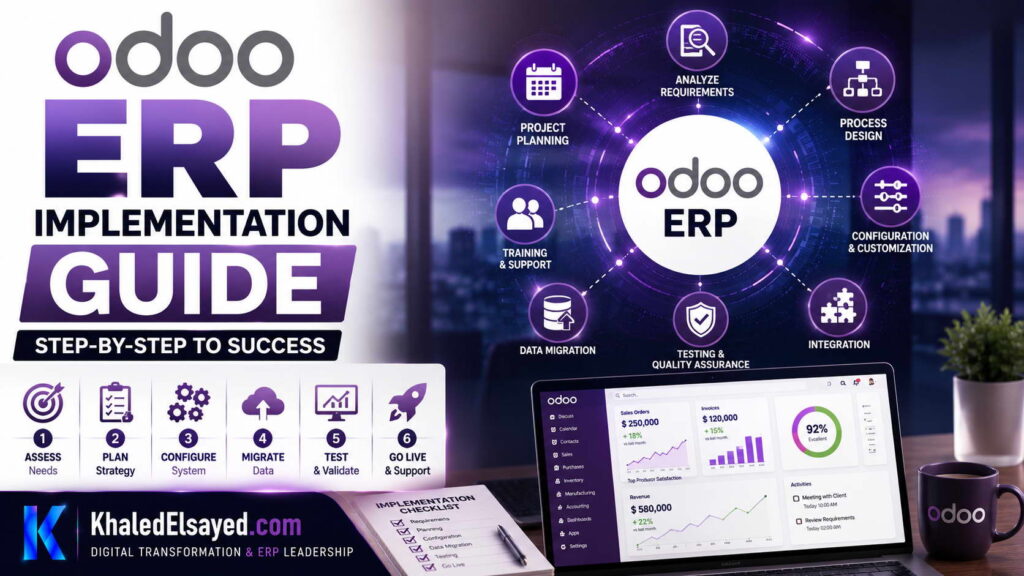
Based on my experience leading erp deployment projects across manufacturing, distribution, and services, I have refined a six-phase implementation methodology that consistently delivers results.
Phase 1: Discovery and Requirements (4-6 Weeks)
The discovery phase establishes the foundation for the entire odoo implementation. During this phase, I work with organizations to document current processes, identify pain points, and define requirements. This phase typically includes process mapping workshops with key stakeholders from each department.
Key activities include: documenting current business processes (as-is state), identifying pain points and inefficiencies, defining requirements and success criteria, mapping requirements to Odoo modules, and establishing the project governance structure.
From my experience, organizations that invest adequately in discovery achieve 80% faster implementations than those that skip this phase. The time spent understanding current processes pays dividends during configuration and testing.
Phase 2: Core Configuration (6-8 Weeks)
During the core configuration phase, I guide organizations through setting up the fundamental modules: accounting, sales, purchasing, and inventory. The key activities include: chart of accounts configuration, product catalog setup, customer and vendor master data creation, initial workflow configuration, and user role and security setup.
I recommend starting with these core modules because they form the operational backbone of most organizations. Once stabilized, additional modules can be added without disrupting operations. The odoo setup during this phase should prioritize configuration over customization—using Odoo’s extensive configuration options before resorting to code modifications.
Phase 3: Data Migration (4-6 Weeks)
Data migration is frequently underestimated in odoo implementation guides, but it is critical to success. The activities include: extracting data from legacy systems, cleansing data to remove duplicates and inconsistencies, transforming data to match Odoo’s data structure, loading transformed data into Odoo using import tools, and validating data accuracy.
I always advise running multiple test migrations before the final cutover. Each test migration reveals issues that can be addressed before the final migration, reducing the risk of data problems at go-live.
Phase 4: Testing and User Acceptance (4-6 Weeks)
Testing validates that the odoo system meets requirements and performs correctly. The activities include: unit testing of individual functions, integration testing of cross-module workflows, user acceptance testing with process owners, performance testing to verify system responsiveness under load, and security testing.
In my experience, user acceptance testing is where most issues are discovered. I recommend involving process owners from each department in this phase—they know the business processes better than anyone.
Phase 5: Go-Live and Hypercare (2-4 Weeks)
The go-live phase transitions the organization from legacy systems to Odoo. Activities include: final data migration, system activation, user go-live, and hypercare support with intensive assistance during the stabilization period.
I recommend scheduling go-live during a low-activity period to minimize business disruption. A well-planned erp deployment with adequate support typically results in 2-3 weeks of productivity dip, followed by steady improvement.
Phase 6: Optimization and Expansion (Ongoing)
Post-go-live, the focus shifts to optimization and expansion. Activities include: monitoring system performance, addressing user feedback, implementing additional modules as needs evolve, and conducting regular system reviews.
Implementation Timeline by Scope
The following table summarizes typical implementation timelines based on my experience:
| Scope | Modules | Timeline |
|---|---|---|
| Core financials | Accounting, Sales, Purchasing | 2-3 months |
| Core operations | Accounting, Sales, Purchasing, Inventory | 3-5 months |
| Full ERP | All modules | 6-9 months |
| Enterprise-wide rollout | Full ERP with customizations | 9-12 months |
Key Features of a Successful Odoo Implementation
Based on my observations across numerous odoo implementation projects, several features distinguish successful deployments from those that struggle.
Modular Implementation Approach: The ability to implement only the required modules and add more as needs evolve is not just a technical advantage but a risk management strategy. I have seen organizations avoid the complexity of full-scale implementations by starting with core financials and inventory, then expanding as they grow.
Strong Project Governance: Successful odoo implementation projects have clear governance structures with executive sponsorship, a dedicated project manager, and defined decision-making authority.
Comprehensive Training: User adoption is the single most important success factor. I recommend allocating 15-20% of the implementation budget to training and change management.
Common Challenges and Solutions in Odoo Implementation
Throughout my odoo implementation experience, I have encountered recurring challenges. Understanding these challenges in advance helps avoid them.
Challenge: Data Migration Complexity. Organizations underestimate the effort required to cleanse and migrate data from legacy systems. The solution is a structured data migration approach with multiple test cycles.
Challenge: User Adoption Resistance. Employees accustomed to familiar systems may resist the change. The solution is comprehensive training, identifying power users who can champion the system, and communicating the benefits clearly.
Challenge: Over-Customization. Excessive customization creates upgrade difficulties. The best practice is to configure rather than customize, using Odoo’s extensive configuration options before resorting to code modifications.
Best Practices from Real Odoo Implementations
Across my portfolio of odoo implementation projects, several practices consistently distinguish successful projects from those that struggle.
Start Small and Expand: Begin with core modules—typically sales, purchasing, inventory, and accounting. Stabilize these foundational processes before adding manufacturing, e-commerce, or other advanced modules.
Data Cleansing Before Migration: Cleanse data before moving it to Odoo. Legacy data with duplicates, inconsistencies, and incomplete records will create problems in the new system.
Engage Users Early: Involve end-users in the implementation process. Their input on workflows and preferences improves adoption and ensures the system supports actual business processes.
Use Configuration Before Customization: Odoo provides extensive configuration options—use them before considering custom code. Configuration is upgrade-safe; custom code creates upgrade debt.
Real-World Use Cases
Case Study: Wholesale Distributor A wholesale distributor with 5,000 SKUs and three warehouses implemented Odoo’s inventory, sales, and accounting modules. Within six months, they achieved 98% inventory accuracy, reduced stockouts by 60%, and cut order fulfillment time from 24 hours to 4 hours.
Case Study: Manufacturer A custom furniture manufacturer implemented Odoo’s manufacturing, inventory, and project modules. The MRP functionality reduced material shortages by 70%, and the project tracking capability improved on-time delivery from 78% to 95%.
My Professional Perspective on Odoo Implementation
When advising executives on how to implement odoo erp step by step, I emphasize that a successful odoo implementation is about discipline, not just technology. The most common mistake I encounter is underestimating the internal labor required. Organizations that allocate sufficient internal resources—project manager, process owners, testers—typically achieve 90% benefit realization within 12 months.
My strategic recommendation is to start with a clear business objective—reducing inventory, accelerating order fulfillment, or improving financial reporting—and select the modules that directly support that objective. Prove value with a focused implementation, then expand systematically.
Frequently Asked Questions
How long does Odoo implementation take?
Core implementation (finance, sales, purchasing, inventory): 3-5 months. Full ERP: 6-9 months. Complex implementations: 9-12 months. The timeline depends on scope, data quality, and organizational readiness.
How much does Odoo implementation cost?
Implementation costs typically range from $15,000 to $200,000+ depending on scope. Core modules: $15,000-$35,000. Full ERP: $35,000-$80,000. Complex implementations: $80,000-$200,000+.
Can Odoo be implemented without consultants?
Yes, but only for very simple deployments. Most organizations benefit from implementation partners who provide configuration expertise, data migration support, and training. The investment typically pays for itself through faster implementation and avoided rework.
What are the most common Odoo implementation mistakes?
Underestimating data migration effort, insufficient user training, over-customization, inadequate project governance, and insufficient internal labor allocation are the most common mistakes I encounter.
Conclusion
Understanding how to implement odoo erp step by step is essential for any organization planning an ERP deployment. The modular architecture, open-source foundation, and comprehensive functionality make Odoo suitable for organizations ranging from startups to established enterprises.
From my years of leading ERP implementations, I have found that the organizations that succeed with Odoo are those that view it not as a one-time project but as a platform for continuous improvement. The odoo system enables ongoing optimization as business needs evolve. My professional recommendation is to start with a focused implementation targeting your most critical business process, prove value, and expand systematically.
Meta Title: Odoo Implementation Guide: Step-by-Step Process 2026 | Khaled Sqawa
Meta Description: Odoo implementation guide by digital transformation expert Khaled Elsayed Sqawa. Learn how to implement Odoo ERP step by step with best practices and real-world insights.
Suggested Tags: Odoo Implementation, ERP Deployment, Odoo Setup, Odoo ERP, Implementation Guide
Khaled Elsayed Sqawa
I am Khaled Elsayed Sqawa, a Senior IT Manager, Digital Transformation Leader, and ERP Consultant with more than 19 years of experience in Information Technology, Digital Transformation, Enterprise Infrastructure, Cybersecurity, Cloud Computing, and ERP Systems.
Throughout my career, I have led large-scale technology initiatives across the FMCG, Manufacturing, Education, and Non-Profit sectors, helping organizations modernize their operations, optimize business processes, strengthen cybersecurity, and leverage technology as a strategic driver of growth and operational excellence.
My expertise covers Digital Transformation Strategy, ERP Implementation and Optimization, Enterprise Infrastructure Management, Cloud Architecture, Cybersecurity, IT Governance, Business Continuity, IT Service Management, Data Centers, Vendor Management, Budget Planning, Process Automation, and Technology Leadership. I have successfully implemented and managed Odoo ERP, Microsoft Dynamics, Microsoft Great Plains, Microsoft 365, Google Workspace, Oracle Cloud Infrastructure, Sophos Firewall, FortiGate Security Solutions, and enterprise network environments.
Currently, I serve as Digital Transformation and Information Technology Manager, where I lead ERP modernization, workflow automation, cybersecurity enhancement, infrastructure development, e-learning platforms, and organization-wide digital transformation initiatives. Throughout my professional journey, I have also held leadership positions including Group IT Section Head and IT Section Head, managing enterprise environments, multi-site operations, nationwide IT support services, infrastructure modernization programs, and business-critical technology projects.
I hold a Bachelor’s Degree in Information Systems and a broad portfolio of internationally recognized professional certifications, including:
• Oracle Cloud Infrastructure Architect Professional
• SAP Technology Consultant
• Google Project Management Professional Certificate
• Google Cybersecurity Professional Certificate
• Microsoft Certified Systems Administrator (MCSA)
• Microsoft Certified Business Management Solutions Specialist (Dynamics Specialist)
• ServiceNow IT Leadership Professional Certificate
• Succeeding as a Senior Manager Professional Certificate
• IT Service Management ISO 20000 Professional Certificate
• Google IT Support Professional Certificate
• ITIL 4 Foundation (Self Study)
I believe that technology should not merely support business operations—it should transform them. My mission is to bridge the gap between business objectives and technology capabilities, enabling organizations to achieve sustainable growth, operational excellence, digital resilience, and long-term success.
Khaled Elsayed Sqawa
خالد السيد سقاوة
Senior IT Manager | Digital Transformation Leader | ERP Consultant | Cloud & Infrastructure Architect
Website: https://www.khaledelsayed.com
LinkedIn: https://www.linkedin.com/in/khaled-elsayed-it