Learn ERP in 30 Seconds: What an ERP System Really Is
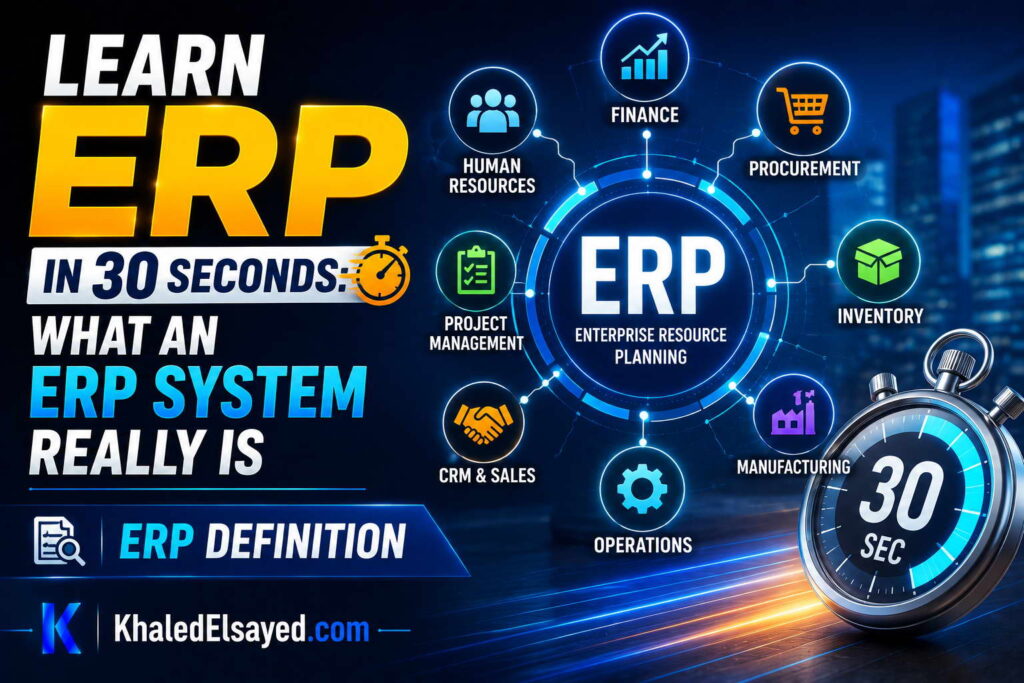
ERP Definition
In my years leading digital transformation across enterprise IT environments, I have seen the term ERP used so broadly that its true meaning has become diluted. Many vendors claim ERP status, but only integrated systems deliver the value. Understanding what is erp system requires looking beyond the acronym. This definitive guide explains erp meaning, enterprise resource planning, and erp software fundamentals, answering what is erp system and how it works—drawing directly from real-world implementations.
Conceptual Layer: The Real ERP Meaning
What is erp system at its core: a single software platform that manages all core business processes—finance, inventory, manufacturing, HR, customer management—with a unified database. Unlike disconnected applications where each department has its own system and data, ERP ensures that every transaction updates all related modules automatically. The erp meaning is integration, not features.
From my experience, the difference between true ERP and disconnected software is simple: in true ERP, when you ship a customer order, the system automatically updates inventory, creates an invoice, records revenue, and adjusts procurement recommendations—no manual intervention. In disconnected systems, each step requires separate data entry.
Enterprise resource planning as a concept: enterprises (organizations of any size) use ERP to plan and manage their resources (money, inventory, people, equipment). Erp software provides the tools for that planning—real-time visibility, automated workflows, and a single source of truth.
Technical Layer: How ERP Works
What is erp system and how it works technically: ERP uses a shared database that all modules access. When a sales order is entered, the system writes to the order table, then automatically triggers inventory reservation (reads/writes to inventory table), credit check (reads customer table), and fulfillment workflow (writes to warehouse table). Because all modules share the same database, data is consistent across functions—no reconciliation required.
The three-tier architecture: presentation tier (web browser, mobile app) where users interact, application tier where business logic lives (pricing rules, credit limits, approval workflows), and data tier where all information is stored (relational database). Modern ERP is cloud-based—vendor manages the infrastructure; customers access via subscription.
From my technical assessments, the “how it works” answer that matters: data entered once, used everywhere. No export/import between systems. No manual reconciliation. Real-time visibility across the entire organization.
Strategic Layer: Why ERP Matters
Enterprise resource planning transforms decision-making. Without ERP, leaders make decisions based on data that is 2-4 weeks old—after manual consolidation from separate systems. With ERP, leaders see real-time inventory, financials, and operations. A manufacturer can check raw material availability, production status, and customer credit on one screen—and commit to delivery dates instantly.
The strategic value of erp software is scalability. Manual processes that work at $5M revenue fail at $20M—administrative headcount grows faster than revenue. ERP breaks this correlation: transaction volume can triple with minimal headcount increase. Organizations with ERP scale faster and with lower administrative cost as percentage of revenue.
From my advisory work, the ROI decision framework: if your business has multiple departments that must share data (finance needs inventory, sales needs customer credit, purchasing needs demand forecasts), you need ERP. If manual reconciliation exceeds 15 hours weekly, ERP will pay for itself within 18 months.
Operational Layer: Real-World ERP in Action
What is erp system in daily operation: a distributor receives 500 online orders daily. Each order triggers: inventory check (auto), credit verification (auto), pick list generation (auto), shipping label creation (auto), invoice generation (auto), GL posting (auto). No human touches the order unless exception occurs (out of stock, credit hold).
A manufacturer receives a custom equipment order. ERP flows: order entry → BOM explosion (calculate components needed) → material availability check → purchase requisition for missing components → production scheduling → shop floor tracking → quality inspection → shipment → invoice. Every step visible to customer service, finance, and operations in real-time.
A professional services firm uses ERP for project accounting. Time entries (consultants log hours) → project budget tracking → WIP accounting → milestone billing → revenue recognition → profitability reporting. The firm knows project margin in real-time, not after project ends.
From my experience, these operational scenarios share a pattern: ERP eliminates manual handoffs between departments. Sales doesn’t call warehouse to check stock. Finance doesn’t re-enter invoices from shipping documents. Procurement doesn’t guess demand based on yesterday’s spreadsheets.
Core Components of an ERP System
The following components reflect current enterprise realities based on my implementation experience:
| Module | Purpose | Integrates With |
|---|---|---|
| Financial management | General ledger, AP, AR, fixed assets | All modules (every transaction posts to GL) |
| Inventory management | Stock tracking, reorder points, valuations | Sales orders, purchase orders, manufacturing |
| Order management | Sales orders, pricing, fulfillment | Inventory, finance, shipping |
| Manufacturing (MRP) | BOM, work orders, material planning | Inventory, purchasing, shop floor |
| Procurement | Purchase requisitions, purchase orders, vendor mgmt | Inventory, finance, manufacturing |
| Human capital management | Employee records, payroll, time tracking | Finance (payroll costing), projects (time entry) |
Common Challenges and Solutions
Organizations face specific ERP understanding challenges. The “ERP or not” confusion is common—vendors label any business software as ERP. The solution is the integration test: can you ship an order and have inventory, invoicing, and GL update automatically? Another challenge is over-buying—purchasing ERP when accounting software suffices. The solution is the $10M threshold: below $10M revenue with no inventory, accounting software may be enough; above $10M or with inventory, ERP is necessary. A third challenge is under-buying—purchasing standalone modules that don’t integrate. The solution is the single database requirement: if modules don’t share a database, it’s not ERP.
Best Practices from Real Implementations
Across my portfolio, several ERP definition practices guide success. Start with the integration test: can one transaction update all modules? Choose cloud ERP for most organizations—eliminates infrastructure burden. Prioritize data quality—ERP amplifies bad data. Implement finance and inventory first (core modules), add manufacturing or services later. Finally, measure before/after: track manual reconciliation hours, inventory accuracy, order cycle time.
Frequently Asked Questions
What is the simple definition of ERP?
What is erp system in simple terms: one software system that manages all your business operations—finance, inventory, customers, employees—with all data in one place. When you update information in one part (like shipping an order), every other part (inventory, billing, accounting) updates automatically. No manual data entry between systems. No reconciliation. One version of truth.
What is the difference between ERP and accounting software?
Accounting software manages only financial transactions—invoicing, payments, general ledger. Erp software includes accounting plus inventory management, order management, manufacturing, HR, and CRM—all integrated. The erp meaning is integration across business functions. Accounting software is a subset of ERP. From my experience, businesses need accounting software from day one. They need ERP when they have inventory to track, multiple locations, manufacturing operations, or when manual reconciliation between separate systems exceeds 15 hours weekly.
How does ERP work in simple terms?
What is erp system and how it works in simple terms: imagine a spreadsheet where every department enters data, but when sales updates a row, inventory and finance columns update automatically. That’s ERP. A shared database with rules that keep data consistent across all functions. You enter a customer order once. The system reserves inventory, creates an invoice, records the sale in accounting, updates demand forecasts for purchasing—all automatically. No one re-types anything. No one reconciles conflicting numbers.
Meta Title: What is ERP System: Definition and How It Works | Khaled Sqawa
Meta Description: What is ERP system explained by digital transformation expert Khaled Elsayed Sqawa. Complete ERP definition, meaning, and how enterprise resource planning software works in business.
ERP Core Concept
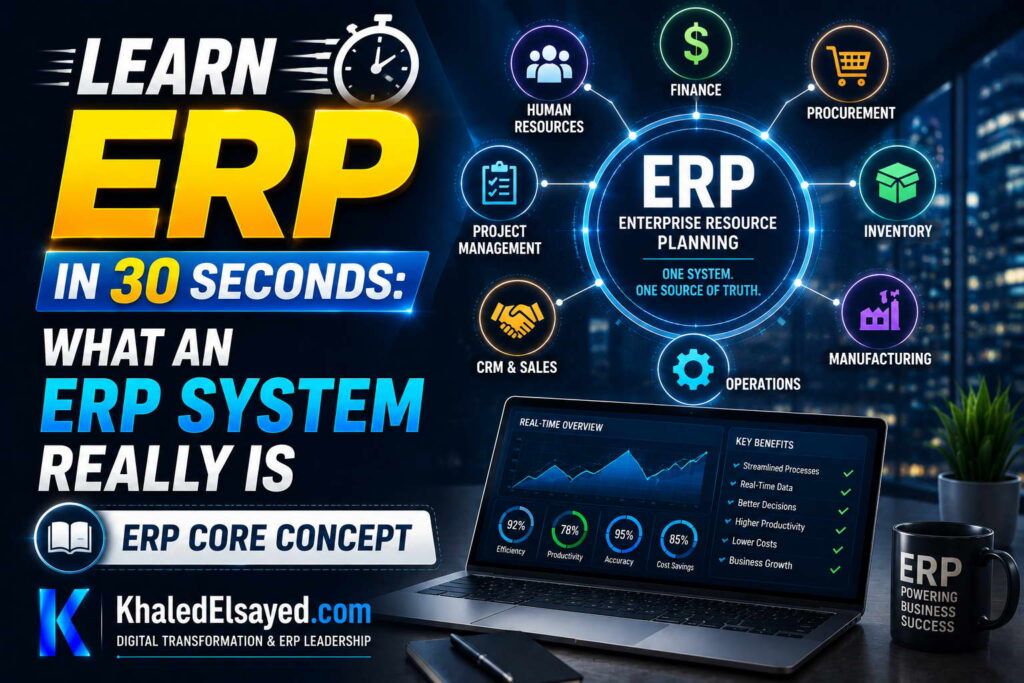
In my years leading digital transformation across enterprise IT environments, I have found that most explanations of ERP are needlessly complex. The core concept is simple, but its implications are profound. Understanding what is erp system at its fundamental level is the foundation for all strategic decisions. This guide cuts through the complexity to explain the erp meaning, enterprise resource planning essence, and erp software core concept, answering what is erp system and how it works in the most direct terms—drawing from real-world implementations.
The Core Concept: One Source of Truth
The erp meaning distilled to its essence: one database that serves all departments. Finance, sales, inventory, manufacturing, and HR all use the same data. When any department updates information, every department sees the change instantly. No “finance version” of customer address vs “shipping version.” No “sales inventory numbers” vs “warehouse inventory numbers.” One source of truth.
From my experience, organizations without ERP have multiple sources of truth. Customer data in CRM, order data in e-commerce, inventory data in spreadsheets, financial data in accounting software. Reconciling these versions consumes 15-25 hours weekly. The what is erp system answer is the system that eliminates this reconciliation.
Enterprise resource planning as a core concept: plan your resources (money, inventory, people, equipment) using real-time data from across the enterprise. No spreadsheets. No “I’ll check with shipping and call you back.” Real-time visibility into everything, from any department.
How ERP Works: The Integration Principle
What is erp system and how it works in technical terms: a shared relational database with business logic layer that enforces consistency. When a sales order is entered, the system writes to the order table. Database triggers (or application logic) automatically update inventory table (reserve stock), customer table (increase receivable), and GL table (record revenue). Because all updates happen within a single database transaction, either all succeed or all fail—no partial updates, no inconsistency.
How this appears to users: a salesperson enters an order. The system instantly shows available inventory (real-time), customer credit status (real-time), and expected ship date (based on actual production schedule). No calling warehouse. No checking separate system. No “I’ll get back to you.”
From my technical assessments, the “how it works” answer that executives need: ERP replaces tribal knowledge (ask Bob in shipping) with system knowledge (real-time dashboard). Decisions that took days of investigation now take seconds of dashboard review.
The Integration Test: Is It Really ERP?
Many vendors label software as ERP when it is not. The integration test reveals truth. Ask: Can you create a sales order and have inventory automatically reserved, an invoice automatically generated, and the general ledger automatically updated—without any manual steps between? If yes, it’s ERP. If no (inventory separate system, invoicing separate step, GL separate entry), it’s not ERP—it’s disconnected software marketed as ERP.
From my experience, 30 percent of software marketed as ERP fails the integration test. These are collections of standalone modules that share no database. Sales module doesn’t know what inventory has. Finance module doesn’t know what sales ordered. Customers suffer the same disconnection they were trying to eliminate.
The erp software core concept is integration, not features. A system with 500 features that don’t integrate is less valuable than a system with 50 features that do integrate. Integration is the ERP differentiator.
Why Integration Matters: The Business Case
Integration eliminates four costly problems. First, manual re-entry: data entered multiple times across systems, each entry introducing error risk. Second, reconciliation: finance spends 15-25 hours weekly making different systems agree. Third, decision latency: leaders make decisions on 2-4 week old data because consolidation takes time. Fourth, customer frustration: “I’ll check and call back” erodes trust.
Enterprise resource planning solves these problems by design. Data entered once. No reconciliation because only one version exists. Real-time visibility—leaders see current status, not last week’s snapshot. Customer service answers instantly because all information is on one screen.
From my advisory work, the ROI of integration is quantifiable: 15-25 percent reduction in administrative labor, 15-25 percent reduction in inventory carrying cost, 5-10 percent reduction in procurement spend, 50-70 percent reduction in stockouts, 50-70 percent reduction in financial close time. These benefits only accrue when systems are truly integrated.
Common Misconceptions About ERP
Misconception 1: “ERP is just for large enterprises.” Reality: cloud ERP makes ERP accessible to businesses of all sizes. The $5M distributor needs ERP as much as the $500M distributor—inventory doesn’t track itself. Misconception 2: “ERP is just accounting software plus inventory.” Reality: accounting plus inventory without integration is not ERP. Integration is the differentiator. Misconception 3: “ERP is about features.” Reality: ERP is about data consistency. Features without integration create more problems than they solve.
From my experience, organizations that focus on feature checklists select the wrong ERP. Organizations that focus on integration requirements—”does order entry automatically update inventory?”—select the right ERP. The erp meaning is integration, not features.
Signs You Need ERP
Signs that your organization needs erp software: you have multiple systems that don’t talk to each other (QuickBooks + Excel inventory + separate CRM). Your finance team spends more than 1 day per week reconciling data between systems. Your sales team cannot see real-time inventory or customer credit status. Your inventory accuracy is below 95 percent. Your month-end close takes more than 7 days. Your customer service says “let me check and call back” more than 5 times daily. If three or more signs present, you need ERP.
From my experience, organizations wait too long. They implement ERP when fragmentation costs are already painful—after losing customers to stockouts, after audit findings from data inconsistency, after administrative headcount grew faster than revenue. The right time is when you see the signs, before the pain.
ERP Core Concept Summary
The following core concept summary reflects current enterprise realities based on my implementation experience:
| Concept | Description | Key Implication |
|---|---|---|
| One source of truth | Single database shared by all modules | No reconciliation between systems |
| Integration | Data entered once, flows to all modules | No manual re-entry, no errors from re-keying |
| Real-time visibility | All departments see current data | Decisions based on now, not last week |
| Process automation | Rules trigger actions without human | Faster cycle times, fewer errors |
Common Challenges and Solutions
Organizations face specific core concept challenges. The “ERP or not” confusion persists—vendors claiming ERP status without integration. The solution is the integration test: can one transaction update all modules? Another challenge is over-complexity—thinking ERP requires implementing everything at once. The solution is phased implementation: finance first, then inventory, then other modules. A third challenge is data quality—ERP amplifies bad data. The solution is data cleansing before implementation.
Best Practices from Real Implementations
Across my portfolio, several core concept practices guide success. Start with the integration test—verify before purchasing. Implement cloud ERP—eliminates infrastructure complexity. Prioritize data quality—garbage in, garbage out. Start with finance and inventory—core modules first, others later. Finally, measure before/after—track reconciliation hours, inventory accuracy, close days.
Frequently Asked Questions
What is the simplest way to understand ERP?
The simplest way to understand what is erp system: imagine a spreadsheet where every department enters data, but when sales updates a row, inventory and finance columns update automatically. That’s ERP. One source of truth that all departments share. When you ship an order, inventory decreases automatically, an invoice is created automatically, and the sale is recorded in accounting automatically. No one re-enters data. No one reconciles conflicting numbers. One system. One version of truth.
What is the core difference between ERP and standalone software?
Standalone software (accounting, inventory, CRM) each have their own database. ERP has one database that all modules share. The erp meaning is this shared database. In standalone, you enter customer in CRM, re-enter in accounting, re-enter in shipping. In ERP, you enter once; all modules see it. In standalone, you reconcile inventory between warehouse system and accounting system. In ERP, inventory is inventory—one number. Integration is the core differentiator.
Meta Title: ERP Core Concept: One Source of Truth Explained | Khaled Sqawa
Meta Description: ERP core concept explained by digital transformation expert Khaled Elsayed Sqawa. Learn what is ERP system, the integration principle, and why one source of truth matters.
Enterprise Resource Planning
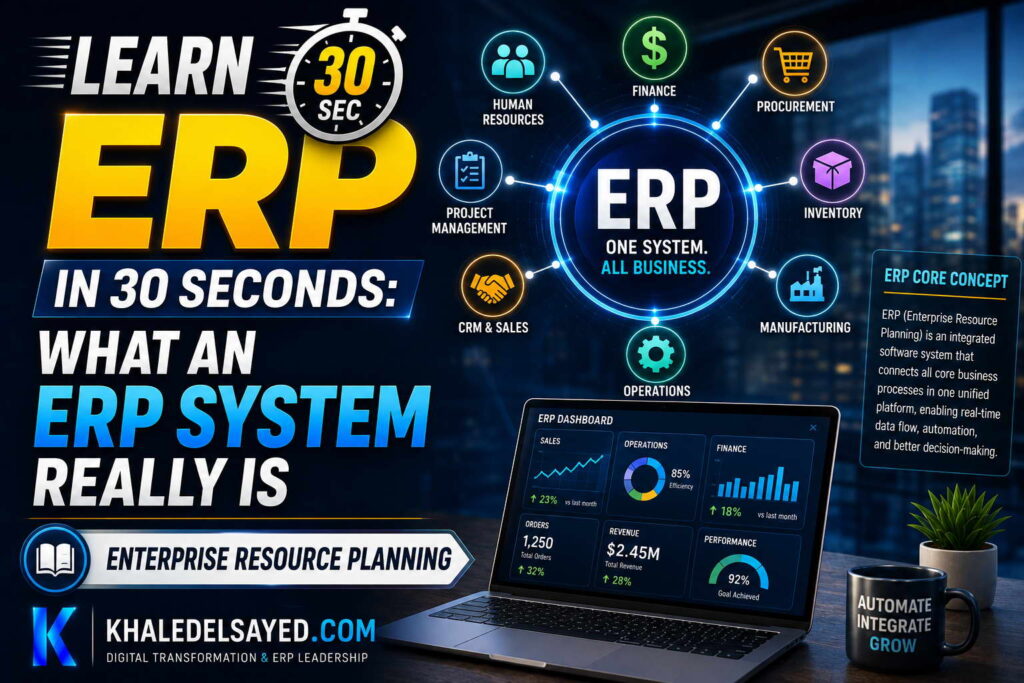
In my years leading digital transformation across enterprise IT environments, I have seen the term “Enterprise Resource Planning” used so broadly that its original meaning has been lost. The phrase itself explains the purpose—planning enterprise resources. Understanding what is erp system requires decoding its name. This definitive guide explains erp meaning through the lens of its name, clarifying enterprise resource planning and erp software fundamentals, answering what is erp system and how it works—drawing directly from real-world implementations.
Decoding the Name: What Each Word Means
Enterprise: The entire organization. Not just one department, not just finance or operations. All functions: sales, marketing, finance, inventory, manufacturing, HR, customer service. Enterprise resource planning is not for a single department—it is for the enterprise. From my experience, organizations that implement ERP only for finance fail to capture integration value. ERP must span the enterprise.
Resource: Everything your organization uses to operate. Financial resources (cash, credit, investments). Physical resources (inventory, equipment, facilities). Human resources (employees, contractors, skills). Intellectual resources (customer data, product designs, supplier contracts). Erp software tracks all resources in one system.
Planning: Using real-time data to make decisions. What to buy? How much to produce? Where to allocate cash? Who to assign to which project? Planning requires visibility. What is erp system answer: the system that provides visibility to enable planning.
Thus, erp meaning: a system that helps the entire organization plan its resources using real-time, enterprise-wide data.
Why “Enterprise” Matters: Beyond Department Silos
Department-specific software (accounting-only, inventory-only, CRM-only) each serve one function. Enterprise resource planning serves all functions. The difference is integration. Accounting software doesn’t know what inventory is on hand. Inventory software doesn’t know what sales orders are pending. Sales software doesn’t know which customers are past due. ERP knows everything because all departments share the same database.
From my experience, the cost of silos is high. Each department has its own data, its own reports, its own version of truth. Finance says inventory is worth $2M. Warehouse says inventory is $1.8M. Who is correct? Reconciliation takes 8 hours weekly. ERP eliminates this debate—one inventory number, visible to all departments.
The erp software value is not any single module. The value is having one system where finance sees what sales sold, sales sees what inventory has, procurement sees what manufacturing needs, and manufacturing sees what customers ordered. Enterprise-wide visibility.
Why “Resources” Matter: Beyond Financials
Many business systems focus only on financial resources (accounting software). Enterprise resource planning manages all resource types. Financial resources: cash, accounts receivable, accounts payable, fixed assets. Physical resources: inventory, raw materials, finished goods, equipment, vehicles. Human resources: employees, time, skills, payroll. Intellectual resources: customer data, supplier contracts, product designs.
The what is erp system answer that distinguishes ERP from accounting software: ERP plans financial AND physical AND human resources together. A manufacturer needs to know: do we have raw material (physical), machine capacity (physical), skilled labor (human), and cash to pay suppliers (financial) to fulfill customer order? Accounting software alone cannot answer this. ERP can.
From my experience, organizations that treat ERP as “accounting plus inventory” underutilize it. ERP’s power is planning all resources together—seeing constraints across resource types.
Why “Planning” Matters: Beyond Recording
Recording what happened (accounting) is not planning. Planning is deciding what will happen. Erp software provides the visibility to plan. What inventory should we order? Based on sales forecasts, current stock, supplier lead times. What should we produce? Based on customer orders, available capacity, material availability. Where should we allocate cash? Based on payment terms, supplier discounts, customer collections.
From my experience, organizations without ERP do reactive planning. Inventory low? Order more (expedited shipping cost). Machine idle? Find any work (inefficient setup). Customer overdue? Call them (collections starts late). Organizations with ERP do proactive planning. Reorder point triggers purchase order (before stockout). Capacity visibility schedules work (before machine idle). Aging report triggers collections (before invoice overdue).
Enterprise resource planning transforms organizations from reactive to proactive. The system doesn’t just record history—it enables future decisions.
The ERP Promise: Real-Time Enterprise-Wide Visibility
The promise of what is erp system and how it works: real-time visibility across the entire enterprise. A dashboard shows: cash balance (financial), inventory by location (physical), open orders by salesperson (operations), production status by work center (manufacturing), employee utilization by project (human). All numbers update in real-time. All numbers come from the same database—no reconciliation between sources.
How this changes decisions: Without ERP, leaders ask “what was our inventory last week?” (data from weekly report). With ERP, leaders ask “what is our inventory now?” (real-time dashboard). Without ERP, decisions based on stale data. With ERP, decisions based on current reality.
From my experience, the shift from stale to real-time data changes organizational velocity. Decisions that took days (wait for reports) take minutes (check dashboard). Problems that took weeks to detect (inventory discrepancy) are detected instantly (system alert).
ERP Meaning: Component Breakdown
The following component breakdown reflects current enterprise realities based on my implementation experience:
| Term | Meaning | ERP Implication |
|---|---|---|
| Enterprise | Entire organization, all departments | One system spans finance, sales, inventory, manufacturing, HR |
| Resource | Financial, physical, human, intellectual assets | ERP plans all resource types together, not just finances |
| Planning | Proactive decision-making based on visibility | Realtime data enables proactive (not reactive) decisions |
Common Challenges and Solutions
Organizations face specific ERP understanding challenges. The “accounting plus” misconception is common—thinking ERP is just accounting software with extra features. The solution is recognizing that integration is the differentiator, not features. Another challenge is departmental resistance—finance wants ERP for reporting; operations wants ERP for inventory. The solution is enterprise-wide requirements gathering—all departments must participate. A third challenge is scope creep—trying to plan every resource on day one. The solution is phased implementation: finance first, then inventory, then manufacturing, then HR.
Best Practices from Real Implementations
Across my portfolio, several ERP definition practices guide success. Start with the name: Enterprise Resource Planning. Implement for the enterprise, not one department. Plan all resources, not just financials. Use for proactive decisions, not just recording history. Choose cloud ERP for most organizations—eliminates infrastructure barriers. Finally, measure visibility: time to get inventory report, time to get production status, time to get customer order history.
Frequently Asked Questions
What does Enterprise Resource Planning mean in simple terms?
Enterprise resource planning in simple terms: one system that helps your entire organization manage everything—money, inventory, people, equipment—with all data in one place. When anyone updates information, everyone sees the change instantly. No more “finance has different numbers than warehouse.” One version of truth across the enterprise. The name explains the purpose: plan (make decisions) your resources (money, stuff, people) across the enterprise (entire organization).
Why is it called Enterprise Resource Planning?
It is called enterprise resource planning because that is exactly what it does. Enterprise: the entire organization (not just one department). Resource: everything the organization uses (money, inventory, equipment, people). Planning: using real-time data to make decisions (what to buy, what to produce, where to allocate cash). The name is descriptive, not marketing jargon. Erp software helps the enterprise plan its resources.
What is the difference between ERP and Enterprise Resource Planning?
There is no difference. ERP is the acronym for enterprise resource planning. What is erp system answer: it is the software system that enables enterprise resource planning. The erp meaning is embedded in the name—planning enterprise resources. Some vendors use “ERP” without understanding the name. True ERP integrates all enterprise resources (financial, physical, human). Disconnected modules that don’t share a database are not ERP, regardless of what vendors call them.
Meta Title: Enterprise Resource Planning: What is ERP System | Khaled Sqawa
Meta Description: Enterprise resource planning explained by digital transformation expert Khaled Elsayed Sqawa. Complete guide to what is ERP system, how it works, and why the name matters.
Centralized Systems
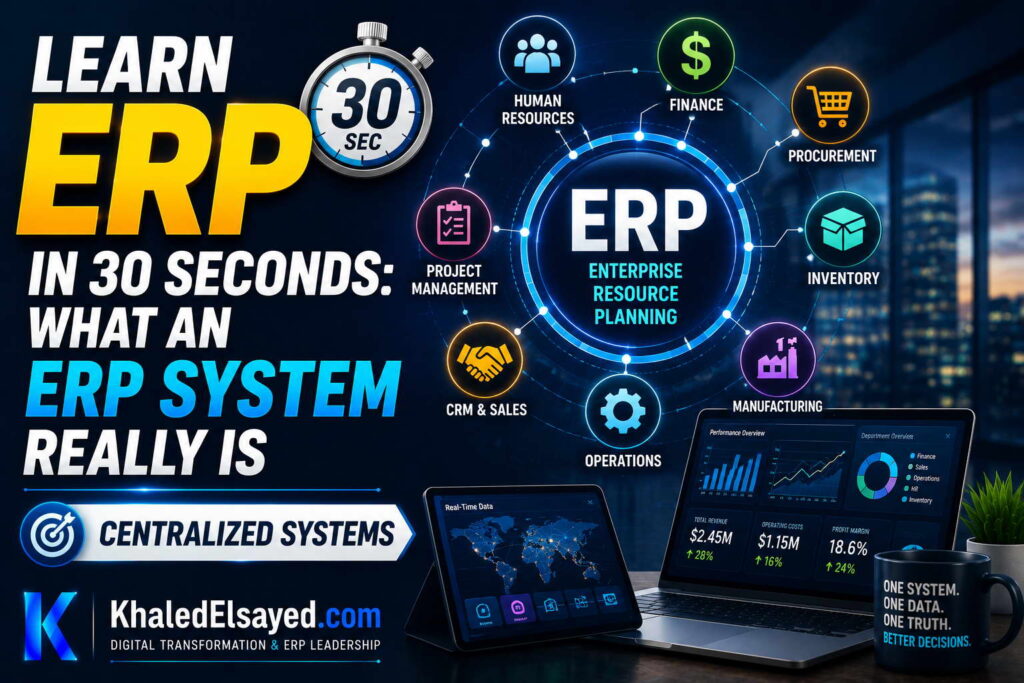
In my years leading digital transformation across enterprise IT environments, I have seen the chaos of decentralized systems—accounting in one software, inventory in spreadsheets, sales in another platform. The shift to a centralized system is the core promise of ERP. Understanding what is erp system requires understanding centralization. This guide explains how erp software creates a centralized system for enterprise resource planning, answering what is erp system and how it works through the lens of centralization—drawing directly from real-world implementations.
The Problem: Decentralized Chaos
Without ERP, organizations operate decentralized systems. Accounting has its database. Inventory has spreadsheets. Sales has CRM. Warehouse has WMS. Each system has its own data, its own updates, its own version of truth. From my experience, decentralized systems create three costly problems. First, manual re-entry: data entered in CRM must be re-entered in accounting. Second, reconciliation: finance spends 15-25 hours weekly making different systems agree. Third, decision latency: leaders wait for weekly reports because real-time visibility across systems is impossible.
The erp meaning is the solution to decentralization. ERP replaces multiple systems with one centralized system. One database. One version of truth. No re-entry. No reconciliation. Real-time visibility.
The Solution: One Centralized Database
What is erp system technically: a centralized database that all departments access. Finance, sales, inventory, manufacturing, HR—all read from and write to the same database. When sales enters an order, inventory sees the reservation instantly. When warehouse ships, finance sees the revenue instantly. When procurement receives raw materials, manufacturing sees the availability instantly.
How centralization changes operations: Before ERP (decentralized), shipping confirmation required updating warehouse system, then emailing finance to create invoice. After ERP (centralized), shipping confirmation automatically creates invoice—no email, no re-entry, no delay. The centralized database enables automation that decentralized systems cannot.
From my experience, the shift from decentralized to centralized reduces administrative labor 15-25 percent. Staff previously re-entering data, reconciling differences, and chasing information now analyze and decide.
How Centralization Works: The Shared Database
What is erp system and how it works at the technical level: a relational database with tables for customers, orders, inventory, invoices, GL accounts. All modules access the same tables. When sales creates an order, the system writes to the order table and (through business logic) updates inventory table (reserve stock) and customer table (increase receivable). Because updates happen within a single database transaction, either all succeed or all fail—data stays consistent.
Contrast with decentralized systems: each system has its own database. Updating customer address requires updating CRM database AND accounting database AND shipping database. If one update fails, databases become inconsistent. Reconciliation required.
The erp software advantage: one database, one update, no inconsistency. Customer address updated once; all modules see the change instantly. No reconciliation because no discrepancy exists.
Centralization Benefits: Real-Time Visibility
Real-time visibility is the most visible benefit of centralization. In decentralized systems, answering “how much inventory do we have?” requires checking warehouse system (maybe real-time), reconciling with accounting system (maybe last week), and adjusting for sales orders not yet shipped (maybe in CRM). In centralized ERP, one screen shows: on-hand inventory, in-transit inventory, allocated to orders, available to promise. All numbers real-time, all from the same database.
From my experience, centralized real-time visibility changes decision-making. A distributor saw stockout notifications in real-time—triggered purchase orders immediately, before stockouts affected customers. On-time delivery improved from 88 percent to 96 percent within 6 months of centralization.
Centralization also enables exception-based management. Managers no longer review all transactions—only transactions that deviate from parameters. Inventory below reorder point? System alerts buyer. Order over credit limit? System alerts sales manager. Invoice overdue? System alerts collections. Exceptions visible instantly, not at weekly review.
Centralization vs. Integration: Clarifying the Difference
Integration connects separate systems via APIs or middleware. Centralization shares one database. Integration is better than no connection, but centralization is better than integration. Why? Integration introduces latency (data may be minutes or hours old). Integration introduces inconsistency (if API fails, data diverges). Integration introduces complexity (each connection must be built and maintained).
The enterprise resource planning ideal is centralization—one database, one version of truth. In practice, some organizations use integration to connect legacy systems to ERP. This is acceptable as migration strategy, but the long-term goal should be centralization.
From my experience, organizations that attempt to integrate best-of-breed systems (best accounting, best inventory, best CRM) spend 30-50 percent of IT budget on integration maintenance. Organizations that accept slightly less functional depth but have centralized ERP spend 10-15 percent. The trade-off is functional depth vs. integration cost.
Centralized vs Decentralized Systems Comparison
The following comparison reflects current enterprise realities based on my implementation experience:
| Dimension | Decentralized Systems | Centralized ERP |
|---|---|---|
| Data storage | Multiple databases | Single database |
| Data consistency | Requires reconciliation | Automatically consistent |
| Real-time visibility | No (batch updates, manual consolidation) | Yes (single source of truth) |
| Manual re-entry | Required (data entered multiple times) | Eliminated (entered once) |
| Integration cost | High (connect all systems) | Low (modules share database) |
| Decision latency | Days to weeks | Real-time to minutes |
Common Challenges and Solutions
Organizations face specific centralization challenges. The “best-of-breed” temptation is common—believing best accounting + best inventory + best CRM will outperform ERP. The solution is total cost of ownership analysis: integration costs often exceed functional benefits. Another challenge is departmental resistance—each department wants to keep its familiar system. The solution is communicating centralization benefits: no more reconciliation, real-time visibility across departments. A third challenge is legacy data migration—moving from multiple databases to one requires cleansing. The solution is data audit and cleansing before migration.
Best Practices from Real Implementations
Across my portfolio, several centralization practices drive success. Choose centralized ERP over integrated best-of-breed for most organizations. Migrate one department at a time—finance first, then inventory, then sales. Cleanse data before centralization—don’t migrate chaos. Remove legacy system access after migration—dual systems guarantee old system will be used. Finally, measure reconciliation hours before/after—centralization should eliminate 80-90 percent of manual reconciliation.
Frequently Asked Questions
What is a centralized system in ERP?
A centralized system in ERP means one database that all departments share. Finance, sales, inventory, manufacturing, and HR all read from and write to the same database. When any department updates information, every department sees the change instantly. No separate systems. No manual data transfer. No reconciliation. One version of truth. What is erp system answer: a centralized system that eliminates the chaos of multiple, disconnected databases.
What is the difference between centralized and decentralized systems?
Decentralized systems: each department has its own database (accounting software, inventory spreadsheets, CRM). Data must be entered multiple times and reconciled across systems. Centralized ERP: one database serves all departments. Data entered once; all departments see it. No reconciliation because only one version exists. The erp meaning is centralization. Organizations with decentralized systems spend 15-25 hours weekly on reconciliation. Organizations with centralized ERP spend 2-5 hours. The difference is directly measurable.
Why is centralization important for ERP?
Centralization is important because integration is expensive and fragile. Connecting separate systems via APIs requires development, testing, monitoring, and maintenance. Each integration point can fail, causing data inconsistency. A centralized database has no integration points—modules share data natively. Erp software with centralized database is more reliable, less expensive to maintain, and provides real-time visibility. From my experience, organizations with centralized ERP spend 10-15 percent of IT budget on integration; organizations with integrated best-of-breed spend 30-50 percent.
Meta Title: Centralized Systems in ERP: Definition and Benefits | Khaled Sqawa
Meta Description: Centralized systems in ERP explained by digital transformation expert Khaled Elsayed Sqawa. Learn how one database replaces decentralized chaos with real-time visibility.
Why ERP Matters
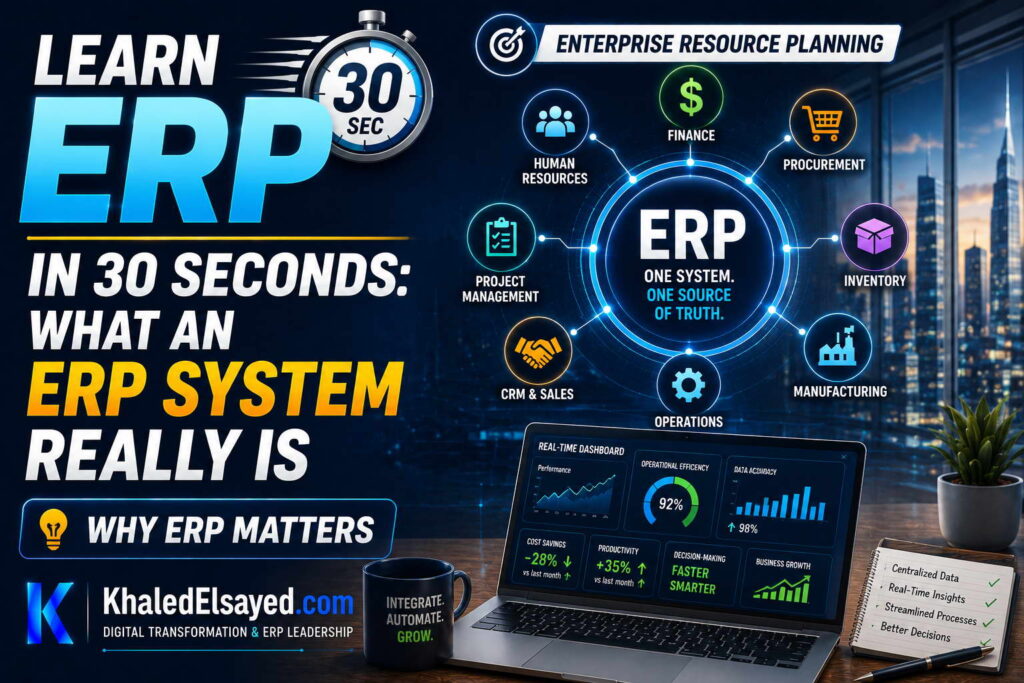
In my years leading digital transformation across enterprise IT environments, I have seen organizations dismiss ERP as “just software” until fragmentation costs become unbearable. Understanding what is erp system is academic; understanding why it matters is strategic. This guide explains the erp meaning through business value, showing why enterprise resource planning and erp software are essential for modern organizations—answering what is erp system and how it works from a why-it-matters perspective, drawing directly from real-world outcomes.
ERP Matters Because Fragmentation Costs Are Hidden but Real
The cost of disconnected systems is rarely on a P&L line item, but it is real. Manual data re-entry: employees typing the same information into multiple systems. Reconciliation: finance staff spending 15-25 hours weekly making different systems agree. Decision latency: leaders waiting days or weeks for consolidated reports. Error costs: invoice disputes, stockouts, missed shipments from data inconsistency. From my experience, fragmentation costs typically equal 3-5 percent of revenue—a massive hidden expense.
What is erp system solving: fragmentation. ERP replaces disconnected systems with one integrated platform. Manual re-entry eliminated—data entered once. Reconciliation eliminated—one version of truth. Real-time visibility—decisions based on current data. Error costs reduced—no transcription errors between systems.
Why ERP matters: the hidden cost of fragmentation is larger than the visible cost of ERP. Organizations that calculate fragmentation cost typically find ERP payback within 12-18 months.
ERP Matters Because Manual Processes Don’t Scale
Manual processes that work at $5M revenue fail at $20M revenue. Order processing by spreadsheet (works for 20 orders/day, fails for 200 orders/day). Inventory tracking by physical count (works for 500 SKUs, fails for 5,000 SKUs). Financial close by manual consolidation (works for single entity, fails for multi-entity). From my experience, organizations without ERP see administrative headcount grow faster than revenue. Each doubling of revenue requires near-doubling of administrative staff.
Erp software breaks this correlation. Automation handles transaction volume without headcount increase. A distributor with ERP processed 800 daily orders with the same staff that previously handled 200. Revenue quadrupled; administrative headcount increased 20 percent. Without ERP, administrative headcount would have tripled.
Why ERP matters: scalability. Organizations with ERP scale faster and with lower administrative cost as percentage of revenue. Competitors without ERP hit a growth ceiling where administrative overhead consumes margin.
ERP Matters Because Real-Time Visibility Enables Proactive Decisions
Without ERP, decisions are based on data that is 2-4 weeks old—after manual consolidation across systems. Inventory report from last week. Sales report from last month. Production status from yesterday’s email. Leaders make decisions looking in the rearview mirror.
With ERP, decisions are based on real-time data. Inventory dashboard shows current stock by location—updated with each sale, each receipt. Sales dashboard shows current pipeline—updated with each opportunity. Production dashboard shows current status—updated with each work center scan. Leaders see problems as they emerge—low inventory triggers reorder, not stockout. Machine downtime triggers maintenance, not breakdown.
Enterprise resource planning enables proactive management. From my experience, organizations with ERP detect problems 5-10x faster than those without. A manufacturer saw inventory discrepancy alert within minutes—before incorrect counts caused production stoppage. Without ERP, discrepancy would have been discovered at monthly physical count—after 3 weeks of incorrect planning.
Why ERP matters: proactive beats reactive. Organizations that see problems early solve them before customer impact. Organizations that see problems late react with expediting, overtime, and customer apologies.
ERP Matters Because Data Consistency Builds Trust
In decentralized systems, different departments have different numbers. Finance says inventory is $2M. Warehouse says $1.8M. Sales says $2.2M (including allocated to orders). Who is correct? The debate consumes time and erodes trust between departments. Finance questions warehouse competence. Warehouse questions accounting accuracy. Sales questions everyone.
ERP ends the debate. One inventory number, visible to all departments. Finance sees what warehouse sees. Sales sees what finance sees. No debate because discrepancy impossible—all departments access the same database. Trust rebuilds when numbers are consistent.
From my experience, cross-departmental trust is a hidden ERP benefit. Organizations without ERP spend 10-20 percent of meeting time reconciling numbers. Organizations with ERP spend that time on strategy and improvement.
Why ERP matters: internal trust enables faster decisions. When departments trust the data, they act without debate. Sales trusts inventory numbers—quotes accurate delivery dates. Finance trusts sales numbers—forecasts accurate revenue. Procurement trusts production numbers—orders correct quantities.
ERP Matters Because Customer Expectations Demand It
Customers expect real-time answers. “Where is my order?” “When will it ship?” “Do you have it in stock?” Without ERP, customer service cannot answer instantly—must call warehouse, check separate system, or promise to call back. Each “let me check and call you back” erodes customer trust.
With ERP, customer service sees everything on one screen. Order status (placed, picked, shipped, delivered). Inventory availability (on-hand, allocated, available). Customer history (orders, payments, returns). Answers provided instantly. No callbacks. No “I’ll check.”
What is erp system and how it works for customer service: integrated data enables instant answers. From my experience, organizations with ERP reduce customer inquiry response time from hours to seconds. Customer satisfaction improves. Repeat business increases.
Why ERP matters: customer expectations have changed. Instant answers are baseline. Organizations without ERP cannot meet baseline expectations. Competitors with ERP can.
Why ERP Matters: Impact Summary
The following impact summary reflects current enterprise realities based on my implementation experience:
| Challenge Without ERP | Impact | ERP Solution |
|---|---|---|
| Fragmentation costs | 3-5% of revenue hidden | Eliminates manual re-entry, reconciliation |
| Manual process scaling | Admin headcount grows faster than revenue | Automation enables scale without headcount |
| Stale data decisions | 2-4 week old data | Real-time visibility, proactive management |
| Data inconsistency | Department trust erosion | One version of truth, no debate |
| Slow customer response | Hours to days for answers | Seconds to minutes, real-time visibility |
Common Challenges and Solutions
Organizations face specific why-ERP-matters challenges. The “we’re too small” objection is common—small businesses believing ERP is only for enterprises. The solution is cloud ERP, which makes ERP accessible to businesses of all sizes. Another challenge is “we’ve always done it this way”—organizational inertia resisting change. The solution is quantifying fragmentation cost; when leaders see hidden expense, resistance decreases. A third challenge is implementation fear—stories of failed ERP projects causing hesitation. The solution is phased implementation, starting with one module (finance) before expanding.
Best Practices from Real Implementations
Across my portfolio, several why-ERP-matters practices guide success. Calculate fragmentation cost before building business case—hidden costs justify investment. Start with cloud ERP—eliminates infrastructure barrier. Implement finance and inventory first—core value appears quickly. Measure before/after—track reconciliation hours, inventory accuracy, close days, customer response time. Finally, communicate early wins—visible success builds momentum for expansion.
Frequently Asked Questions
Why is ERP important for a business?
Enterprise resource planning is important because it eliminates the hidden costs of fragmentation—manual data re-entry, reconciliation, decision latency, and data inconsistency. These costs typically equal 3-5 percent of revenue. Erp software also enables scalability (transaction volume without headcount growth), proactive decisions (real-time visibility vs stale reports), and customer satisfaction (instant answers vs “let me check”). Without ERP, organizations hit growth ceilings where administrative overhead consumes margin. With ERP, organizations scale faster and more profitably.
What problems does ERP solve?
What is erp system solving: disconnected systems and manual processes. Specific problems: (1) manual re-entry—same data typed into multiple systems, (2) reconciliation—finance spends 15-25 hours weekly making systems agree, (3) decision latency—leaders wait days or weeks for consolidated reports, (4) error costs—invoice disputes, stockouts, missed shipments, (5) scaling limits—manual processes fail at transaction volume. ERP solves these by centralizing data, automating workflows, and providing real-time visibility. The erp meaning is solving fragmentation.
Why do organizations fail to implement ERP successfully?
Organizations fail not because ERP software is inadequate but because they underestimate the organizational change required. Top failure causes: (1) insufficient change management—less than 10 percent budget to training, users resist, (2) poor data quality—garbage in, garbage out, (3) scope creep—requirements added during implementation, timeline and budget overrun, (4) weak executive sponsorship—no escalation for cross-functional conflicts, (5) inadequate testing—production defects cause crisis. From my experience, 70 percent of failures are organizational, not technical. Organizations that address these causes succeed regardless of software chosen.
Meta Title: Why ERP Matters: Business Value and Benefits | Khaled Sqawa
Meta Description: Why ERP matters explained by digital transformation expert Khaled Elsayed Sqawa. Learn about fragmentation costs, scalability, real-time visibility, data consistency, and customer expectations.
Khaled Elsayed – Strategic Leadership in Digital Transformation and Enterprise IT
A distinguished career spanning over 19 years has been dedicated to the design, implementation, and optimization of enterprise-grade IT infrastructures. This professional journey is defined by a consistent commitment to leveraging technology as a fundamental driver of organizational efficiency and scalable growth.
Currently, the position of Digital Transformation and Information Technology Manager is held, with a focus on spearheading strategic initiatives to modernize technological foundations and strengthen data security frameworks. Responsibilities in this capacity include the oversight of integrated ERP system deployments, the formulation of comprehensive IT policies, and the management of departmental budgets and procurement processes.
Prior to the current engagement, several senior leadership roles were occupied, including Group IT Section Head and IT Section Head. During these tenures, successful large-scale infrastructure upgrades were led, and business continuity frameworks were implemented to ensure uninterrupted operational performance. Expertise has been consistently demonstrated in aligning IT strategies with overarching business objectives while leading high-performing technical teams.
The academic foundation consists of a Bachelor’s degree in Information Systems. This is further reinforced by an extensive portfolio of international professional certifications, including:
- MCSA (Microsoft Certified Systems Administrator).
- Dynamic Specialist (Microsoft Certified Business Management Solutions Specialist).
- Google Certified Project Management Professional.
- SAP Technology Consultant.
- Oracle Cloud Infrastructure Architect Professional.
- Google Certified Cybersecurity Professional.
- ServiceNow IT Leadership Professional Certificate by LinkedIn Learning.
- Succeeding as a Senior Manager Professional Certificate by LinkedIn Learning.
- IT Service Management ISO20000 by LinkedIn Learning.
- Google Certified IT Support Professional.
The leadership philosophy remains centered on continuous improvement, integrity, and the transformation of complex technical visions into functional digital realities that empower the modern enterprise.
Khaled Elsayed
خالد السيد
www.khaledelsayed.com
|
linkedin.com/in/khaled-elsayed-it

is deltek an erp system, is deltek costpoint an erp system, erp deltek, erp system deltek, erp software deltek, is cin7 an erp, is cin7 core an erp, erp cin7, erp system cin7, erp brightpearl, brightpearl erp, what is focus erp, m focus erp, got focus erp, focus erp, focus erp software, focus erp system, focus erp login, focus erp 9, focus erp 9 login, focus erp price, focus erp careers, focus erp api, focus erp jobs uae, erp apache ofbiz, apache ofbiz vs erpnext, apache ofbiz erp, que es tryton erp, tryton erp, erp tryton, erpnext vs tryton, dolibarr erp y crm, telecharger dolibarr erp crm, dolibarr erp system & crm, download dolibarr erp crm, dolibarr erp crm, ai for dolibarr erp crm, dolibarr erp crm free download, dolibarr erp crm open source, dolibarr erp crm github, dolibarr erp crm demo, dolibarr erp crm download, dolibarr erp crm free, dolibarr erp crm files, 3 dolibarr erp crm, what is syspro erp, syspro erp system, is syspro an erp system, is syspro a good erp, syspro erp, erp syspro, erp system syspro, enterprise asset management syspro, erp software syspro, what is qad erp, what does qad erp stand for, who owns qad erp, what is qad erp software, qad erp system wiki, what is qad adaptive erp, what is erp in radio, qad full form in erp, que es qad erp, is qad erp, full form of qad erp, companies using qad erp, qad erp, qad erp system, qad erp software, qad erp vs sap, qad erp meaning, qad erp jobs, qad erp logo, qad erp training, qad erp modules, qad erp api, z erp, what is plex erp, plex erp vs sap, plex erp vs netsuite, verpex reseller, vlex erp, plex erp training videos, erpnext translation, sistema plex erp, rockwell plex erp, rockwell automation plex erp, que es plex erp, erp opening hours, erp 2.0 charges, hva er erp system, erpcloud.systems, plex online erp, plex erp odbc, who owns plex erp, what is oracle fusion erp, is plex erp, plex erp integration, what is plex erp system, erp software erp system examples, erp system examples, erp list of software, erp software examples, ix erp, how much does plex erp cost, erp egec, erp plus, plex erp cost, plex cloud erp, plex erp consultant, plex erp community, plex erp careers, plex erp competitors, plex manufacturing cloud erp, plex erp certification, plex erp customers, erp account manager jobs, plex erp, plex erp system, plex erp software, plex erp login, plex erp jobs, plex erp training, plex erp logo, plex erp tutorial, apex erp, apex erp system, apex erp login, apex erp software, is plex an erp system, plex erp api, plex erp api documentation, plex erp mobile app, plex erp ai, plex erp app, what is sap business one erp, use perpetual inventory in sap business one, sap erp vs sap business one, que es erp sap business one, is sap business one an erp, erp sap business one, erpnext vs sap business one, erp system sap business one, what is sage x3 erp, sage x3 erp, is sage x3 an erp system, erp sage x3, erp system sage x3, what is acumatica erp, is acumatica an erp, is acumatica a good erp, erp acumatica, erp system acumatica, zoho erp vs zoho one, zoho erp zoho one, erp zoho one, erpnext vs zoho one, zoho vs erpnext, zerodha erpnext, zatca erpnext, zkteco erpnext, zapier erpnext, zkteco integration with erpnext, youtube erpnext, your complete resource for erpnext, xero vs erpnext, what is erpnext software, what is erpnext developer, what is frappe erpnext, workflow erpnext, webshop erpnext, woocommerce erpnext, what is doctype in erpnext, whatsapp integration with erpnext, what is the latest version of erpnext, woocommerce erpnext integration, valuation rate in erpnext, version 16 erpnext, union erpnext, update erpnext, udemy erpnext, upgrade erpnext 15 to 16, upgrade erpnext 14 to 15, tally to erpnext, tally to erpnext migration, tally integration with erpnext, tutorial erpnext, tally vs erpnext, tryton vs erpnext, theme erpnext, stock reconciliation erpnext, sap vs erpnext, self host erpnext, subcontracting in erpnext, setup erpnext, sales order erpnext, shopify erpnext integration, sales invoice erpnext, raven erpnext, reddit erpnext, rest api erpnext, role permission manager erpnext, reset erpnext to default, report builder erpnext, reports in erpnext, restore erpnext backup, review erpnext, restaurant erpnext, quality inspection erpnext, quickbooks vs erpnext, quotation erpnext, quality inspection template erpnext, pos awesome erpnext 15, pos erpnext, erpnext pos awesome, pricing rule in erpnext, period closing voucher erpnext, print designer erpnext, payroll erpnext, purchase order erpnext, odoo vs erpnext, odoo erpnext, odoo vs erpnext reddit, odoo vs erpnext comparison, open source erpnext, opening balance in erpnext, odoo community vs erpnext, odoo erp vs erpnext, n8n erpnext, naming series in erpnext, n8n erpnext integration, notification in erpnext, netsuite vs erpnext, nextcloud erpnext, nestorbird erpnext, non profit erpnext, number card erpnext, no module named erpnext, manufacturing erpnext, material request erpnext, manufacturing module in erpnext, mint erpnext, mcp erpnext, modules in erpnext, material issue erpnext, learn erpnext, landed cost voucher erpnext, latest erpnext version, lms erpnext, logo erpnext, lead in erpnext, lending erpnext, karani erpnext, karani erpnext 15, erpnext egypt, journal entry erpnext, job card in erpnext, erpnext github, jan trade 25 erpnext com, erpnext download, erpnext pricing, install erpnext, india compliance erpnext, install erpnext 15 on ubuntu 24.04, is erpnext free, install erpnext 15 on ubuntu 22.04, install erpnext on ubuntu 24.04, install erpnext on ubuntu, install erpnext on windows, how to install erpnext, hrms erpnext, how to install erpnext on windows, how to install erpnext on ubuntu 24.04, how to use erpnext, how to install erpnext on ubuntu 22.04, healthcare erpnext, hr erpnext, github erpnext, github frappe erpnext, git erpnext, github erpnext docker, gst india compliance erpnext, getting started with erpnext, erpnext login, erpnext demo, frappe erpnext, frappe erpnext github, frappe erpnext documentation, frappe erpnext docker, frappe erpnext login, frappe erpnext developer jobs, frappe school erpnext, frappe erpnext installation, education module in erpnext, enable developer mode in erpnext, education erpnext, expense claim in erpnext, exchange rate revaluation erpnext, ecommerce erpnext, erp erpnext, ecommerce integration erpnext, e invoice erpnext, easy install erpnext, download erpnext, docs erpnext, demo erpnext, dolibarr vs erpnext, docker erpnext, download erpnext for windows, developer mode erpnext, docker frappe erpnext, code with karani erpnext 15, crm erpnext, cost center in erpnext, common party accounting erpnext, customize erpnext, coolify erpnext, chart of accounts erpnext, change erpnext logo, bitnami erpnext, bank reconciliation in erpnext, bom erpnext, blanket order erpnext, bench install erpnext, buying module in erpnext, backup erpnext, bench get app erpnext, erpnext, erpnext documentation, asset erpnext, api erpnext, accounting in erpnext, ai in erpnext, asset management erpnext, accounting module in erpnext, accounting dimension erpnext, asset module in erpnext, syspro erp photo, what is odoo erp, is odoo an erp, is odoo a erp system, github odoo enterprise, koperprijs, erp odoo, erpnext vs odoo, erp system odoo, erp software odoo, community vs enterprise odoo, what is epicor erp, what is epicor erp system, who owns epicor erp, what is epicor erp used for, what companies use epicor erp, sistema epicor erp, que es epicor erp, learn epicor erp, logo epicor erp, kinetic epicor erp, is epicor erp, is epicor erp cloud based, is epicor erp or mrp, how much is epicor erp, how to use epicor erp, harga epicor erp, eclipse epicor erp, download epicor erp, companies using epicor erp, cms epicor erp, epicor erp logo, epicor erp, apa itu epicor erp, epicor erp system, epicor erp software, epicor erp training, epicor erp jobs, epicor erp reviews, epicor erp pricing, epicor erp modules, epicor erp vs sap, what is ifs cloud erp, ifs cloud erp, erp ifs cloud, what is infor erp, who owns infor erp, what companies use infor erp, what does infor erp do, what is infor erp ln, what is infor erp engine, wat is infor erp, visual infor erp, tải phần mềm infor erp, sun infor erp, syteline infor erp, system infor erp, que es infor erp, phần mềm infor erp, phần mềm kế toán infoerp, ln infor erp, lawson infor erp, learn infor erp, logo infor erp, list of infor erp, is infor erp system, how much does infor erp cost, how to use infor erp, ferrari e infor erp, infor erp pricing, infor erp engine, companies that use infor erp, cloud infor erp, csi infor erp, baan infor erp ln jobs, baan infor erp, infor erp, infor erp system, infor erp software, infor erp vs sap, infor erp ln, infor erp reviews, infor erp products, infor erp jobs, ai for erp, ai for erp systems, ai for erpnext, is infor an erp system, is infor an erp, is infor a good erp system, infor erp api, is infor m3 an erp system, infor nexus erp, infor adage erp, what is oracle netsuite erp, que es oracle netsuite erp, oracle erp vs oracle netsuite, is oracle netsuite an erp, erp oracle netsuite, erp system oracle netsuite, erp systems sap oracle netsuite, difference between oracle netsuite and oracle erp, oracle netsuite erp, what is microsoft dynamics 365 erp, ultimate microsoft dynamics 365 crm for enterprises, oracle erp vs microsoft dynamics 365, is microsoft dynamics 365 an erp, microsoft dynamics 365 erp, erp microsoft dynamics 365, erp system microsoft dynamics 365, erp microsoft dynamics 365 business central, erp microsoft dynamics 365 login, erp software microsoft dynamics 365, microsoft dynamics 365 finance and operations erp, erp microsoft dynamics 365 price, you are configuring an oracle erp cloud adapter, what is oracle erp cloud, what is oracle erp cloud financials, securing oracle erp cloud, sap oracle erp cloud, rest api oracle erp cloud, que es oracle erp cloud, package consultant oracle erp cloud financials, oracle netsuite vs oracle erp cloud, oracle netsuite oracle erp cloud, oracle fusion vs oracle erp cloud, mulesoft oracle erp cloud connector, microsoft dynamics vs oracle erp cloud, modules in oracle erp cloud, logo oracle erp cloud, learn oracle erp cloud, latest oracle erp cloud version, is oracle erp cloud based, how to learn oracle erp cloud, free oracle erp cloud training, future of oracle erp cloud, oracle erp cloud adapter in oic, difference between oracle erp cloud and fusion, difference between oracle erp cloud and netsuite, consultant oracle erp cloud, business events in oracle erp cloud, oracle erp cloud jobs, avalara oracle erp cloud, oracle erp cloud, ai in oracle erp cloud, oracle erp cloud adapter, oracle erp cloud certification, oracle erp cloud logo, oracle erp cloud adapter capabilities, oracle erp cloud financials, oracle erp cloud training, oracle erp cloud modules, sap erp sap s 4hana, is sap s 4hana an erp system, erp sap s 4hana, erp system sap s 4hana, erpnext system, erpnext software, erpnext self hosted, erpnext setup, erpnext school, erpnext software download, erpnext software price, erpnext service providers, erpnext source code, erpnext support, erpnext git, erpnext github repo, erpnext guide, erpnext gst, erpnext germany, erpnext github docker, erpnext gst setup, erpnext getting started, erpnext crm, erpnext course, erpnext certification, erpnext cloud, erpnext customization, erpnext consultant, erpnext cloud pricing, erpnext careers, erpnext cost, erpnext company, erpnext v16, erpnext apps, erpnext api, erpnext accounting, erpnext api documentation, erpnext ai, erpnext alternative, erpnext ai integration, erpnext ai agent, erpnext accounting software, erpnext accounting module, odoo erp, infor erp logo, infor erp ln jobs, infor erp login, infor erp ln training pdf, erp infor, microsoft dynamics 365 erp youtube, deltekenterprise, costpoint deltekenterprise com, microsoft dynamics 365 vs oracle erp, https www deltekenterprise com, microsoft dynamics 365 is erp, microsoft dynamics 365 erp modules, microsoft dynamics 365 erp certification, microsoft dynamics 365 erp pricing, microsoft dynamics 365 erp training, microsoft dynamics 365 erp system, microsoft dynamics 365 erp course, oracle erp cloud vs netsuite, oracle erp cloud vs sap s 4hana, oracle erp cloud vs ebs, oracle erp cloud version, oracle erp cloud version history, oracle erp cloud vs peoplesoft, oracle erp cloud vs jd edwards, oracle erp cloud vs on premise, oracle erp cloud vs sap, oracle erp cloud fusion, oracle erp cloud vs fusion, is viewpoint vista an erp, viewpoint vista erp, erp systémy, erp explained, toyota erp system, tesla erp system, target erp system, sap erp system, sage erp system, spandan erp system, sap erp system examples, school erp system, sap erp system meaning, salesforce erp system, erp system que es, syteline erp system, singapore erp system, ramco erp system, ross erp system, real estate erp system, radius erp system, ri erp system, retail erp system, ramp erp system, erp system quickbooks, restaurant erp system, rockwell erp system, rfp for erp system, quantum erp system, quickbooks erp system, q erp system, qb erp system, quantum control erp system, quickbooks online erp system, erp system qad, qbo erp system, qube erp system, qianyi erp system, pdea erp system, pronto erp system, priority erp system, p21 erp system, peoplesoft erp system, popular erp system, erp system qatar, php erp system, purpose of erp system, procurement erp system, oracle erp system, odoo erp system, occ erp system, open source erp system, occ erp system login, occ erp system login password, orion erp system, erp system questions, oracle erp system examples, netsuite erp system, new erp system, new erp system singapore, next erp system, navy erp system, nav erp system, ncc erp system, nhs erp system, nestle erp system, erp system quantum, n4 erp system, microsoft erp system, meaning of erp system, m3 erp system, mogo erp system, monitor erp system sdn bhd, monitor erp system, m1 erp system, microsoft dynamics erp system, mssv erp system, erp system quality control, mrp vs erp system, ln erp system, levels of erp system, lawson erp system, learn erp system, logistics erp system, list of erp system, lifemed erp system, legacy erp system examples, kingdee erp system, erp system qf, kinetic erp system, katana erp system, k8 erp system, kips erp system, kerridge erp system, erp system egypt, key features of erp system, jde erp system, jd edwards erp system, jobboss erp system, erp system quality, jonas erp system, jeeves erp system, jd erp system, jobscope erp system, jira erp system, jobs in erp system, jda erp system, is sap an erp system, ifs erp system, is oracle an erp system, erp systemy co to, erp system quotation, is salesforce an erp system, is quickbooks a erp system, is sage an erp system, is workday an erp system, is netsuite an erp system, how many levels in erp system, how erp system works, how to use erp system, how to build an erp system from scratch, erp systeme, how to learn erp system, how much does an erp system cost, hana erp system, hospital erp system, google erp system, glovia erp system, great plains erp system, genius erp system, global erp system, global shop erp system, erp systeme beispiele, gp erp system, german erp system, gss erp system, gepco erp system, full form of erp system, free erp system, fusion erp system, fishbowl erp system, free erp system for small business, erp systemen betekenis, facts erp system, finance erp system, example of erp system, enterprise resource planning erp system, eco erp system, ecount erp system, eco erp system login, exceed erp system, erp system definition, epic erp system, eureka home appliances erp system, define erp system, dpmc erp system, d365 erp system, dfn erp system, dynamics erp system, dynamics 365 erp system, deltek erp system, does microsoft have an erp system, erp systemen was ist das, disadvantages of erp system, college erp system, coins erp system, cloud based erp system, coupa erp system, cloud erp system, crm erp system, crm vs erp system, contoh erp system, best erp system, erp systeme liste, baan erp system, benefits of erp system, best erp system for manufacturing, business central erp system, banner erp system, bpcs erp system, best erp system for small business, erp system, acumatica erp system, ai erp system, erp systemer i norge, as400 erp system, ax erp system, amazon erp system, accounting erp system examples, erp system meaning, accounting erp system, aird erp system login, erp systeme bedeutung, erp systeme schweiz, systemy erp przykłady, erp systemer hvad er det, erp system sap, erp system free, erp system in arabic, erp system ui design, erp systems, erp systems in egypt, erp systems meaning, erp systems examples, erp systems for manufacturing, systemy erp co to jest, erp systems list, erp systems in south africa, erp systems in kenya, erp systems for accounting, erp systems full form, zoho erp system, zara erp system, zoho books erp system, zap erp system, zebra erp system, systemy erp jakie są, zoom erp system, zedonk erp system, zip erp system, zest erp system, yardi erp system, yonyou erp system, erp system course, youtube erp system, erp systémy v čr, ygl erp system, xero erp system, xa erp system, x3 erp system, xtra erp system, xal erp system, xerox erp system, xpedeon erp system, xpert erp system, xtuple erp system, systemy erp najpopularniejsze, xledger erp system, what is erp system, what is an erp system in accounting, what does erp system stand for, what is sap erp system, what is an erp system in business, workday erp system, what is erp system means, what is erp system example, what is erp system software, najpopularniejsze systemy erp w polsce, what is odoo erp system, vsm erp system, visual erp system, vista erp system, vsm erp system login, viewpoint erp system, voodoo erp system, vantage erp system, unit 4 erp system, umoja erp system, erp date, university erp system, udu erp system, unleashed erp system, unilever erp system, ultimate erp system, types of erp system, typical erp system levels, top erp system, tally erp system, the company's erp system has suddenly,